-
ChicagoImpart Encyclopedia of Art. "Kaavi Kala." September 30, 2026. https://imp-art.org/articles/kaavi-kala/.
-
MLA"Kaavi Kala." Impart Encyclopedia of Art, Sep. 30, 2026, https://imp-art.org/articles/kaavi-kala/.
-
HarvardImpart Encyclopedia of Art (2026) Kaavi Kala. Available at: https://imp-art.org/articles/kaavi-kala/ (Accessed: 16 October 2026).
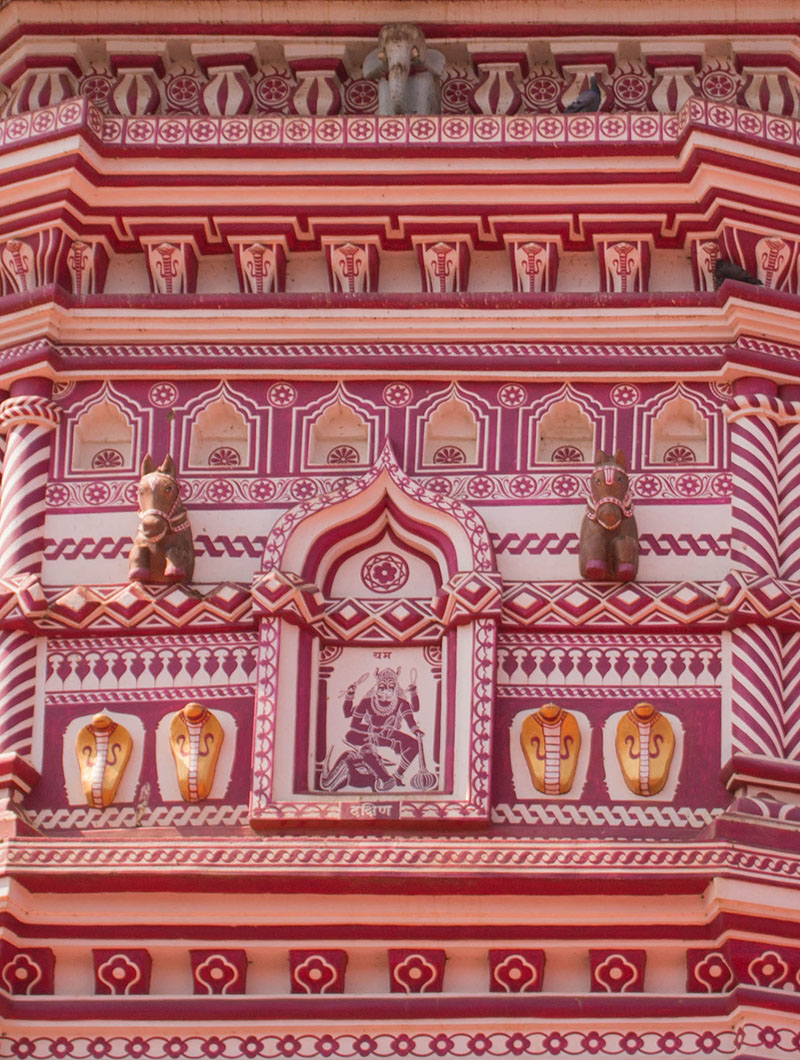
A sgraffito mural technique historically practised in parts of India’s Konkan coast, primarily Goa and the coastal districts of Karnataka, kaavi kala or kaavi kale (‘kaavi art’) is named for the red ochre pigment it uses, derived from the iron-rich lateritic soil of the region. Its monochrome designs are created by layering red lime plaster on white and scratching through the red to reveal the white underneath. In Karnataka, kaavi murals are primarily found in temples; in Goa, they are found in diverse religious buildings as well as homes and trading houses. No longer widely practised, the art is considered at risk of extinction.
Historical background
Laterite stone or compressed laterite mud blocks have historically been the primary building materials on the Konkan coast; their rough surface was often plastered over, and kaavi work was created over it. The kaavi mural technique has been orally transmitted through generations of hereditary artisans, and there exist no written records on its origins. It is generally believed that the art originated in Goa; an early kaavi panel in Karnataka depicting figures wearing Goan-style dress and ornamentation has been interpreted to suggest an older tradition traceable to Goa. It has also been suggested that kaavi art in Goa may have developed from the Portuguese introduction of the sgraffito technique that was popular in medieval Italy.
Kaavi work likely spread following the onset of the Goa Inquisition in 1561, when various Goan communities, including recent Christian converts, Saraswat Brahmins, and other Hindus left Goa and resettled along the Karwar-Mangalore coast of present-day Karnataka. The kuladevata (family deities) of some of these communities, uprooted from shrines that were destroyed, required new temples for their reinstallation. Kaavi murals were commissioned for these temples in Karnataka, though who actually carried out the work remains unclear. Kannada inscriptions found on some of these murals have helped historians date the oldest extant panels to the sixteenth century. A few panels — including those at the Mahalasa Narayani Temple in Kumta (1565) and the Marikamba Temple in Sirsi (1689) — explicitly record construction dates for the temples, with explanatory captions in Devanagari script identifying the murals’ subjects. The Hindu practice of jirnoddhara — the periodic renovation of temples — often complicates both the dating and the conservation of historical murals, since only the date of the most recent renovation is typically recorded and older murals may be destroyed during renovation.
The practice was likely re-established in Goa after the Inquisition ended in 1812 and communities that had left returned. Subsequent developments in the design repertoire of kaavi work were inflected by cultural material from Karnataka, such as imagery from Yakshagana, a dance-drama tradition of the Tulu Nadu coast.
Visual characteristics
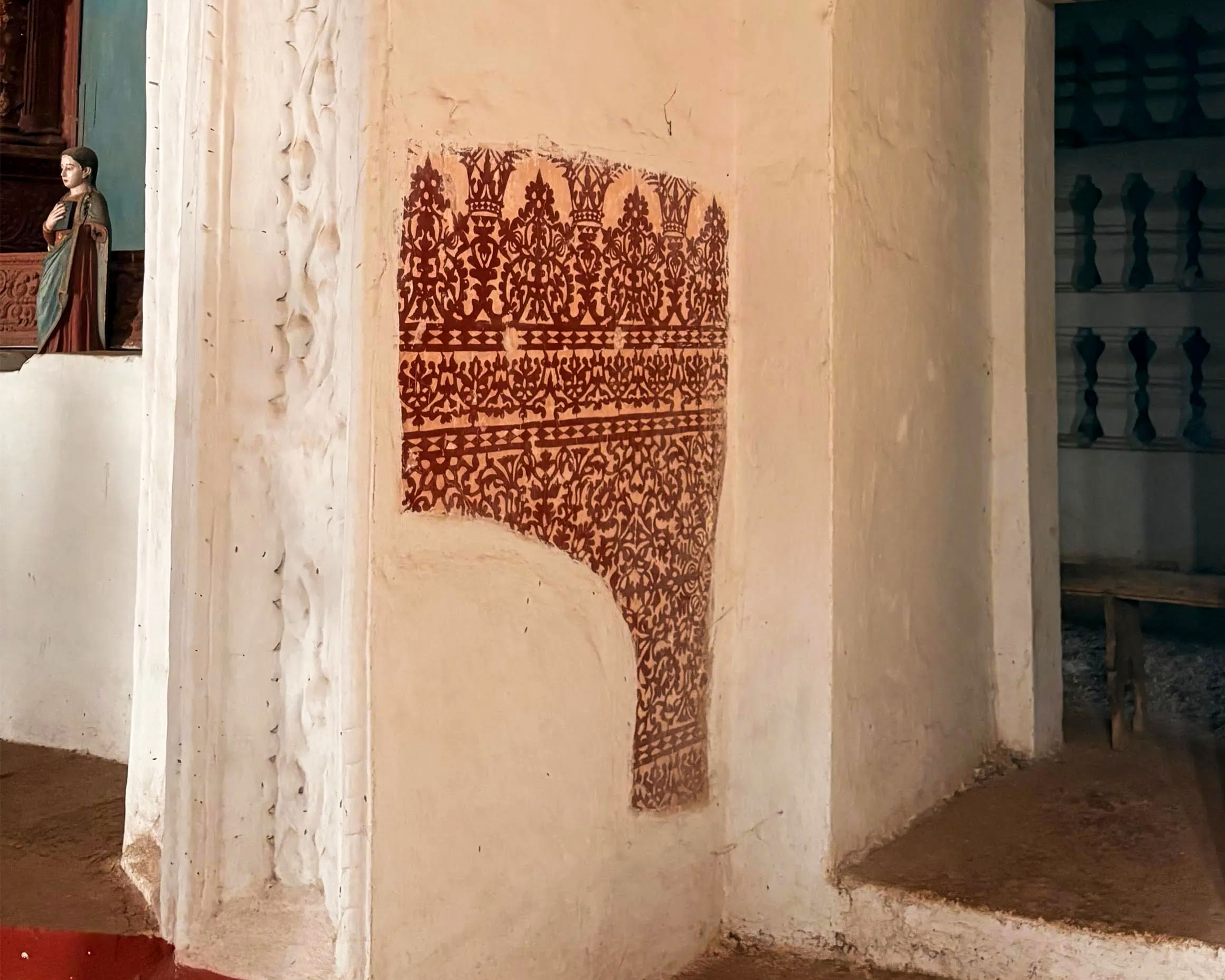
Kaavi art appears on interior and exterior walls of a building. Continuous decorative bands in various patterns often frame niches, entryways and windows, run along cornices, pilasters and plinths, or wrap around pillars, with motifs such as medallions sometimes appearing individually. Large figurative murals appear most often in temples, each spanning 0.5 to over 3 square metres in area.
Geometric and floral border patterns could be worked freehand by a skilled kaavi artisan and were rarely repeated exactly from building to building. Documented motifs include floral medallions, leaves and vines, spades, scrolls, and geometric patterns. A commonly observed motif converts a floral medallion into a tree or flowering plant by the simple addition of a stem or trunk beneath the petals. Animals also appear; here, artisans sometimes displayed their skill by creating ambiguous illusions such as two monkeys that appear to be four, or a bull and an elephant with a shared head, the bull’s hump doubles as the elephant’s trunk and its horns as the tusks.
In religious architecture
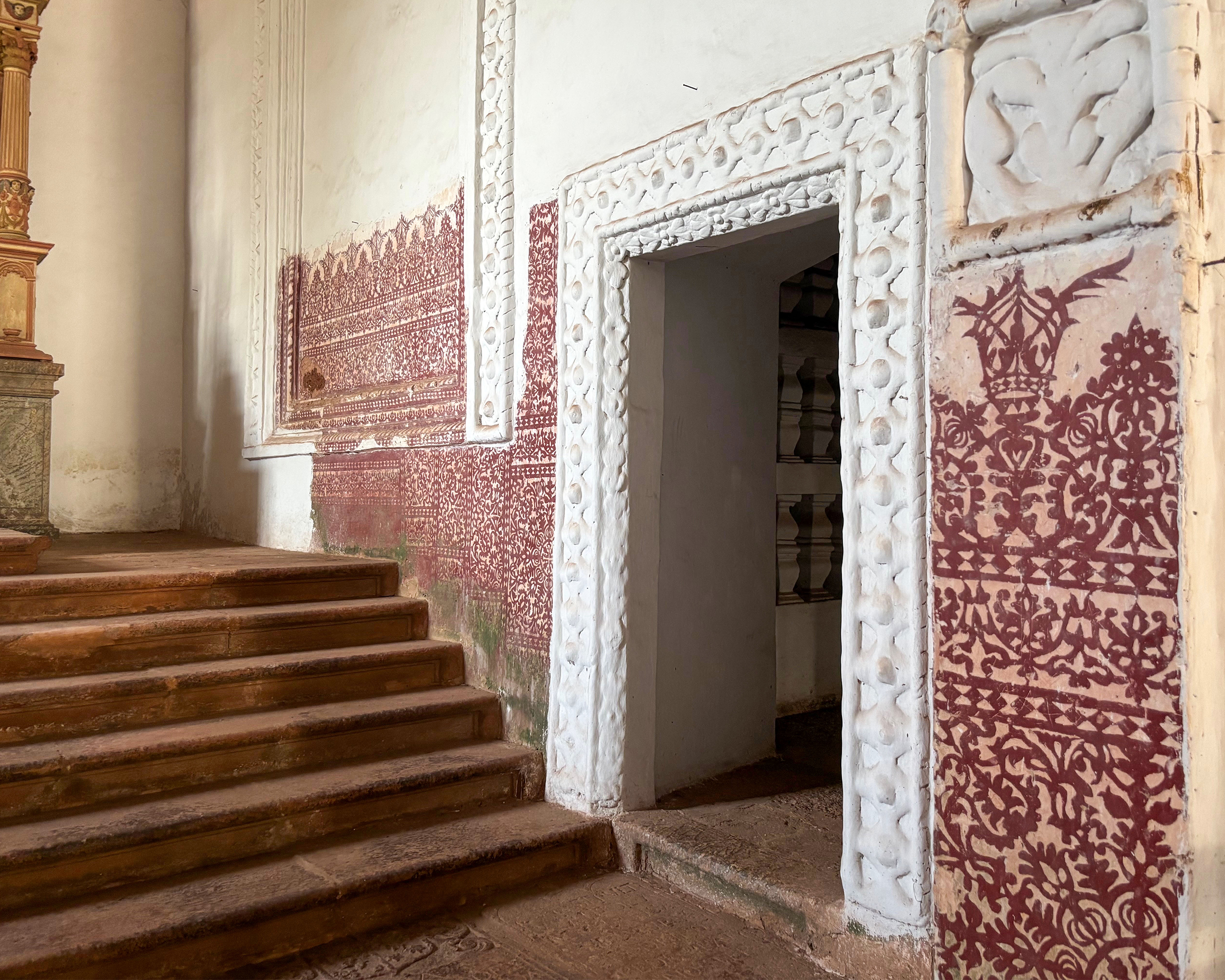
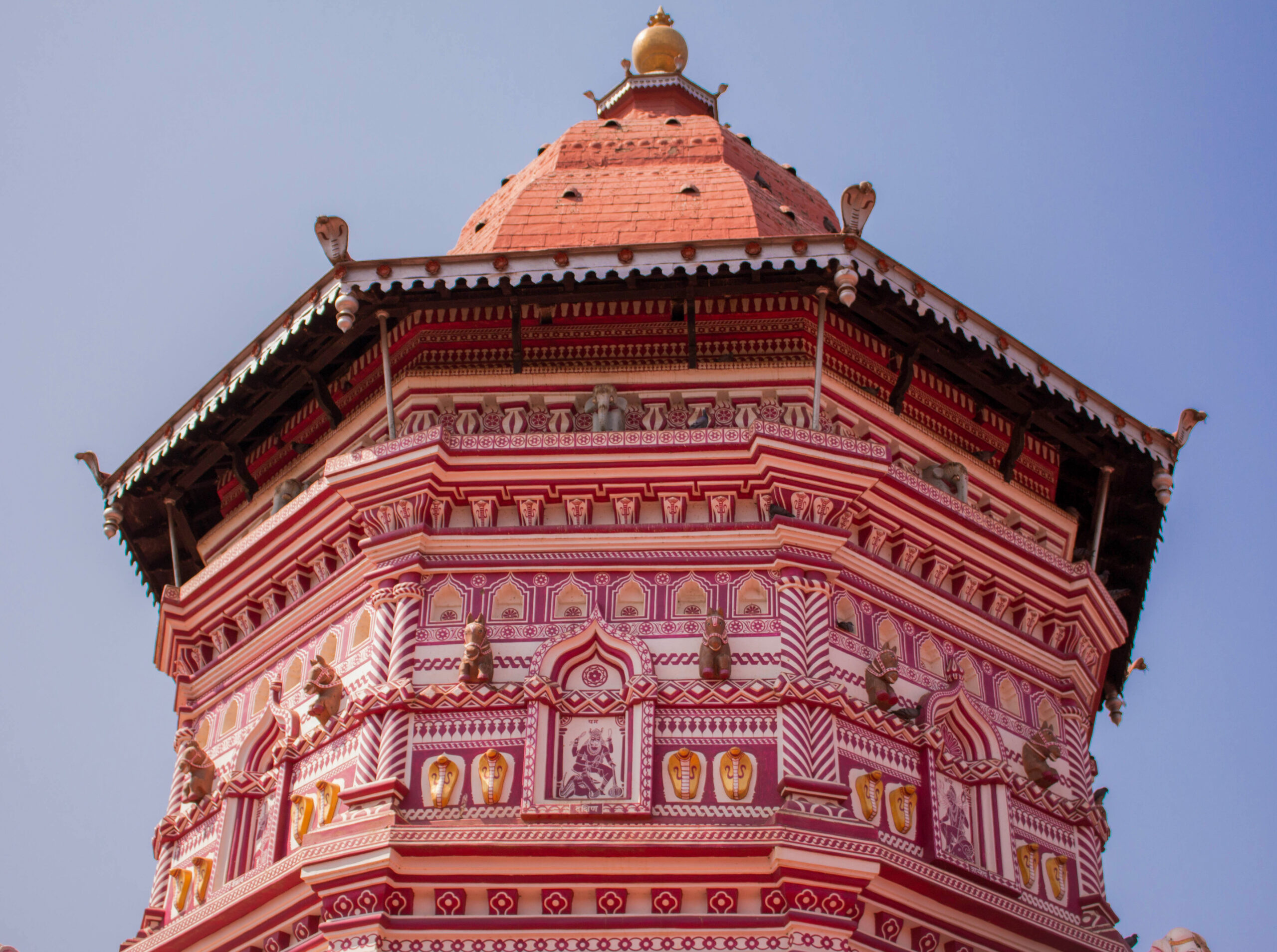
In Goa, kaavi art is found in churches, mosques, Hindu temples for folk and Brahmanical deities, and Jain temples; in Karnataka, it is found predominantly in temples. In Goa, the Maruti Temple in Pernem and the Morjai Temple in Morjim host major extant panels; more elaborate examples are seen in temples in Karnataka, such as the Sri Lakshmi Narayan Mahamaya Temple in Ankola, the Marikamaba Temple in Sirsi, and the Mahalasa Narayani Temple in Kumta. Kaavi murals at the Chapel of Our Lady of the Mount and the Old Archiepiscopal Palace in Old Goa, show Indic influences in their design; a mural at the Palace features a gandaberunda motif — a two-headed bird considered to be an avatar of Vishnu — that may derive from the iconography of Kadamba, Chalukya, Hoysala and Vijayanagara dynastic seals.
In temples, kaavi work adorns several distinct zones, appearing on both walls and ceilings throughout: the main entrance (mahadvara), the porch leading into it (mukhamandapa), the assembly hall preceding the sanctum (navaranga), the adjoining veranda used for seating, and the sanctum itself (garbhagriha). In addition to patterns and figural compositions, architectural elements like pillars and cornices are also depicted, complementing elements of the temple structure. The large, figural murals in temples draw from myths particular to the temple or its patron deity. Gods, goddesses, and episodes from the Ramayana, Mahabharata, the Puranas and regional folklore are common subjects. Murals in Karnataka sometimes also depict historical figures such as kings or philosophers — one shows a Hoysala king fighting a lion, another a Vijayanagara king receiving foreign travellers at his court. Figures are often rendered in dynamic poses, typically dancing or fighting, and often carrying weapons and other objects, with a suggestion of three-dimensional depth despite the flat, monochrome medium. They wear elaborate jewellery and intricately decorated, flowing garments, usually in styles particular to the Konkan coast.
Elements of standard Hindu iconography are deployed: murals are often framed by a prabhavali (Sanskrit, ‘ring of light’) — a halo-like oval or circle decorated with flame-tips (jvala) — and often feature recurring motifs such as the lion-faced kirtimukha (‘face of glory’) and lotus buds or blooms. Murals may also be topped with kalasha, mukuta, or gopuram forms. Animals depicted include bulls, monkeys and peacocks. Armed dvarapala (door-keeper) figures appear; notably, in Goan temple murals these appear to borrow elements from the Yakshagana theatre from Karnataka’s Tulu Nadu region. In particular, their headgear, mace and sword closely resemble those of the king in the Dashavatara episode of the Badagutittu style of Yakshagana.
In secular architecture
Kaavi murals are also found in Goan homes and the businesses or guest houses attached to them. Catholic houses tend to confine ornamentation to their exteriors, while Hindu houses extend it, storytelling included, onto interior walls as well. Here kaavi work often depicts narrative scenes derived from ordinary life rather than mythological subjects. A mural at one such house depicts a landlord watching a troupe of travelling performers. Historical social changes are more clearly reflected in such secular murals; clothing, for example, reveals the influence of colonial rule, with doormen appearing in long turbans and knee-high dhotis carrying cudgels and country-made guns, and nobles occasionally depicted in shirts and boots. However, ornaments, dhotis and sari drapes particular to the Konkan coast are nonetheless more common. Protective symbols, such as the face of a yali, may be rendered by entryways or windows to ward off misfortune; sometimes figuration is done away with entirely in favour of patterns.
Materials and process
The kaavi pigment — known variously along the Konkan coast as thambdi mathi, kaav, kaavi, kyavi, or kaavye, and uramunji or huramunji — is derived from the region’s red laterite mud, historically drawn from local quarries and sometimes from Basavaraja Durga Island in northern Karnataka. Lime for the plaster was obtained from seashells through a process of burning with charcoal overnight in a furnace, which yielded three grades of quicklime (calcium oxide), depending on the shells’ proximity to heat. The bottom and top layers were set aside for other purposes; the middle layer was slaked by letting it mature in a clay pot with water for at least two weeks, with regular stirring. The lime putty formed was then sieved through jute or cotton cloth to remove any remaining unslaked particles or impurities.
Three separate plasters were prepared from this putty: one rough, one smooth, and one coloured red with kaavi. For the rough plaster, the putty was combined with plain river sand and various organic substances, including jaggery, wood-apple juice (Aegle marmelos), crushed tamarind seed, gum arabic, aloe vera juice, liana-creeper decoction (Ancistrocladus heyneanus), and liquid from the sausage-tree fruit (Kigelia africana); the paste was then pounded with a wooden pestle, and set aside to ferment for ten days. Recipes for the exact mix varied and were usually handed down the family line orally. Smooth plaster was made using the same process with a smaller portion of sand. The shells in the lime add texture and glow to the walls. For the red kaavi plaster sieved red laterite soil was worked into a smaller quantity of fresh putty until it reached a soft, spreadable paste, then left to ferment for two days for a butter-like consistency, with the organic additions folded in again just before use.
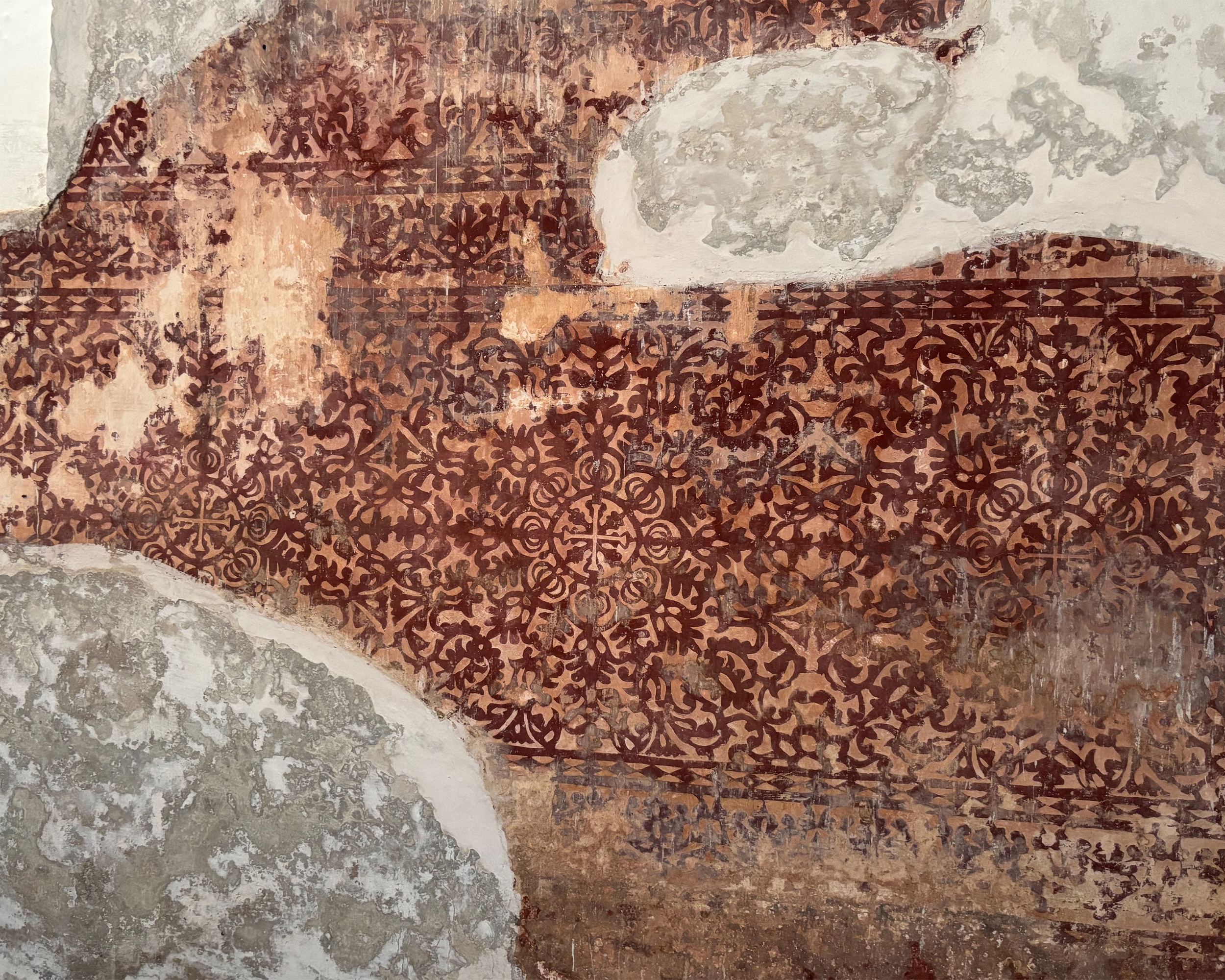
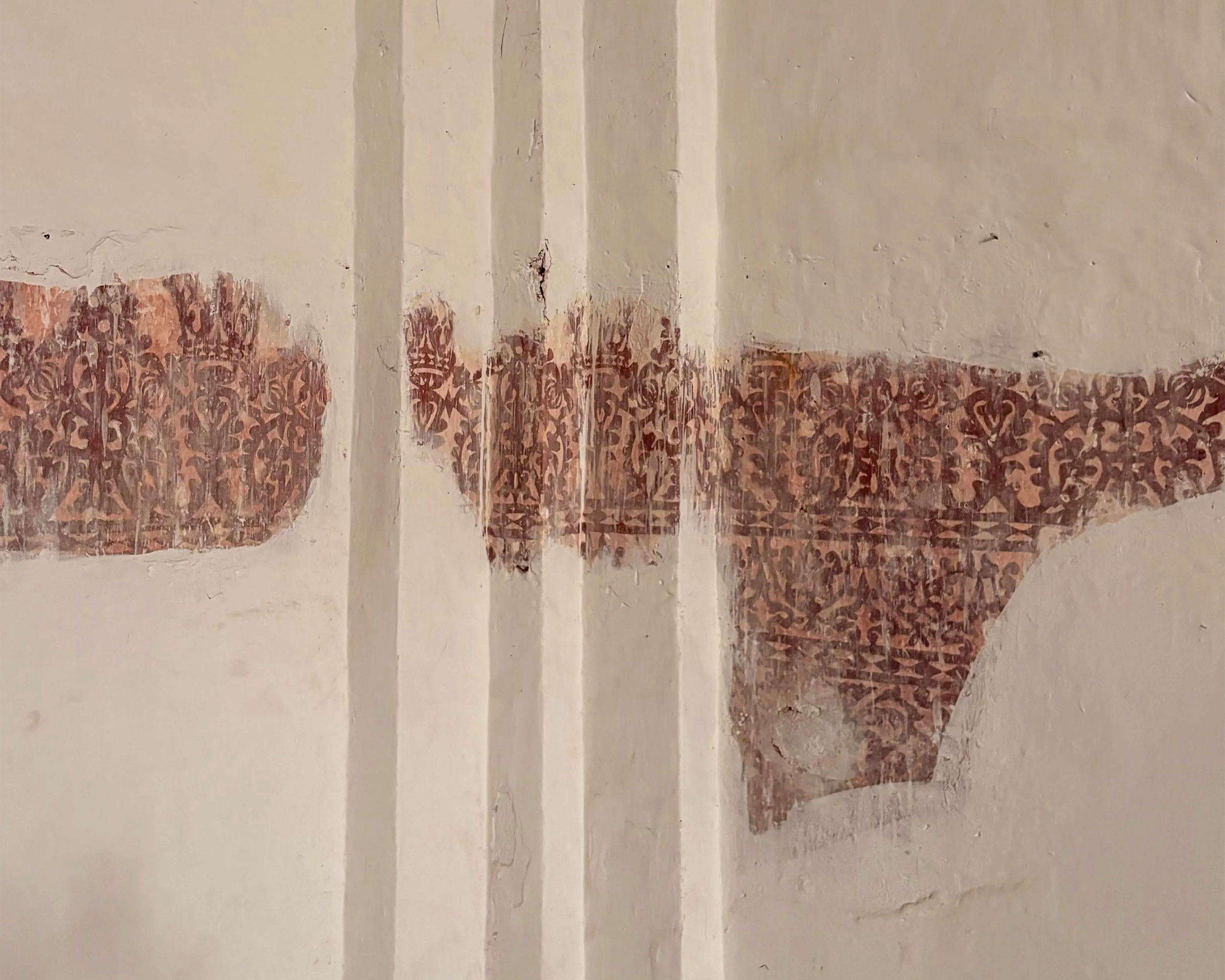
To prepare a wall for plastering, the surface was coated with two layers of lime plaster: first a rough layer about 20 to 40 millimetres thick, followed by a layer of smooth plaster, applied either while the rough layer was still wet, or once it had dried, followed by an eggshell-thin layer of the kaavi paste. Once applied, the plaster was polished with smooth river stones. While it was still wet, the artisan etched the rough design onto it using a steel bodkin (kanta) or other tools. The white plaster beneath was exposed, to serve as the background and negative space around the image formed by the red kaavi plaster. Some designs were made freehand. Depending on the size and complexity of the design, wooden stencils and compasses were sometimes used to create repetitive geometric patterns. For large or complex sections of the mural, stencils were improvised by perforating preliminary sketches drawn on paper, and dusting dry lime through the holes.
Once the etching was complete, the murals were left to dry for about a day; after this, water was sprayed on them every four hours for roughly a week. After the first round of curing, the day after etching, a second polishing with a smooth stone, coconut husk, and oil ensured that cracks were sealed. This curing process ensured the longevity of the mural in the humidity of the region’s heavy monsoon. Some murals in Goa were made with an additional finishing step: after etching, the negative space of the image was refilled with white plaster, so that the red and white layers appear level. This finish can be found at the Chapel of Our Lady of the Mount, the Sé Cathedral, and the remains of the Saint Augustine Tower.
Contemporary status
Most kaavi murals in historical temples and churches have been lost to colonial-era destruction, neglect, or lax renovation practices in recent years; the murals that survive in Goa are largely in ancestral homes. Scholars and heritage activists today consider kaavi art to be nearly extinct as new works are rarely made. Few, if any, kaavi artisans remain active in Goa today; scholarship from the late 1990s noted that some master craftsmen still lived in coastal Karnataka, though their services had largely fallen out of use even then. Preservation projects, undertaken with the help of scholars of the craft, have helped maintain the murals on some temples in Karnataka.
The Kaavi Art Foundation, established by artist and heritage activist Janardhan Rao Havanje, has documented over 800 extant murals and their makers across Karnataka and Goa. Havanje has been active in the restoration of kaavi murals since the early 2000s. He has also created several kaavi works for houses in the coastal region of Karnataka, and for the Mangaluru International Airport; the latter murals feature scenes and figures from Konkan history and culture, including the Inquisition-era exodus of artists that led to the spread of the craft. He has also trained art graduates in the kaavi technique and is advocating for a Geographical Indication (GI) tag for it, which, as of 2026, is pending approval by the Goa state government.
First published: 30 September 2026
Image Gallery
Bibliography
Geographical Indications Registry, Government of India. “Goa Kaavi Art.” https://search.ipindia.gov.in/GIRPublicSearch/Application/Details/1142.
Havanje, Janardhan Rao, and Caroline D’Souza. “Kaavi Kalé: The Indigenous Architectural Ornamentation Technique of the Konkan Coast, India.” Journal of Traditional Building, Architecture and Urbanism, no. 1 (2020): 383–94. https://doi.org/10.51303/jtbau.vi1.365.
Kamat, Krishnanand. “Kavi Art of Coastal Karnataka.” In Art and Architecture of Karnataka, edited by D. V. Devaraj and Channabasappa S. Patil. Mysore: Department of Archaeology and Museums, 1996. http://www.kamat.com/database/articles/kaviart.htm.
Kamat, Krishnanand. “Kavi Art of Indian West Coast.” Kamat’s Potpourri. First published January 1998, last updated January 13, 2026. Accessed July 7, 2026. http://www.kamat.com/kalranga/kaviart/kaviart.htm.
Kamat, Krishnanand. ಕಾವಿ ಕಲೆ (Kavikale). Karnataka Lalithakala Academy, 1993. https://archive.org/details/kavikale0000drkr/page/12/mode/2up.
Kerkar, Rajendra. “Renovation: Kaavi Art’s Vital Enemy.” Times of India, November 6, 2014. Accessed January 2, 2025. https://timesofindia.indiatimes.com/city/goa/renovation-kaavi-arts-vital-enemy/articleshow/45051435.cms.
Naik, Trupti C. “Kaavi — The Regional Mural Art of Konkan: Seeking the Lost Intangible Layer of Cultural Landscape (Murals Found in Konkan Region Maharashtra, Goa and Karnataka).” Krishi Sanskriti, 2019. https://krishisanskriti.org/vol_image/25Oct201906100814%20%20%20%20%20Trupti%20C%20%20Naik%20%20%20%20%20%20%20%20%201%20%20%20%20%20%20%20%2091-97.pdf.
N. K. R., Ashwani Kumar. “Kaavi Art: From Temples, Churches to Airports.” Deccan Herald, September 29, 2022. Accessed January 2, 2025. https://www.deccanherald.com/spectrum/spectrum-top-stories/kaavi-art-from-temples-churches-to-airports-1149082.html.
N. K. R., Ashwani Kumar. “The Keeper of the Kaavi Legacy.” Deccan Herald, January 1, 2025. Accessed January 2, 2025. https://www.deccanherald.com/dh-changemakers/the-keeper-of-the-kaavi-legacy-3337278.
Pandit, Heta. “The Forgotten Art of Kaavi from Goa, India.” MEMORIAMEDIA Review 2, Art. 5 (2017): 1–6. ISSN 2183-3753. https://www.memoriamedia.net/pdfarticles/EN_MEMORIAMEDIA_REVIEW_Kaavi.pdf.
Parrikar, Rajan. “Morjai Temple.” Blog post. July 21, 2015. Accessed January 2, 2025. https://blog.parrikar.com/2015/07/21/morjai-temple/.
Sonak, Sangeeta M. Marine Shells of Goa: A Guide to Identification. Cham: Springer, 2017.
Feedback