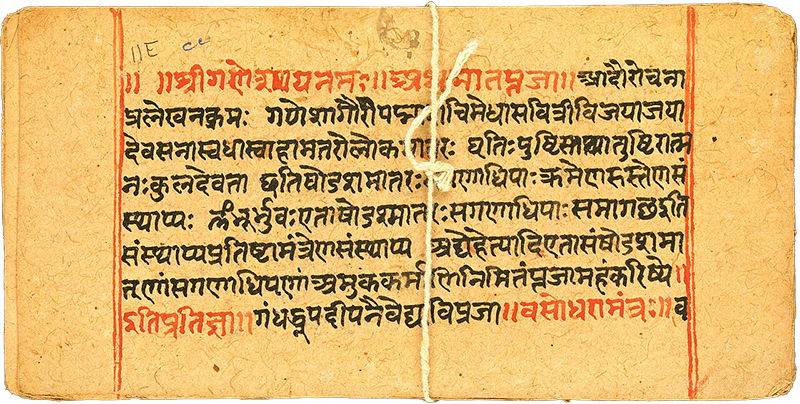
In scholarship, term most frequently referring to the Indo-Aryan family of languages and their scripts — including Sanskrit, Brahmi and Kharoshthi — or more generally to the classical, Sanskritic culture of the Indian subcontinent. Precursors of Sanskrit, known only through linguistic reconstruction, have been given names such as Old Indic and Middle Indic by specialists. The word ‘Indic’ derives from the Latin Indicus, meaning ‘of India’, and has been in use since the seventeenth century at least, often used loosely to mean ‘having to do with India’.
More Definitions
Dhamma
The Pali word for dharma, it stands for the “the law of nature” or “the truth” and primarily refers to…
Brahmi Script
A writing system or script that appeared as a fully developed universal system in Asia c. third century BCE. It…
Tenjur
A sacred text belonging to the Tibetan Buddhist canon, comprising commentaries, treatises and a collection of abhidharma (ancient Buddhist texts).…
Agamic Texts
Meaning “tradition” or “received knowledge” in Sanskrit, the term refers to a set of scriptures within Hinduism, Jainism and Buddhism.…
Quran
The primary religious scripture of Islam, containing the word of God as revealed by the archangel Jibrail (Gabriel) to the…
Baburnama
The memoir of Zahiruddin Babur, the founder of the Mughal Empire. Written in the Chagatai language in an autobiographical style,…
Jataka
A large collection of approximately 550 stories about the Buddha’s former lives in both human and animal form. The stories…
Devi-Bhagavata Purana
Also known as Devi Bhagavatam, it is often categorised as a Mahapurana and revolves around the figure of the Devi…