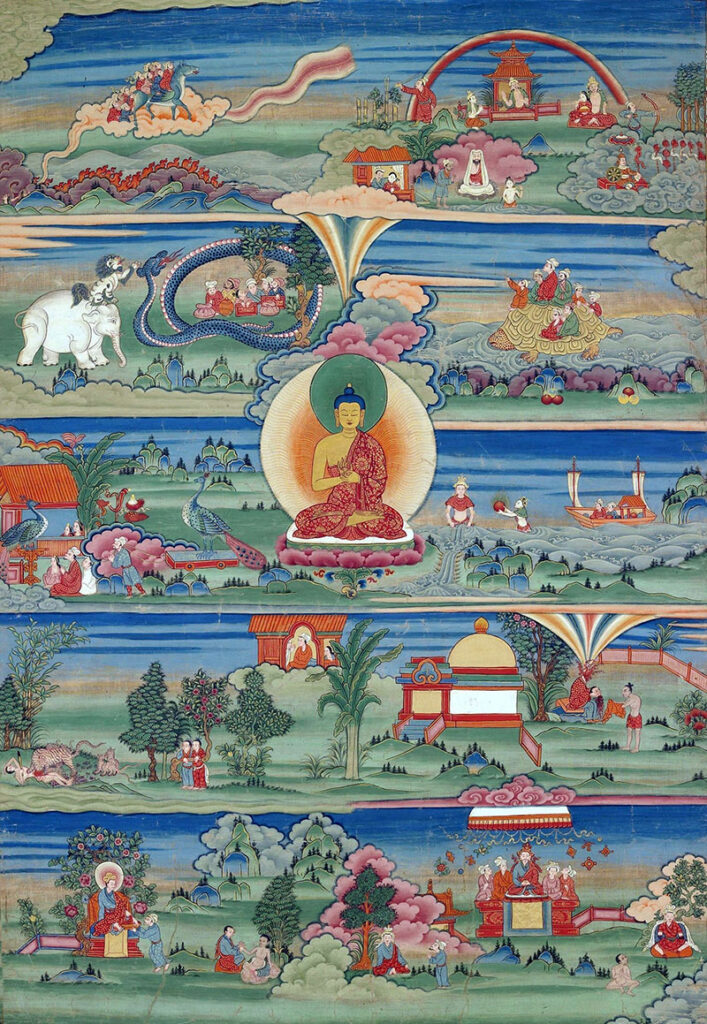
A large collection of approximately 550 stories about the Buddha’s former lives in both human and animal form. The stories are mostly set in the Indian subcontinent and are dated between 300 BCE and 400 CE. Some of the narratives are part of the Pali canon in Theravada Buddhism. Several of the stories are also the primary subjects of the Ajanta Cave murals.
More Definitions
Mudra
Originating from the Sanskrit word for "seal" or "mark," it is a symbol or ritual gesture that is performed using…
Vishnudharmottarapurana
An ancient Hindu encyclopaedic text consisting of three khandas (parts), it deals with a wide range of subjects, including cosmology,…
Kufic Script
The earliest extant Islamic script, historically preferred for use in the Quran. The calligraphic script is angular and slow-moving, with…
Laila Majnun
A seventh-century Arabic tale that narrates the love story of the poet Qays ibn al-Mulawwah and Layla bint Mahdi. Popularly…
Tathata
A central concept in Buddhism that denotes the essential or true nature of reality, which is beyond the range of…
Upanishad
A body of texts written in Sanskrit and considered to be the latter part of the Vedas. They cover issues…
Heer-Ranjha
An epic love story popular in the Punjab region across present-day Pakistan and India, it narrates the story of lovers…
Abhinaya
According to the Natyashastra, it may be understood as a combination of two words — abhi meaning "towards" and naya…