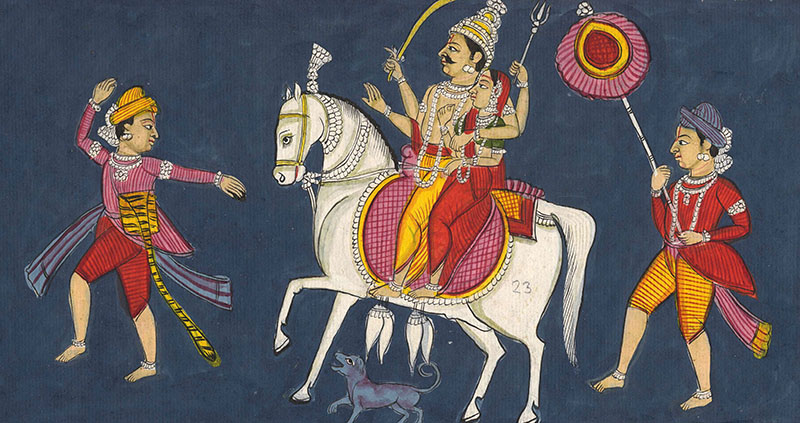
The tutelary deity of a family or a clan. The term is derived from the Sanskrit words kul, meaning “family” or “clan,” and devata, meaning “deity.
Kuladevata
Link copied!
The tutelary deity of a family or a clan. The term is derived from the Sanskrit words kul, meaning “family” or “clan,” and devata, meaning “deity.
Link copied!
A demon in Hindu mythology who is said to have originated from the earwax of Vishnu. He is believed to…
A Daitya king and the grandson of Prahalad, he is mentioned in a number of texts and myths within Buddhism,…
A text of the Lokottaravada school of early Buddhism, it was written in Sanskrit, Pali and Prakrit between the second…
The name of the anthropomorphic form of Varaha, an avatar (manifestation) of the Hindu deity, Vishnu. As Varaha, Vishnu assumes…
A sixteenth-century Tamil text attributed to Paranjothi Munivar, which comprises sixty four stories narrating the miracles of the Hindu deity,…
The equivalent of the Capricorn Zodiac sign within Hindu astrology, it is a mythical sea creature that is believed to…
One of the two major ancient Indian epics written in Sanskrit, it is believed to have been composed by Valmiki…
A major Vedic deity, he is believed to be the king of the realm of gods within Hinduism and Buddhism,…