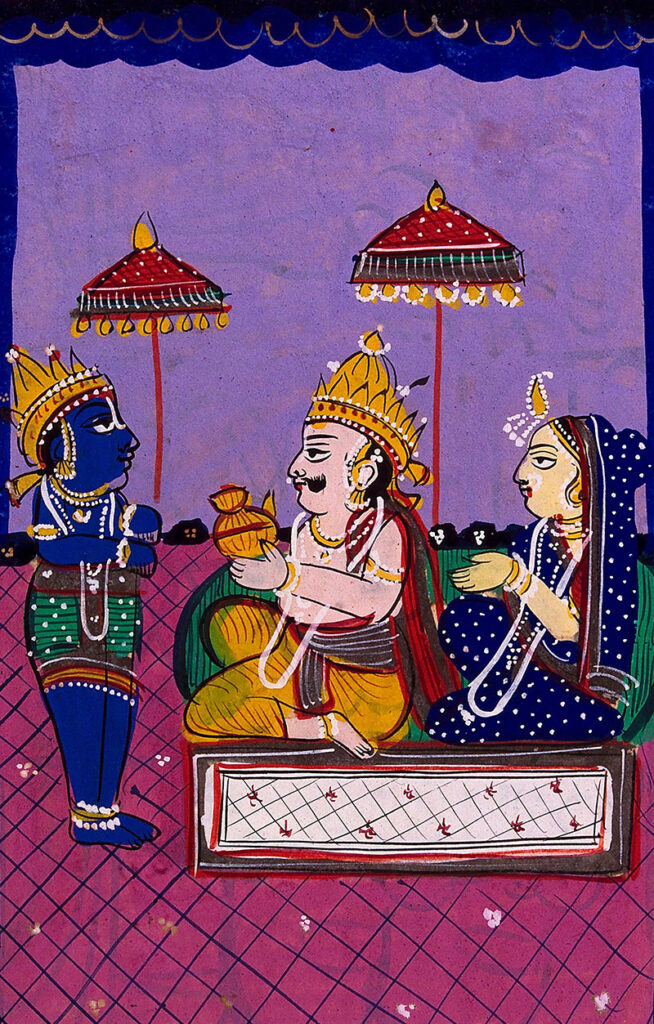
A Daitya king and the grandson of Prahalad, he is mentioned in a number of texts and myths within Buddhism, Hinduism and Jainism. He is a part of the Dashavatar legend of the Hindu god, Vishnu. Within Buddhism, he appears as an audience to the Buddha’s sermons and in a dialogue with the bodhisattva Avalokiteshvara. He is also one of the pravtivasudevas (anti-heroes) in Jain mythology. He is a prominent and celebrated figure in the southern Indian regions of Kerala and Tulunadu, particularly during the festival of Onam.
More Definitions
Mahabharata
The longest Indian epic poem, traditionally attributed to the legendary sage Vyasa and compiled into its extant recension sometime between…
Madrassa
An institution of higher learning in the Islamic thought. In its earliest form, it was an extension of mosques and…
Mahakala
A deity common to Buddhism, Hinduism and Sikhism, whose name is composed of the Sanskrit maha, meaning "great," and kala…
Palden Lhamo
A wrathful female deity in Tantric Buddhism who is considered to be a dharmapala (protector of dharma) and the protector…
Vedas
A body of religious texts composed in Sanskrit and considered the oldest scriptures in Hinduism. There are four primary texts…
Bodhisattva
Within the Mahayana tradition of the Buddhist faith, it refers to any figure who has renounced society and is on…
Mahavidyas
A group of ten goddesses from the Tantric Hindu pantheon, consisting of Kali, Tara, Shodashi, Bhuvaneshvari, Chhinnamasta, Bhairavi, Dhumavati, Bagalamukhi,…
Mahakali
The Goddess of time and death, she is a major deity in Shaivism and Tantric Shaktism, where she is considered…