-
ChicagoImpart Encyclopedia of Art. "Dambulla Cave Temple." April 6, 2026. https://imp-art.org/articles/dambulla-cave-temple/.
-
MLA"Dambulla Cave Temple." Impart Encyclopedia of Art, Apr. 6, 2026, https://imp-art.org/articles/dambulla-cave-temple/.
-
HarvardImpart Encyclopedia of Art (2026) Dambulla Cave Temple. Available at: https://imp-art.org/articles/dambulla-cave-temple/ (Accessed: 20 October 2026).
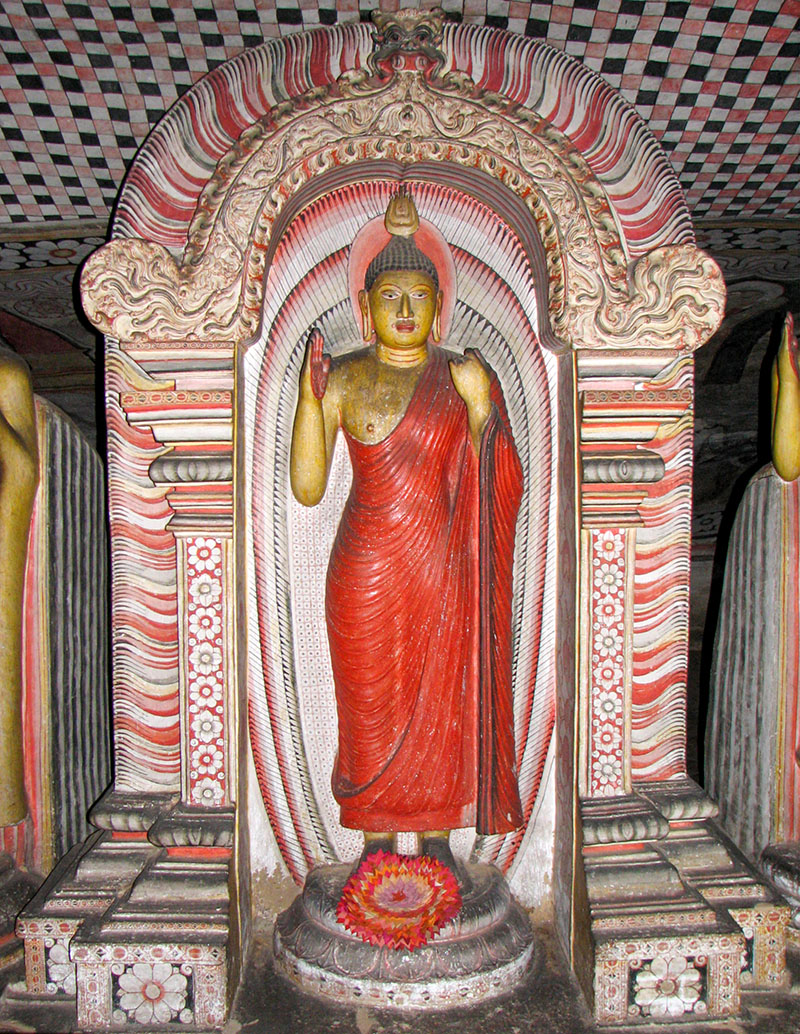
A set of five cave shrines located among about eighty rock shelters in the Central Provinces, Sri Lanka, the Dambulla cave temple has been an active Buddhist site since the third century BCE. It is known for its extensive murals and sculpture dating from the medieval period. It is the second largest cave temple complex in South and Southeast Asia, after the Ajanta caves in India, and was declared a UNESCO World Heritage Site in 1991.
Site
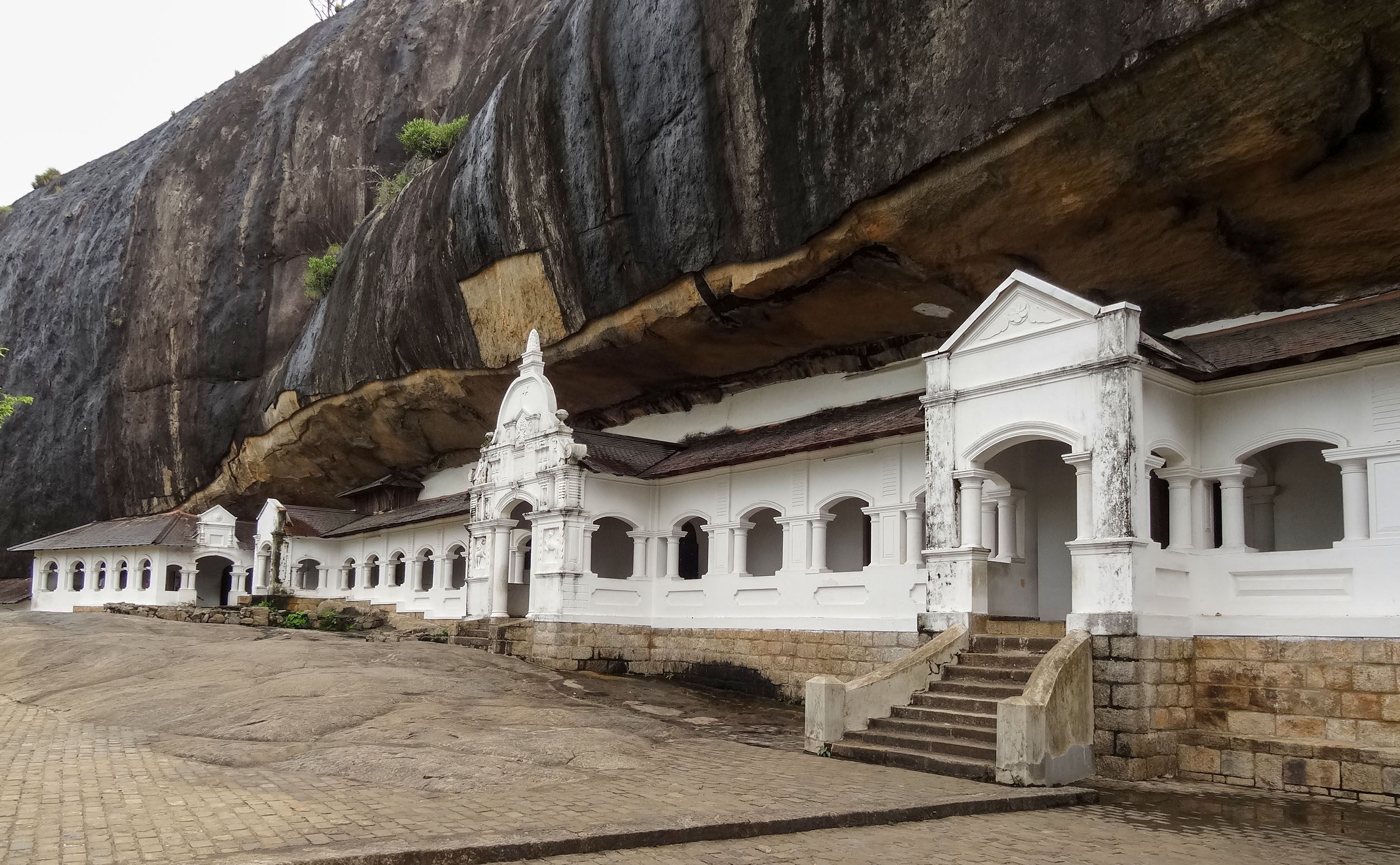
The site, in the Dambulla region, covers about 25 hectares, with topographical similarities to the nearby site of Sigiriya. Its most prominent features are two large rock formations or inselbergs that form natural shelters and terraces. The five primary caves are located on a high terrace on the southern rock formation. A courtyard outside the caves contains lotus ponds and a large bodhi tree, both commonly seen at Buddhist religious sites. The site now also houses a modern temple at a lower elevation. Other caves are clustered in and around this rock formation to the site’s southwest.
In the third century BCE, the Dambulla caves were occupied by Theravada Buddhist monks, who likely had social and economic exchanges with residents of the surrounding area. The primary caves have been continuously occupied since. The surrounding bouldered hills and forests have yielded archaeological evidence of prehistoric and early historic human settlements and burial complexes, notably the Ibbankatuwa megalithic tombs and a settlement that is among the earliest known farming communities in Sri Lanka.
Historical development
The Dambulla complex is one of over a hundred Buddhist monastic rock complexes that were established in Sri Lanka between the third and first centuries BCE. These were generally rock shelters which might be further excavated, with the addition of screen walls, lean-to roofs, and drip-ledges cut into the face of the rock, often with inscriptions carved below. Whilst it is generally accepted that the caves at Dambulla were converted into shrines, or viharayas, in the first century BCE, it is not known exactly when most of them were excavated to their present area. The main caves were initially one long tunnel-like space in a roughly east-west orientation, with visitors possibly entering from the west; they were later separated by walls or partitions.
A large part of the present layout and form of the caves — including most of the sculpture therein — is attributed to the patronage of the Polonnaruwa ruler Nissanka Malla (r. 1187–96), who commissioned a substantial renovation of the main caves and new statues of himself and of the Anuradhapura ruler Valagamba Abhaya (or Wattagamani) (r. first century BCE) in Cave 2. His contributions are detailed in a Sinhalese inscription at the site and in the thirteenth-century Sinhalese prose text Pujavaliya. The Kandyan king Senarat (r. 1604–35) supported more restoration work on the caves.
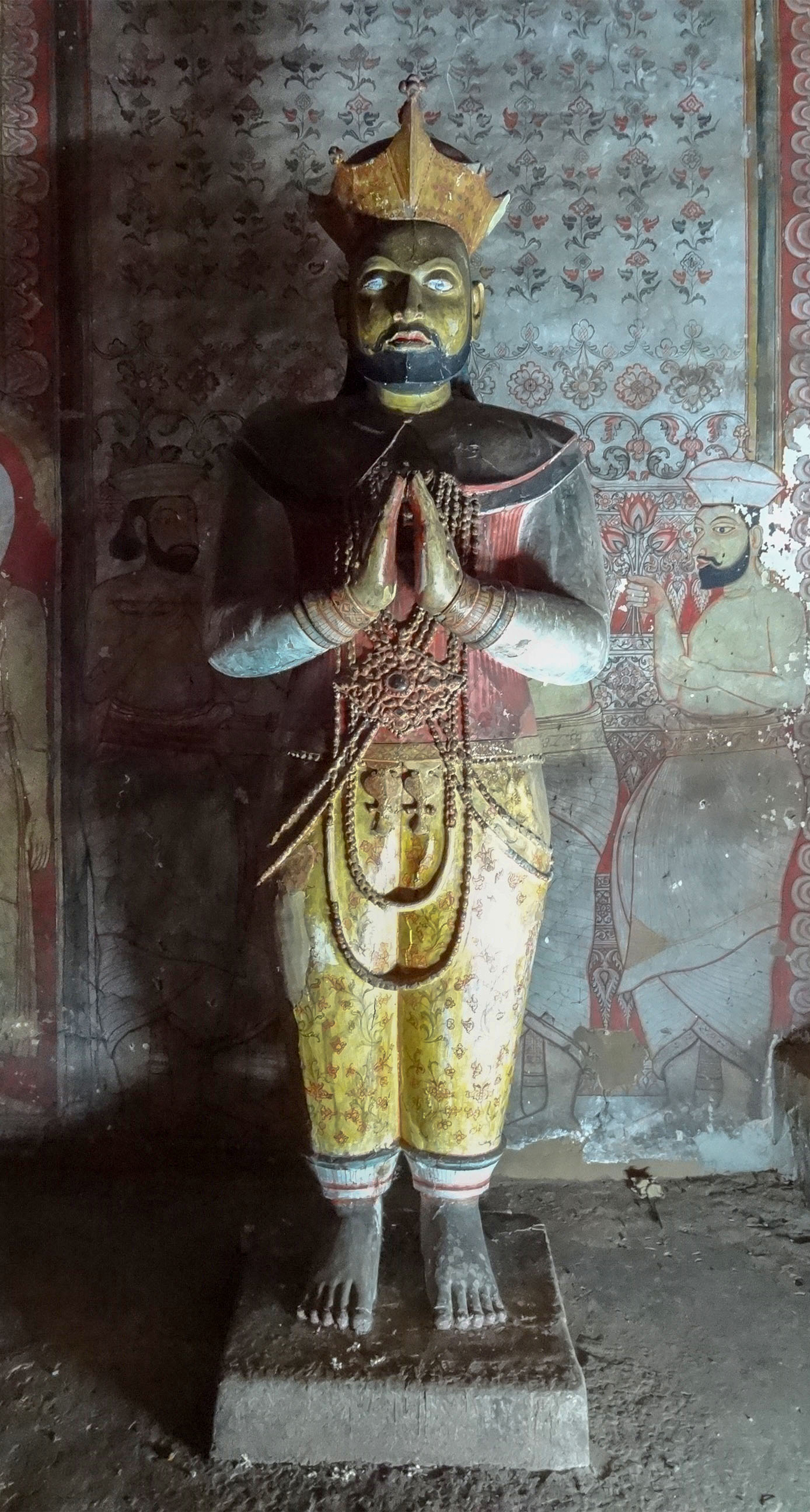
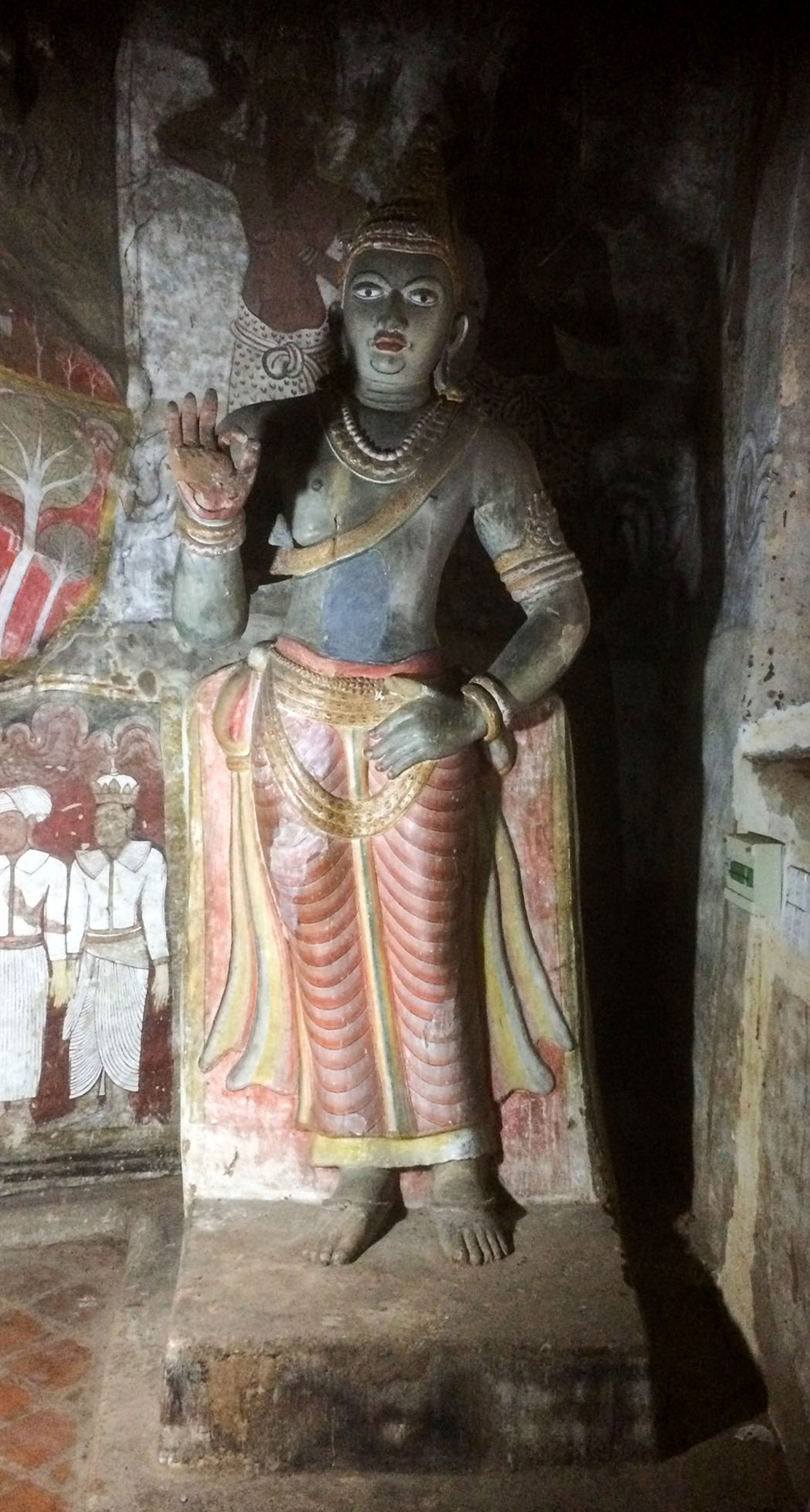
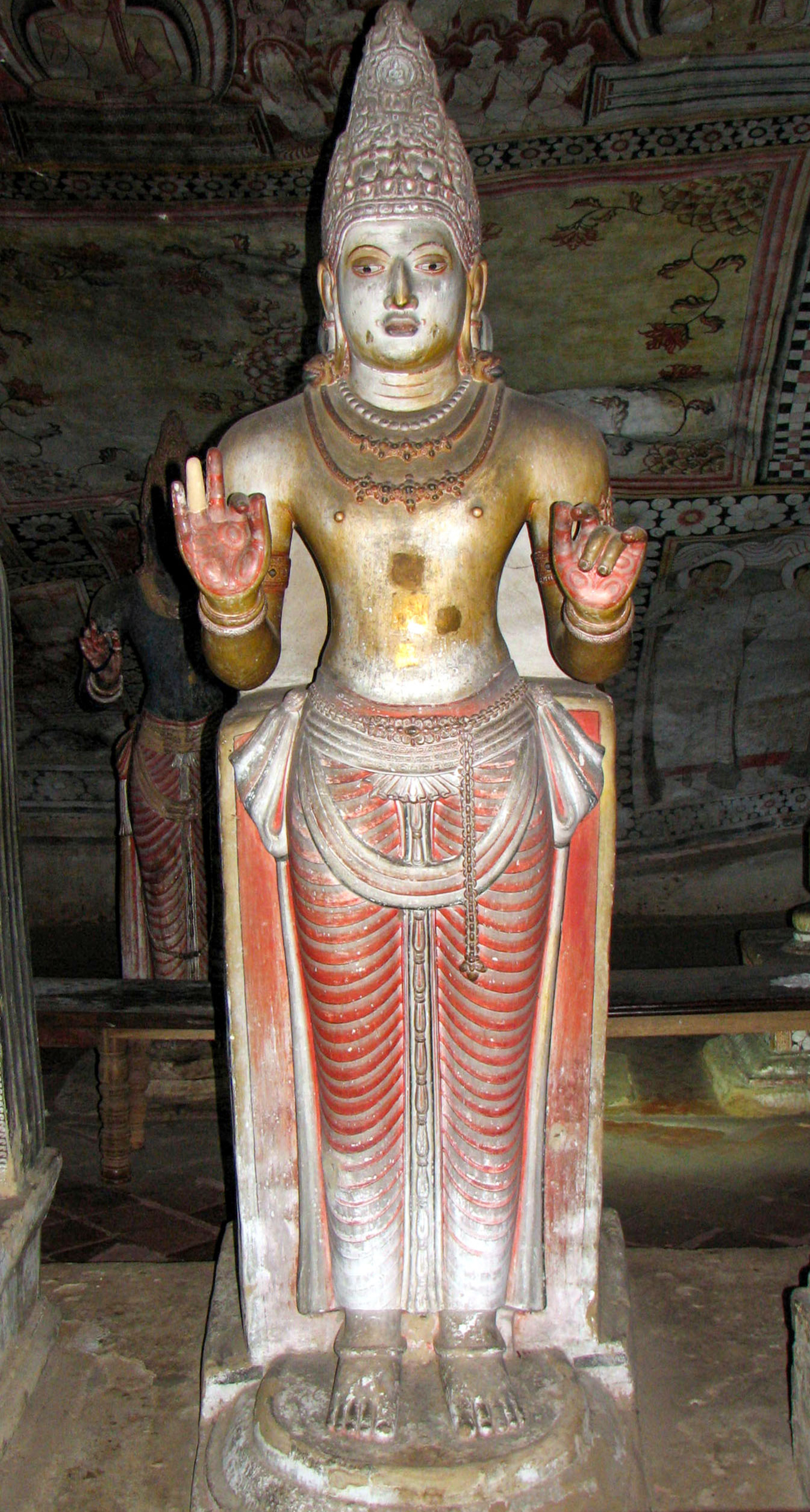
A subsequent major addition and restoration was supported by Kandyan king Kirti Sri Rajasinha (r. 1747–82) as part of his larger efforts to revive and formalise Buddhist practice in the country — wall and ceiling murals were added, and older ones overpainted; the sculptures were painted; and a roofed veranda built along the front of the caves. Cave 3 also saw significant expansion and ornamentation. The murals have survived largely intact, and cover about 2100 square metres — in effect, most of the caves’ interior surfaces. Though the fall of the Kandyan kingdom in 1815 meant a loss of royal patronage, private donors enabled the periodic upkeep of the site and minor additions to the murals continued throughout the eighteenth, nineteenth and early twentieth centuries. In the 1930s, the veranda was rebuilt as a covered arcade which sealed the cave openings, save for doorways to each and a few windows for light and ventilation.
Plan and sculptures
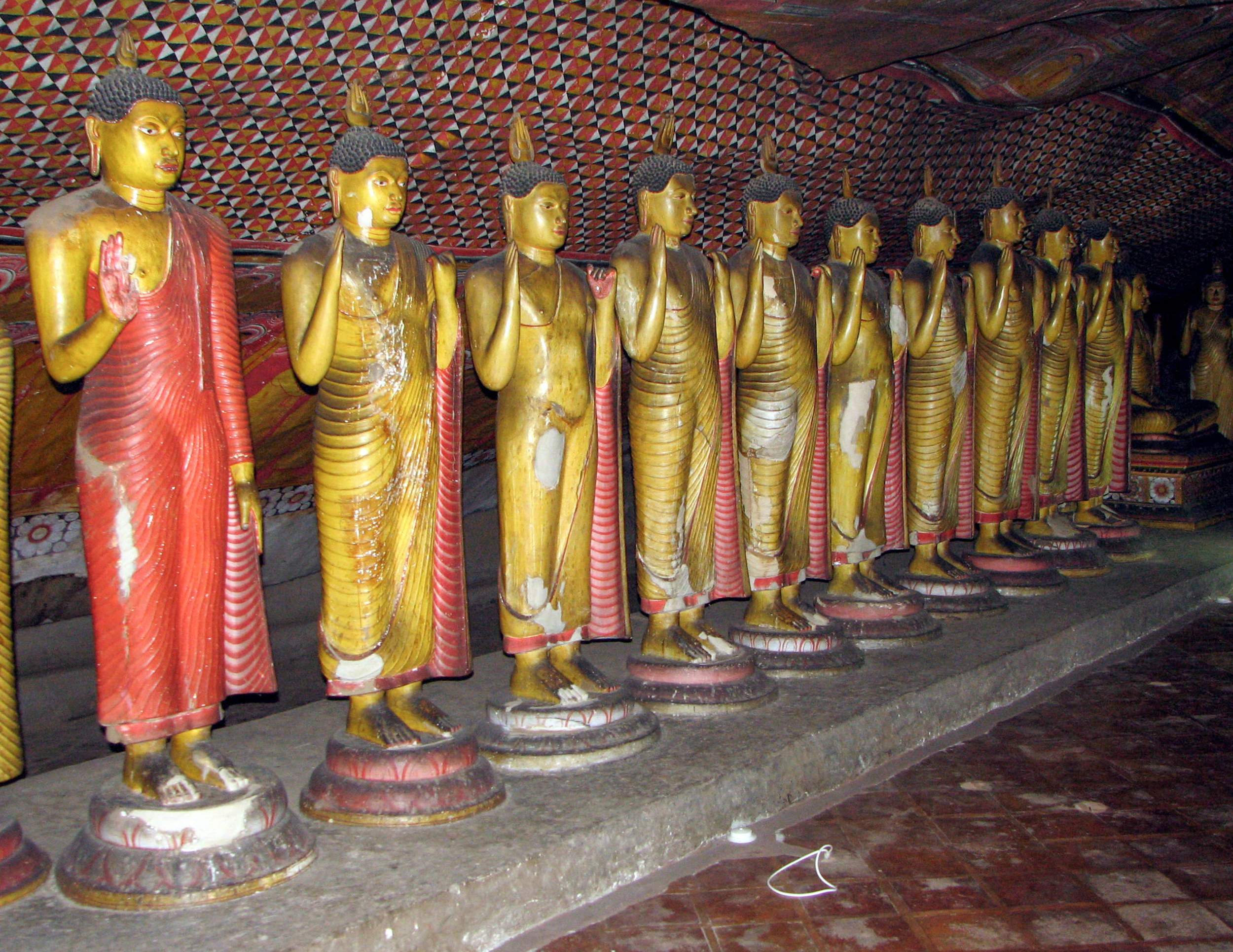
The five caves are numbered from east to west, each housing one viharaya. Cave 1 is known as the Deva Raja Viharaya (Cave of the Divine King); the first textual instance of this name appears as late as 1726, though the cave is much older. The epithet refers to the Sri Lankan folk protector deity Upulvan, depicted in a wooden statue in an adjoining section, believed to be made of red sandalwood, now painted over in blue. Upulvan commonly appears as a guardian deity at Sri Lankan Buddhist sites and has been identified with the Hindu god Vishnu since at least the fourteenth century CE. As such, the statue is often referred to simply as a Vishnu statue. Most of the cave’s area contains a 14-metre long statue of the reclining Buddha that depicts the final moments of his life (parinirvana). A statue at his feet is likely to be his disciple Mahakassapa.
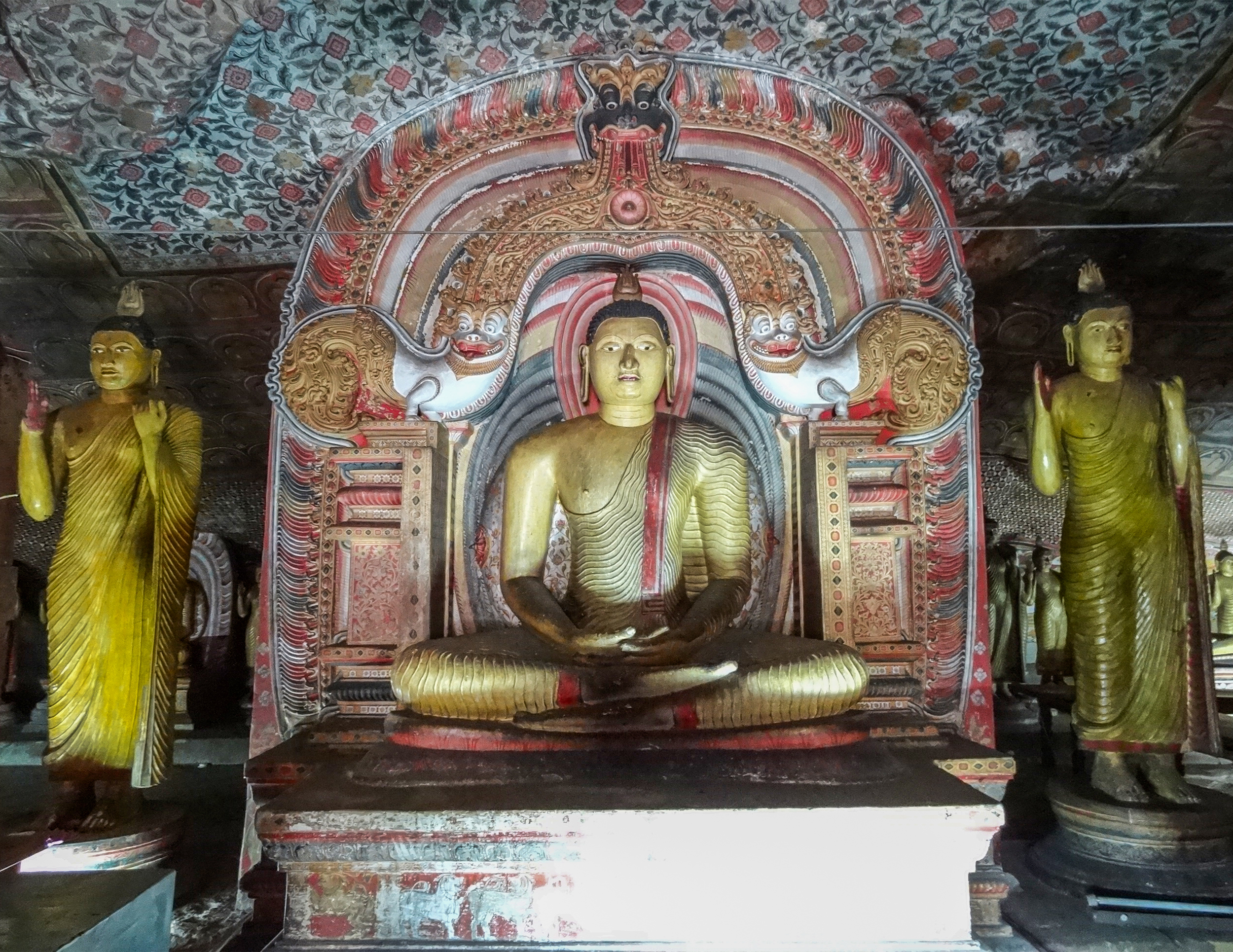
Cave 2 is the largest and most elaborate of the five. Known as the Maharaja Viharaya (Cave of the Great King), it measures about 52 by 23 metres, with the roof as high as 7 metres in some places. The southern and western walls are made of brick. The cave features two entrances and may have been designed for visitors to enter from the west. It contains over fifty statues, many of them larger than life size. A group of standing and seated Buddha images here includes Maitreya and Natha, a Sri Lankan folk deity assimilated into Buddhism — with the central statue framed by a makara torana (decorative arch featuring a makara). This statue also shows some gilding that has been attributed to Nissanka Malla, though it is now mostly painted over. Behind the makara torana there are two statues of folk deities — Upulvan again, and Saman. Also present in the cave are a reclining Buddha statue dated to the nineteenth century, two statues that may depict Nissanka Malla and Valagamba, and four more seated Buddhas. A dagoba — known as a chaitya lena (cave stupa) — occupies the space between the two entrances, surrounded by eight Buddha images, each surmounted by a cobra hood. This chaitya lena, along with the one in Cave 3, is considered by some scholars to be the most sophisticated in Sri Lanka.
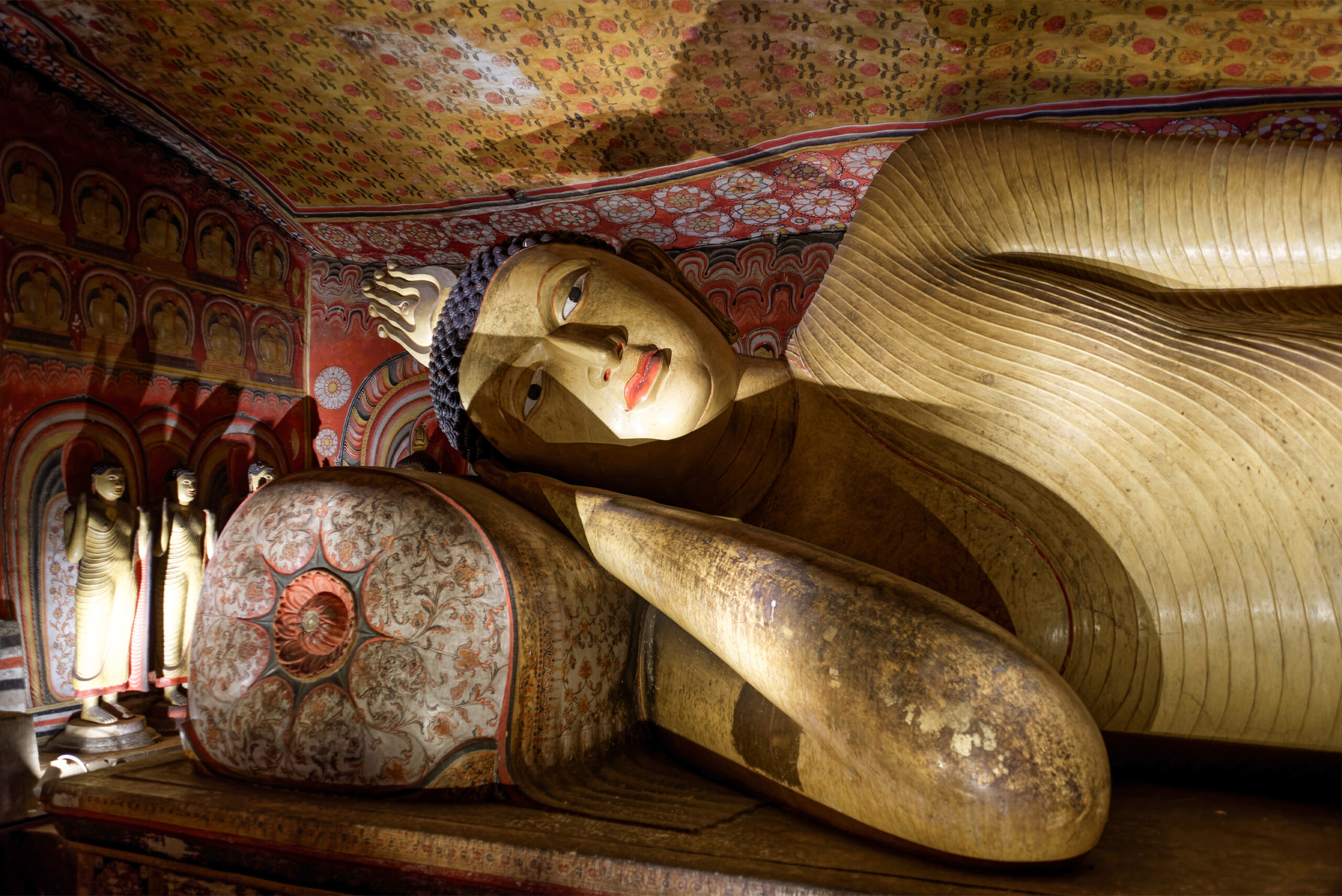
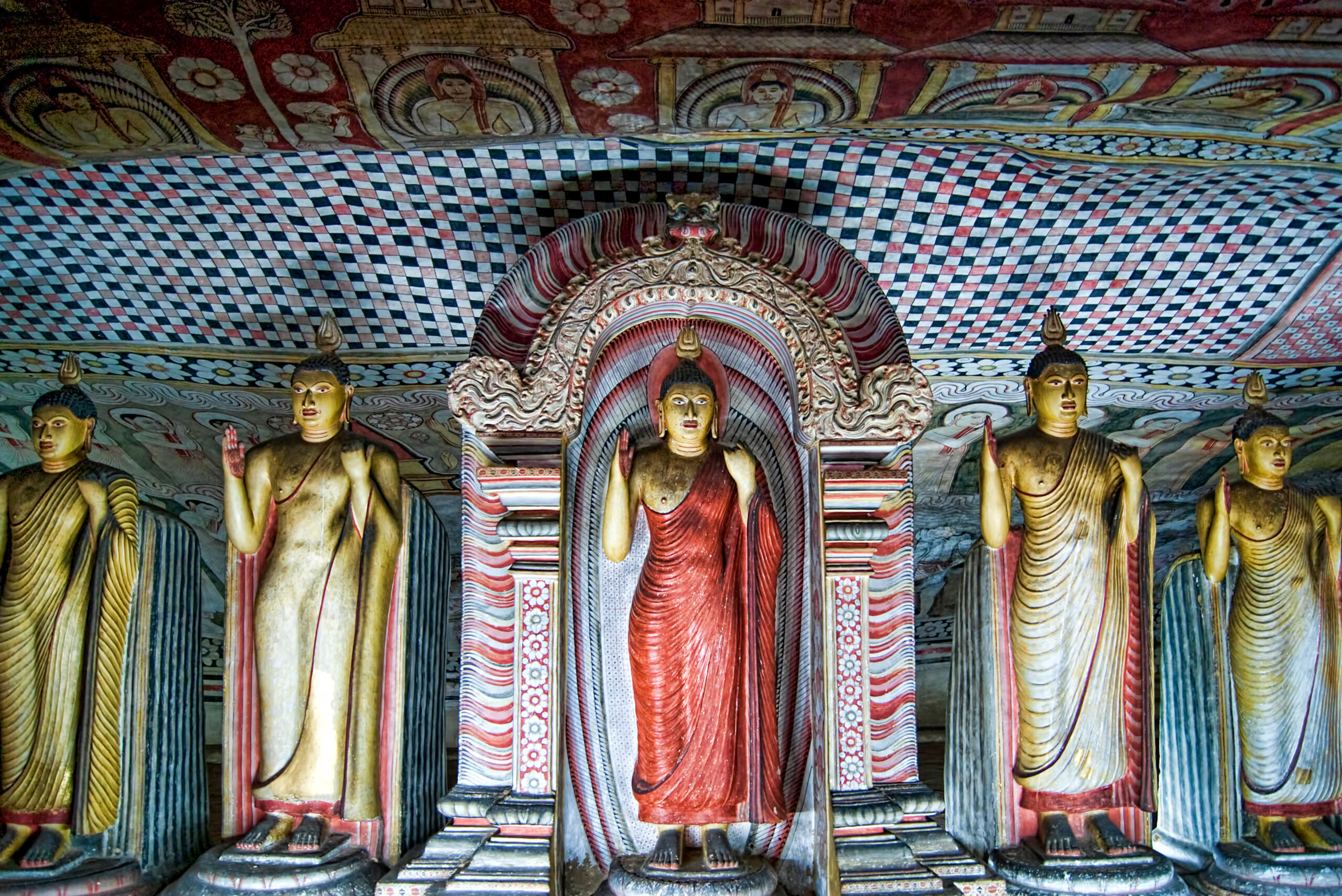
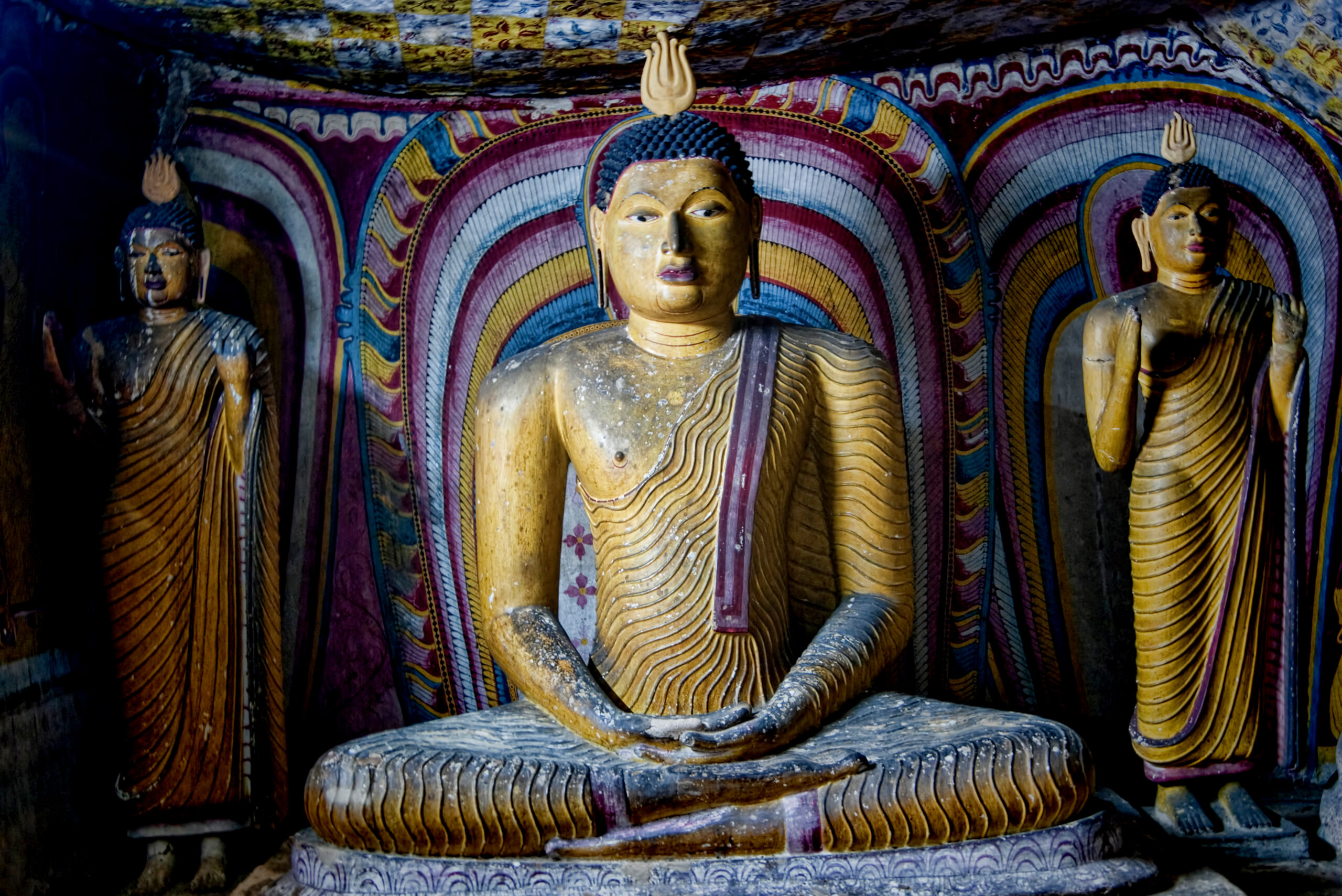
Cave 3 is known as Maha Aluth Viharaya (Great New Temple); it was likely brought to its present form in the early 1780s by Kirti Sri Rajasimha, who is depicted here in a life-size statue. Before its conversion into a temple — which also meant significant excavation — this cave may have been used for storage. It is the second largest cave, measuring 27 by 25 metres, and 11 metres at its highest. It also contains over fifty statues, including a reclining Buddha along the western wall, and a seated Buddha in the centre framed by a makara torana.
Cave 4, known as Paschima Viharaya (Western Temple), contains several statues of the Buddha and a copper-topped dagoba, which is believed to have once contained the jewels of Valagamba’s queen Somavanthi. It was, however, broken into and looted by thieves some time in the twentieth century.
Cave 5 known as Devana Aluth Viharaya (Second New Temple) has been dated to the late eighteenth century or even later; it contains a large reclining Buddha, measuring about 10 metres long, and other smaller statues of the Buddha, some of which, like those in Cave 2, are surmounted by cobra hoods. It was the last to be decorated — in 1915, via funds from a private donor — and had historically been used as a storage space.
Murals
Conservation efforts at the site — such as those undertaken as part of the Sri Lankan government’s 1982 Cultural Triangle project — have largely focused on the murals, which form one of the largest preserved groups of rock and wall paintings from the modern era in non-Himalayan South Asia. Largely dated to the eighteenth century Kandyan rule, the presently visible murals of the cave interiors are believed to be more elaborate and expansive than the earlier layers underneath. Conservators have emphasised the importance of preserving the existing layer rather than removing it to reveal earlier images, in order to respect the tradition of upkeep and addition at the site.
The murals are densely composed, filling the walls and ceilings with floral, geometric or Thousand Buddha patterns. The figures are typical of the Kandyan style, with broad shoulders, a slender waist and pronounced facial features, such as full lips and aquiline noses. In Cave 2, which has the most dense and elaborate murals, the images depict key incidents from the life of the Buddha, including his seven-week meditation at Bodh Gaya, the first Buddhist council at Rajgir, and the first sermon at Sarnath. On the wall and ceiling near the folk deity statues, the Hindu god Ganesha and the folk god Vataragama are shown. In Cave 3, Maitreya features prominently in the murals; a mural on the southern wall also depicts Anavatapta, the mythical lake at the bottom of Mount Meru. The largest mural in Cave 4 is noteworthy: it shows the Buddha seated in a pillared, decorated assembly hall, surrounded by disciples and other representatives. This image provides insight into what the temporary furnishings of such structures might have been like — the ceiling is decorated with hanging ornaments, and large numbers of lotus buds with long stems are affixed to the columns. Murals in cave 5 depict folk guardian deities Kataragama, Upulvan-Vishnu, and Devata Bandara. Notably, the only known representation before the contemporary era of the lion motif on the Sri Lankan national flag was in a mural at Dambulla, where it appeared on the flag of the Anuradhapura king Dutagamunu, depicted in battle with the Tamil Chola king Ellalan; the mural was defaced in the 1950s.
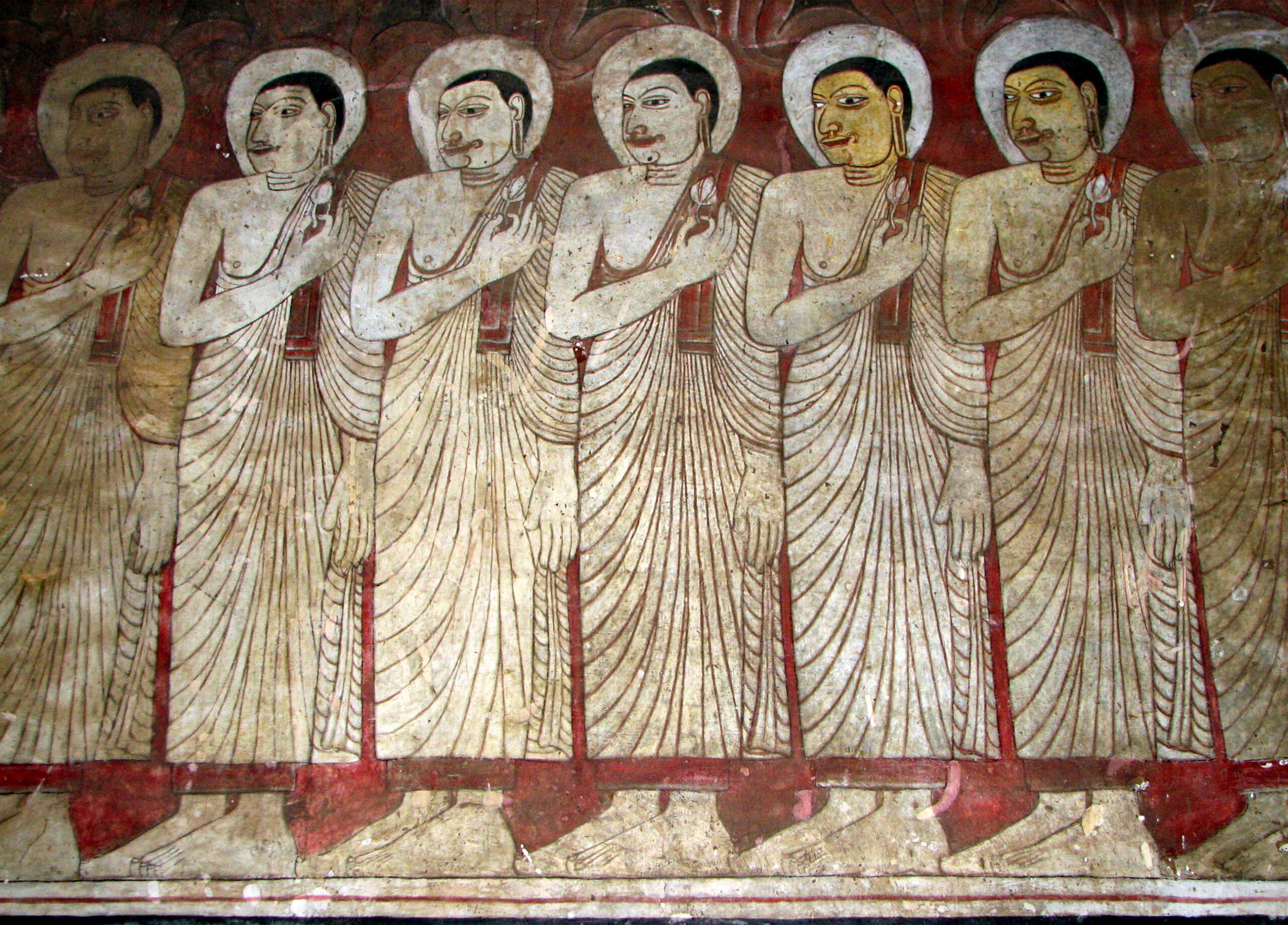
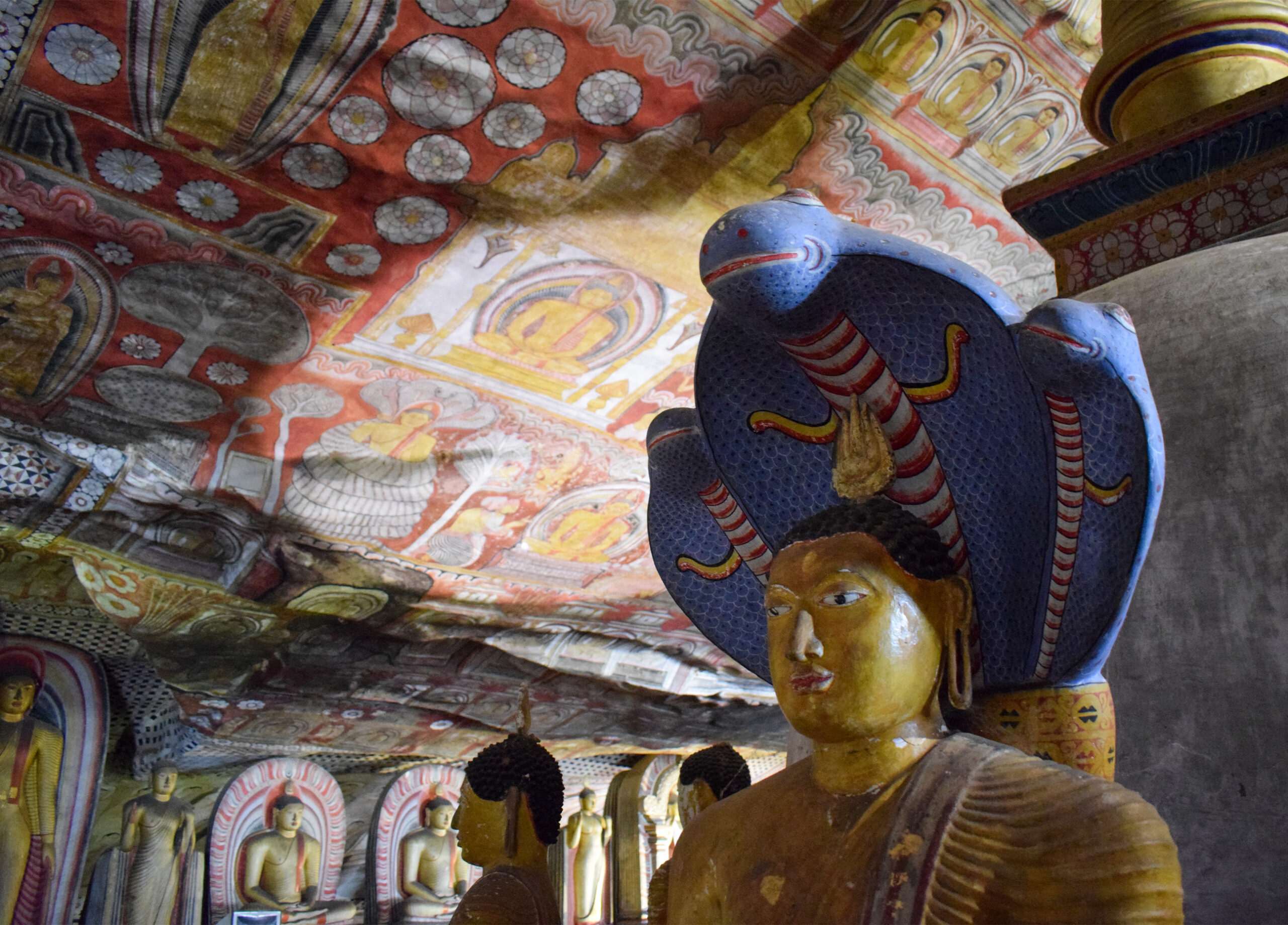
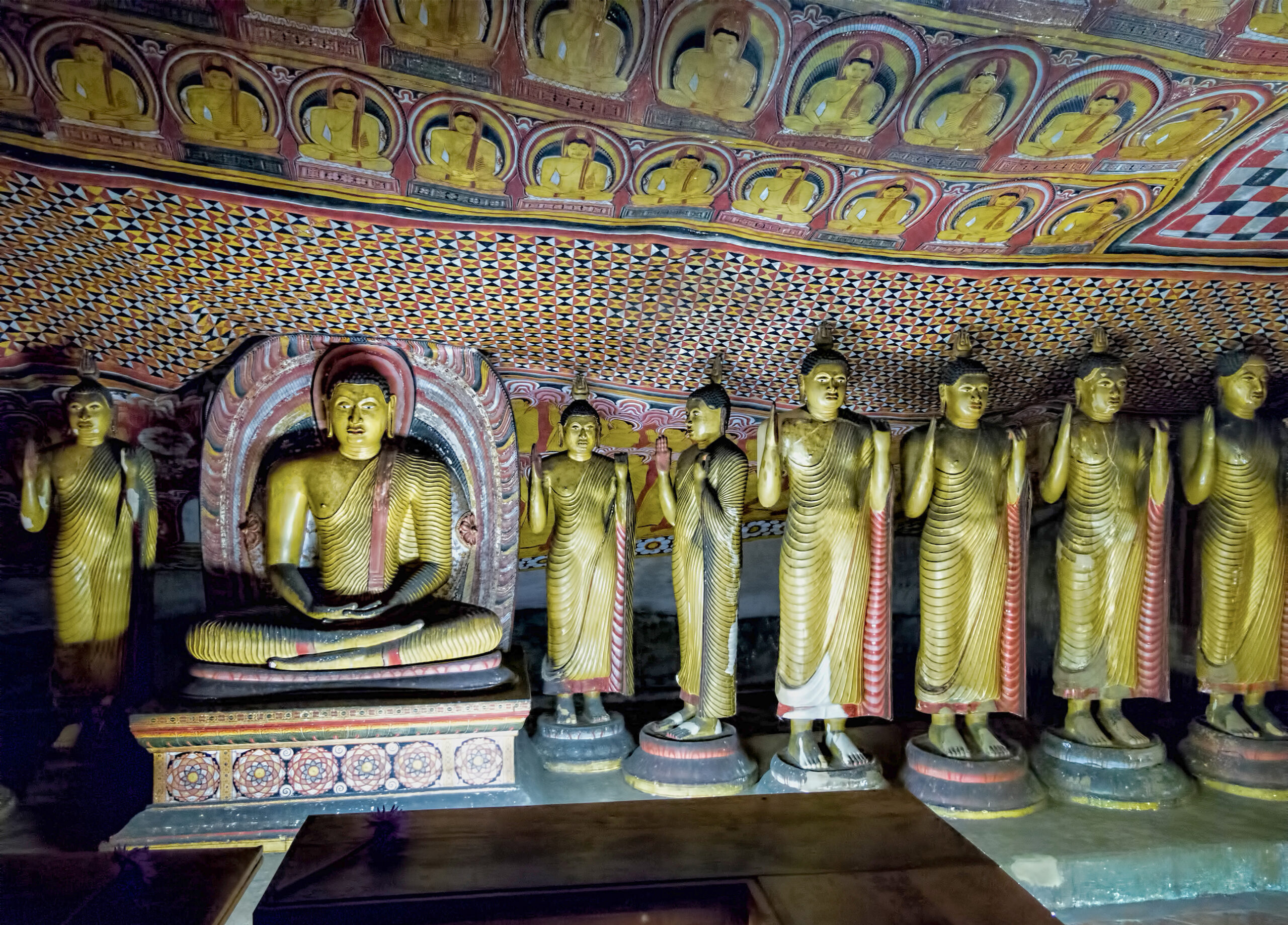
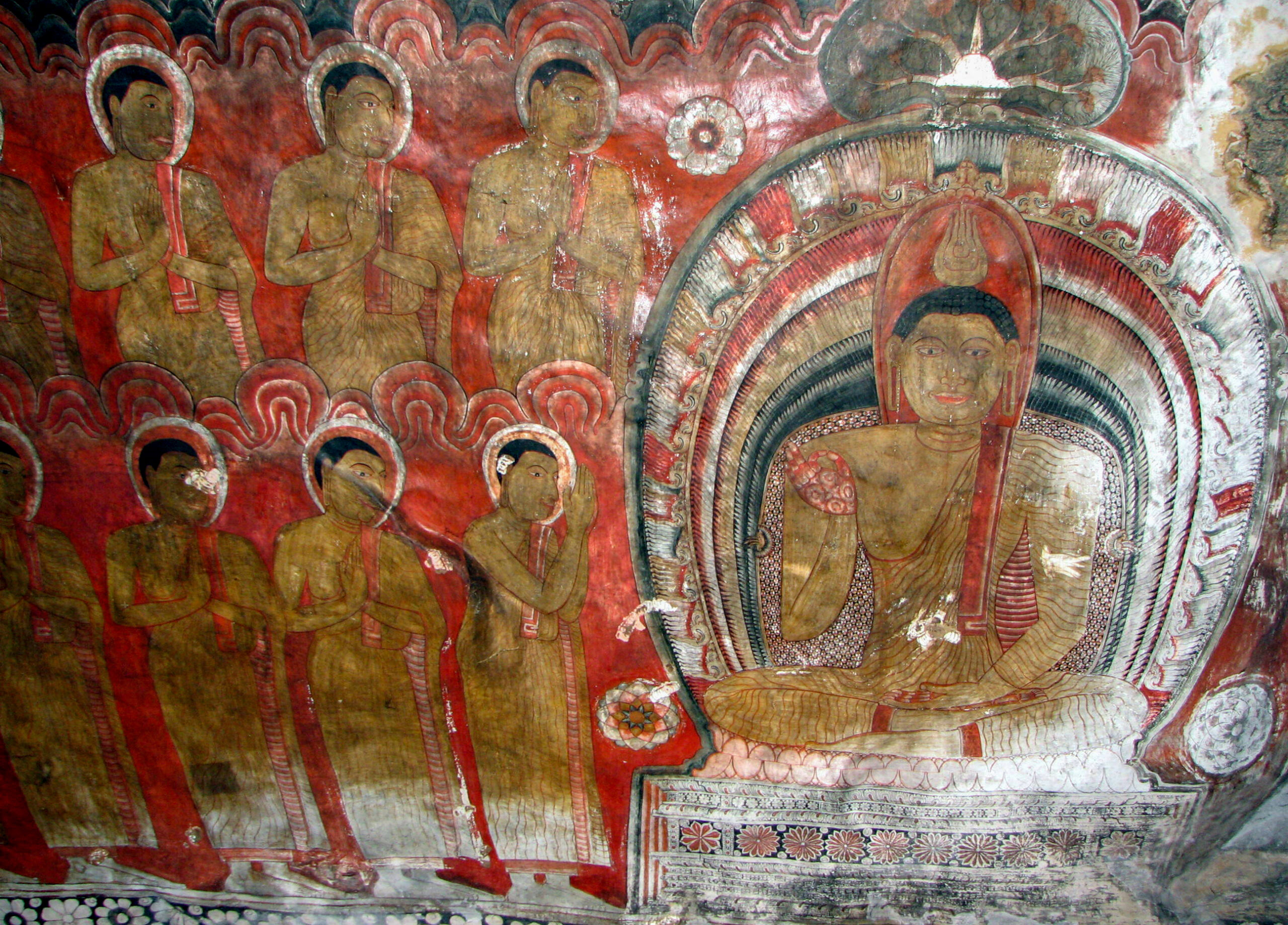
The base of the murals was applied in three layers: the first two comprised sand, clay, stone grit, and coconut fibres mixed with wood-apple tree sap, which acted as an adhesive, and the third was a plaster of white kaolin clay. The images are rendered primarily in shades of red and yellow, blue, black and white. The pigments used are red cinnabar, indigo for blue, jackfruit sap or burned cotton for black, orpiment or realgar for various shades of red and yellow, and gamboge for deeper yellow. For white, the kaolin layer was left exposed. Notably, no protective layer was applied on these murals, unlike comparable paintings in other parts of the country, but the paintings have been well preserved because of the adhesive in the base layer, the formation of a carbonised patina, and the sheltered location. However, as the pigments are water soluble, conservators have avoided water-based cleaning.
Cultural and political significance
Dambulla was one of five sites — the others being Anuradhapura, Polonnaruwa, Kandy, and Sigiriya — included in the Cultural Triangle Project, initiated in 1982 by the Sri Lankan government and UNESCO. It is also accordingly called the Golden Temple of Dambulla or the Rangiri Dambulla cave temple. Following its restoration, Dambulla came to be particularly symbolic of Sinhala cultural pride during a time that saw the expansion of Sinhala-Buddhist ethnonationalism. This owed firstly to its association, largely legendary, with Valagamba Abhaya who is said to have found refuge and counsel here while fleeing attack from a Tamil kingdom; legend also attributes the creation of the shrines to him. Secondly, it was the site of the Matale rebellion of 1848, when the Dambulla clergy led a peasant uprising against the British colonial government, fuelled primarily by increased license fees and new taxes that adversely affected plantation workers.
The Dambulla temple also became the site of modern contestations within the Sinhala Buddhist establishment on legitimate or ‘pure’ Buddhist practice. Textual sources suggest that the Dambulla clergy had a history of disregarding orthodox standards of purity and training for monks. Following the 1848 rebellion, Dambulla was placed under the authority of the more orthodox Asgiri monastic chapter, whose members were seen as loyal to British interests, and now began to control appointments at Dambulla. In the 1980s the Dambulla clergy began to challenge this authority. They also protested the nationwide practice of caste-based ordination formalised since at least the eighteenth century, in which only members of the Goyigama caste are eligible to be monks. In 1992, the Dambulla head monk also led a sit-in satyagraha here to protest a large hotel project nearby in view of the site’s sanctity; the protests were unsuccessful and the Heritance Kandalama hotel, designed by architect Geoffrey Bawa, was completed in 1995. However, these events contributed to an increasingly popular conception of Dambulla as an ancient site emblematic of cultural and religious purity. In the 1990s, a strict dress code and a ban on cameras were also enforced at the site, to this end.
First published: 6 April 2026
Image Gallery
Bibliography
Abeysekara, Ananda. Colors of the Robe: Religion, Identity, and Difference. Columbia, USA: University of South Carolina Press, 2002.
Bandaranayake, Senake. “The Dambulla Rock Temple Complex, Sri Lanka.” In Conservation of Ancient Sites on the Silk Road, edited by Neville Agnew (Los Angeles: Getty Conservation Institute, 1997), 46–55.
Basnayake, H. T. Dambulla Project: First Archaeological Excavation and Research Report. Colombo: Central Cultural Fund, Ministry of Cultural Affairs, Sri Lanka, 1988.
Burrows, S. M. The Buried Cities of Ceylon. Colombo: A. M. & J. Ferguson, 1894.
“Dambulla Rock Inscription of Kīrti Niśśaṅka Malla.” Siddham. November 12, 2019. https://siddham.network/inscription/in03032/.
Enriquez, C. M. Ceylon, Past and Present. New Delhi, Madras: Asian Educational Services. 1999.
Godakumbura, C. E. “History of Archaeology in Ceylon.” The Journal of the Ceylon Branch of the Royal Asiatic Society of Great Britain & Ireland 13 (1969). http://www.jstor.org/stable/43483463.
Seneviratne, H. L. The Work of Kings: The New Buddhism in Sri Lanka. Chicago: University of Chicago Press, 1999.
International Council on Monuments and Sites. “No. 561.” World Heritage List, October 31 1989. https://whc.unesco.org/document/153765.
Seneviratna, Anuradha. Golden Rock Temple of Dambulla, Cave of Infinite Buddhas. Colombo: Central Cultural Fund, Ministry of Cultural Affairs, Sri Lanka, 1983. https://books.google.com.au/books?id=5sweAAAAMAAJ&source=gbs_navlinks_s.
Feedback