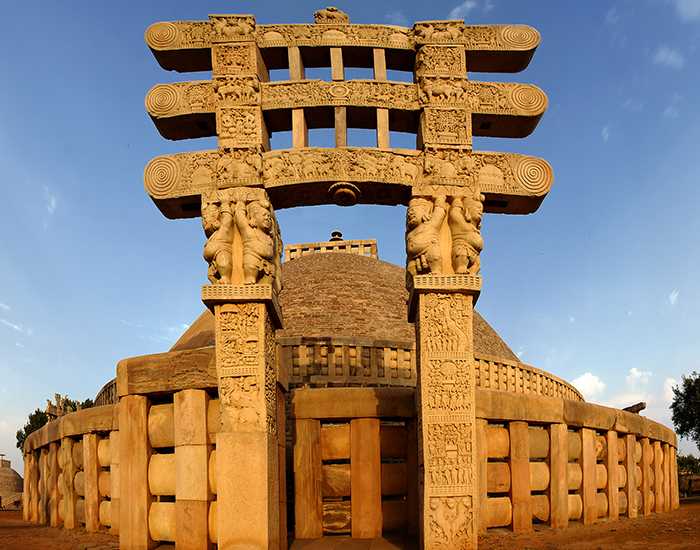
Meaning ‘gateway’ or ‘arched entrance’ in Sanskrit and Pali, torana refers to a free-standing gateway marking the entrance to a Buddhist shrine or stupa, or a Hindu temple. Usually made of stone, it comprises two pillars supporting two or three transverse beams extending beyond the pillars on both sides, or an ornamented arch forming a single structure. The oldest surviving Buddhist torana is at the Bharhut Stupa, dated to c. 250 BCE.
More Definitions
Vaulted
An architectural descriptor for ceilings or roofs that feature self-supporting arches known as vaults. In its simplest form, the vault…
Stupi
A bulbous structure that is the apex of a temple and placed on the roof. Also known as the kalasha,…
Peristyle
A row of pillars surrounding an enclosed space or enclosing an open space, taking the form of a porch or…
Kapotabandha
In Indian temple architecture, it is a style of decorative moulding seen on a tier of the adhisthana, the raised…
gopuram
Towering, multi-storeyed gateway characteristic of South Indian Dravida temple architecture. A temple may have several gopurams, or gopuras, punctuating the…
stringcourse
Horizontal band running along the exterior surface of a building or a boundary wall, serving aesthetic and sometimes functional purposes.…
Krishna Mandapa
A open-air bas relief sculpture in Mamallapuram, Tamil Nadu, attributed to the reign of the Pallavas. It is 8.8 meters…
Mahamandapa
A pillared pavilion or hall found in Dravida temples. Typically the largest mandapa (pavilion) of the temple, the mahamandapa serves…