-
ChicagoImpart Encyclopedia of Art. "Sigiriya Murals and Mirror Wall." March 9, 2026. https://imp-art.org/articles/sigiriya-murals-and-mirror-wall/.
-
MLA"Sigiriya Murals and Mirror Wall." Impart Encyclopedia of Art, Mar. 9, 2026, https://imp-art.org/articles/sigiriya-murals-and-mirror-wall/.
-
HarvardImpart Encyclopedia of Art (2026) Sigiriya Murals and Mirror Wall. Available at: https://imp-art.org/articles/sigiriya-murals-and-mirror-wall/ (Accessed: 16 October 2026).
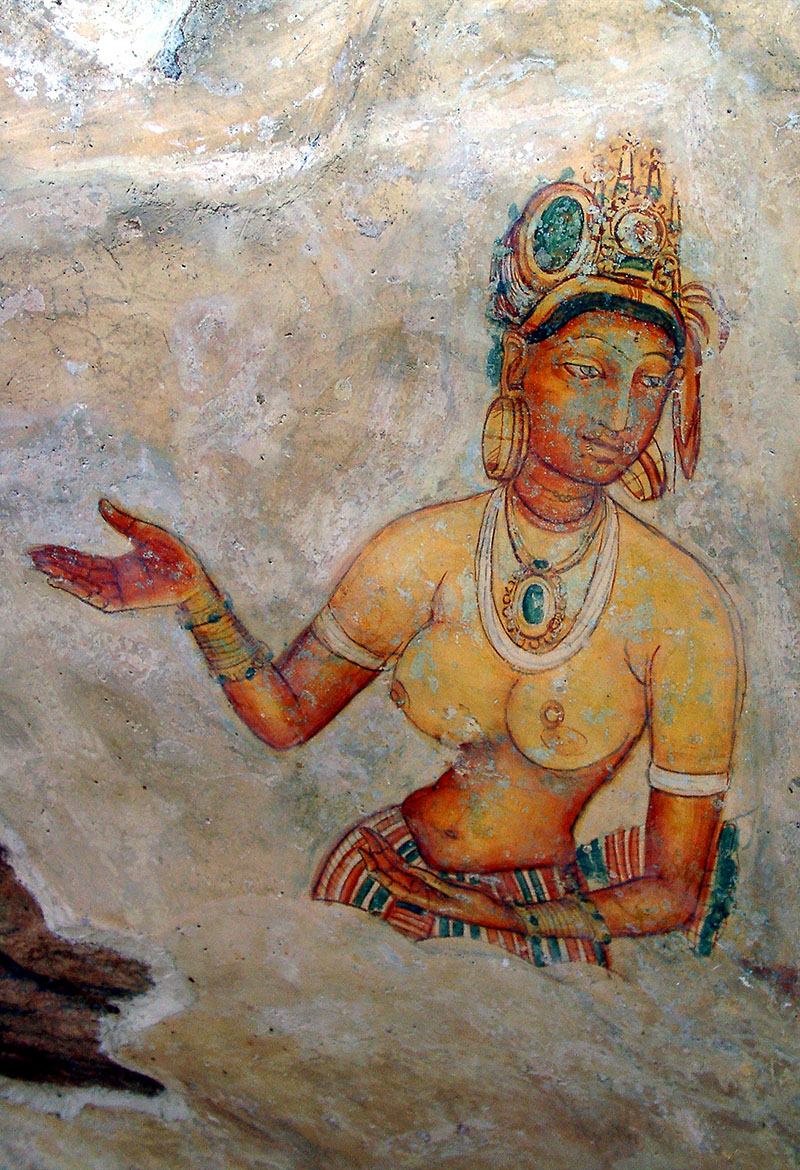
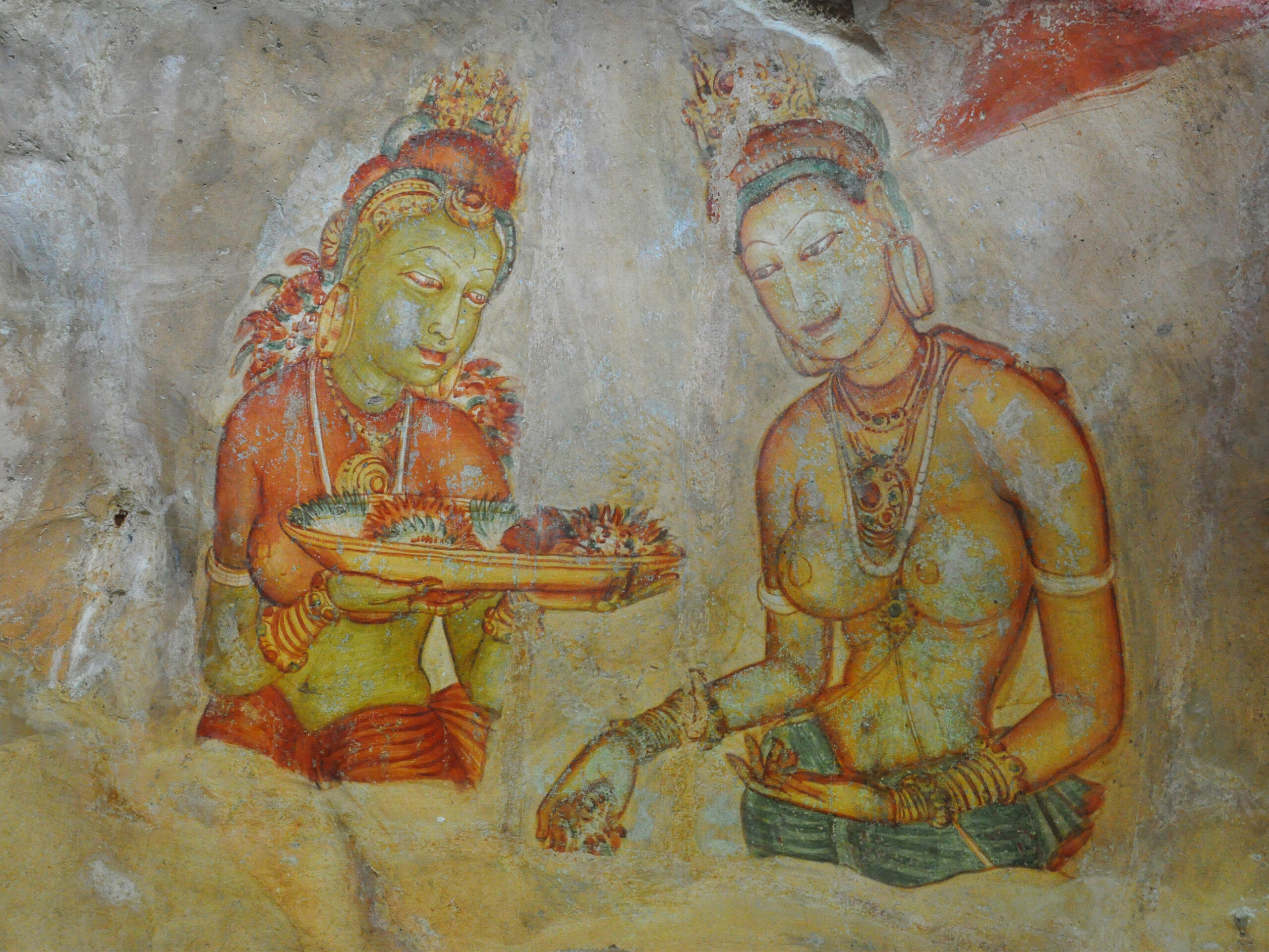
A set of fifth-century murals depicting a group of women is found at the Sigiriya cliff fortress in central Sri Lanka. Below them is the Mirror Wall, a polished wall bearing visitors’ inscriptions in response to them between the sixth and fourteenth centuries CE. The surviving murals show twenty-two female figures, commonly interpreted as apsaras or celestial nymphs, though sometimes as the concubines of the Moriya king Kassapa (r. 477–92 CE), who commissioned the Sigiriya monument complex.
Site
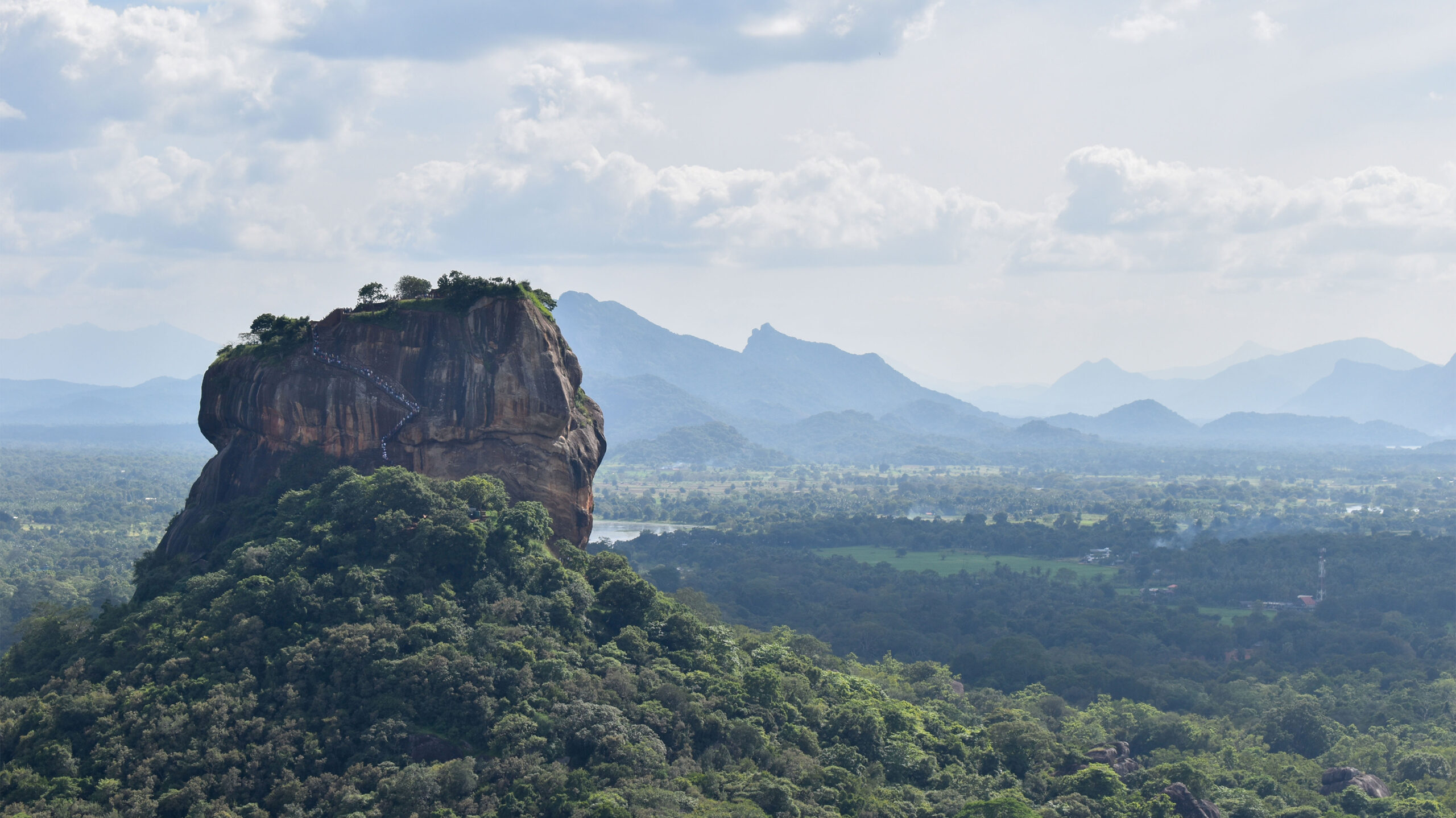
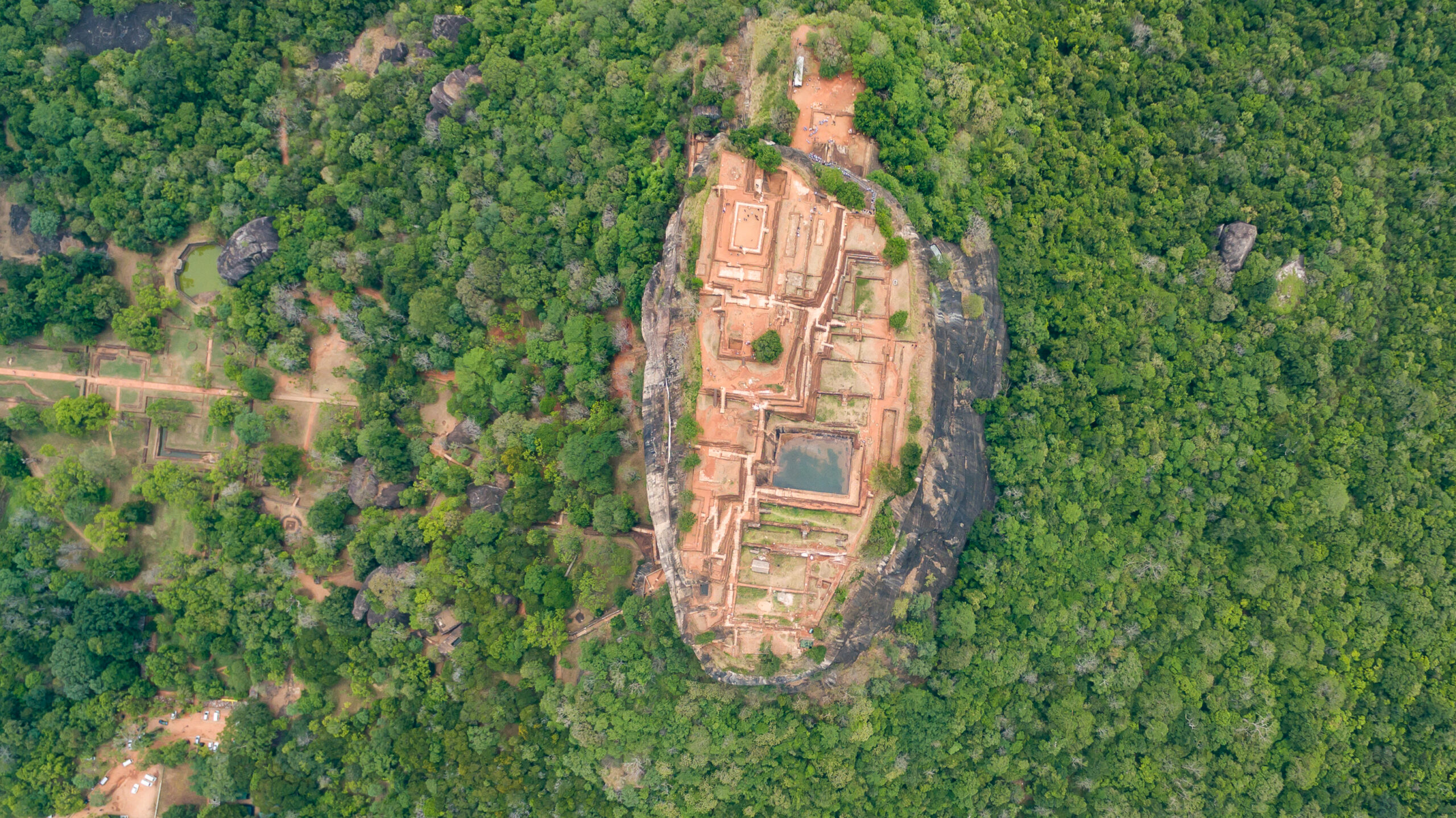
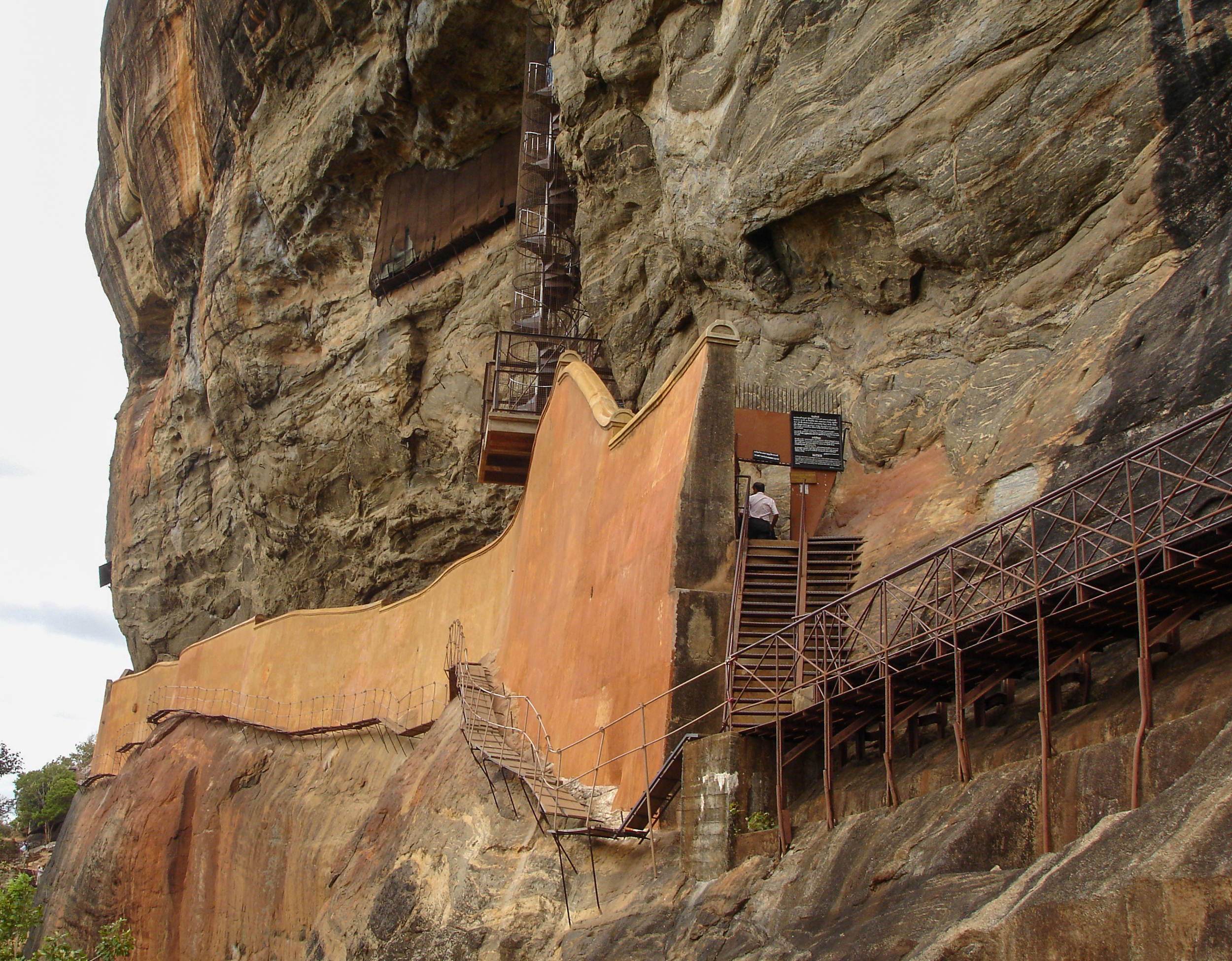
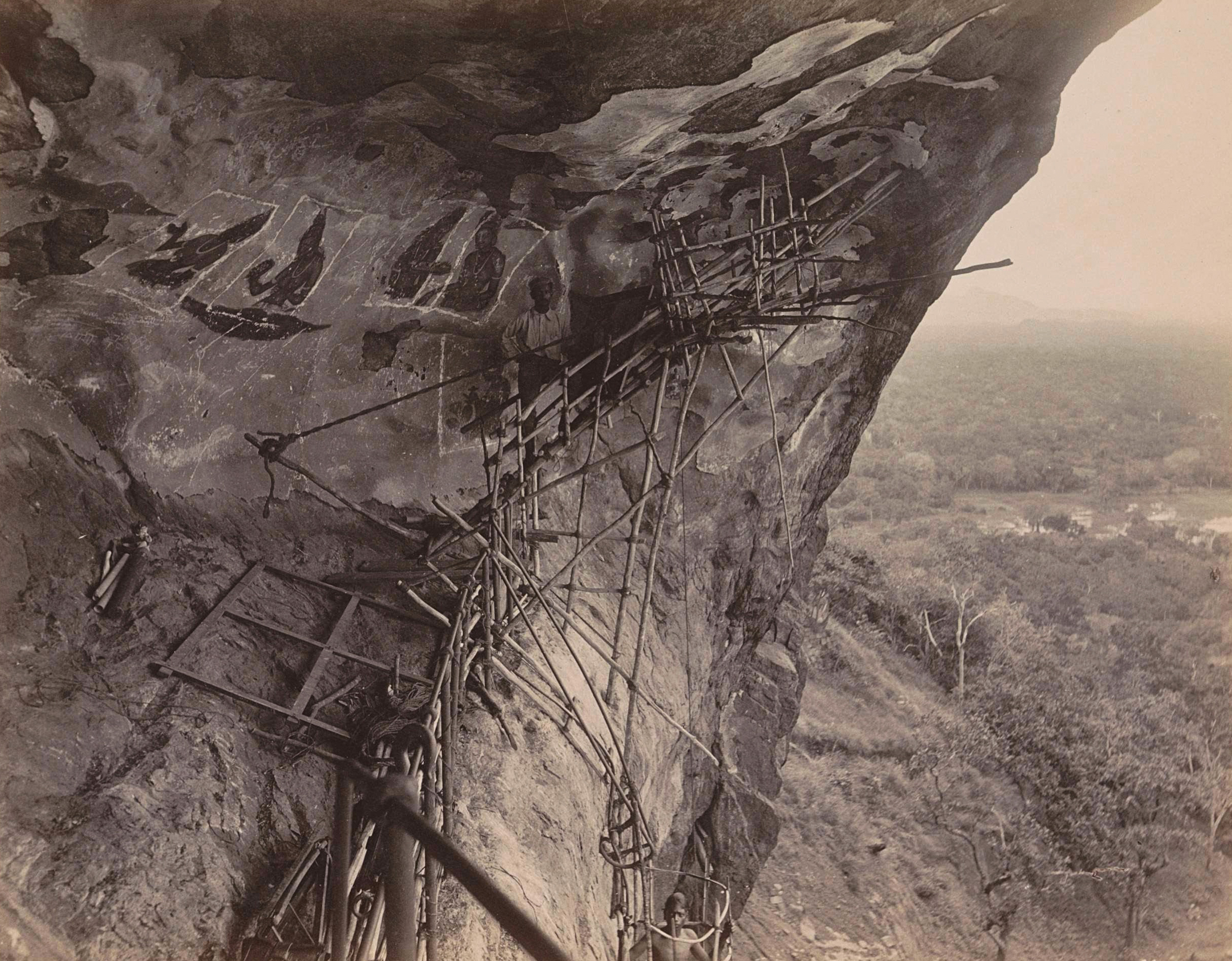
The Sigiriya rock, known in Sinhala as Sigiri gala, is a 180-metre tall natural monolith whose flattish top has an area of about 1.6 hectares or 16,000 square metres. Kassapa constructed a fortification in the form of a monumental lion here; the rock’s slopes and top accommodate a brick and stone complex with water reservoirs, as well as boulder and terrace gardens. The latter are considered among the oldest surviving historical gardens in South Asia and are a notable example of medieval courtly gardens in Sri Lanka. The murals and Mirror Wall are on the western face of the rock, approximately 40 and 30 metres above ground level, respectively. While it is unclear how medieval visitors viewed the murals, today a corridor built along the rock face enables access to visitors.
There is evidence for Sigiriya having been occupied for nearly five thousand years. Between the third century BCE and the first century CE, the hills and caves around the cliff formed a Buddhist monastic complex, with Brahmi inscriptions from the third to second century BCE mentioning the names of patrons. The walls of some of the caves still bear traces of murals — these are broadly dated to the first millennium CE and are considered to be both chronologically close and stylistically similar to the murals at the fortress. The site re-emerged as a monastery after Kassapa’s death, until the thirteenth or fourteenth century. The inscriptions on the Mirror Wall show that the complex drew a number of visitors in this period. In the sixteenth and seventeenth centuries, Sigiriya was an outpost of the kingdom of Kandy.
Historical background
In the last quarter of the fifth century, Kassapa usurped the Moriya kingdom by killing his father, the king Dhatusena, and driving his brother, the rightful heir, into exile in southern India. He fled from the erstwhile capital Anuradhapura to the more remote and secure Sigiriya, where he built the fortress complex to serve as his capital. Historical chronicles describe Kassapa’s desire to model the Sigiriya complex on Alakamanda, the mythical Buddhist city of the gods and home to Kubera, which is believed to be located similarly at a height among cliffs. Historian Senarath Paranavithana suggests that Kassapa’s monumental constructions at Sigiriya may have been an expression of his conception of himself as a deified monarch or devaraja — a concept emerging from the earlier Indian notion of the chakravartin — that was increasingly adopted from the late centuries BCE, especially in the Indianised states and polities of Southeast Asia.
Mural figures
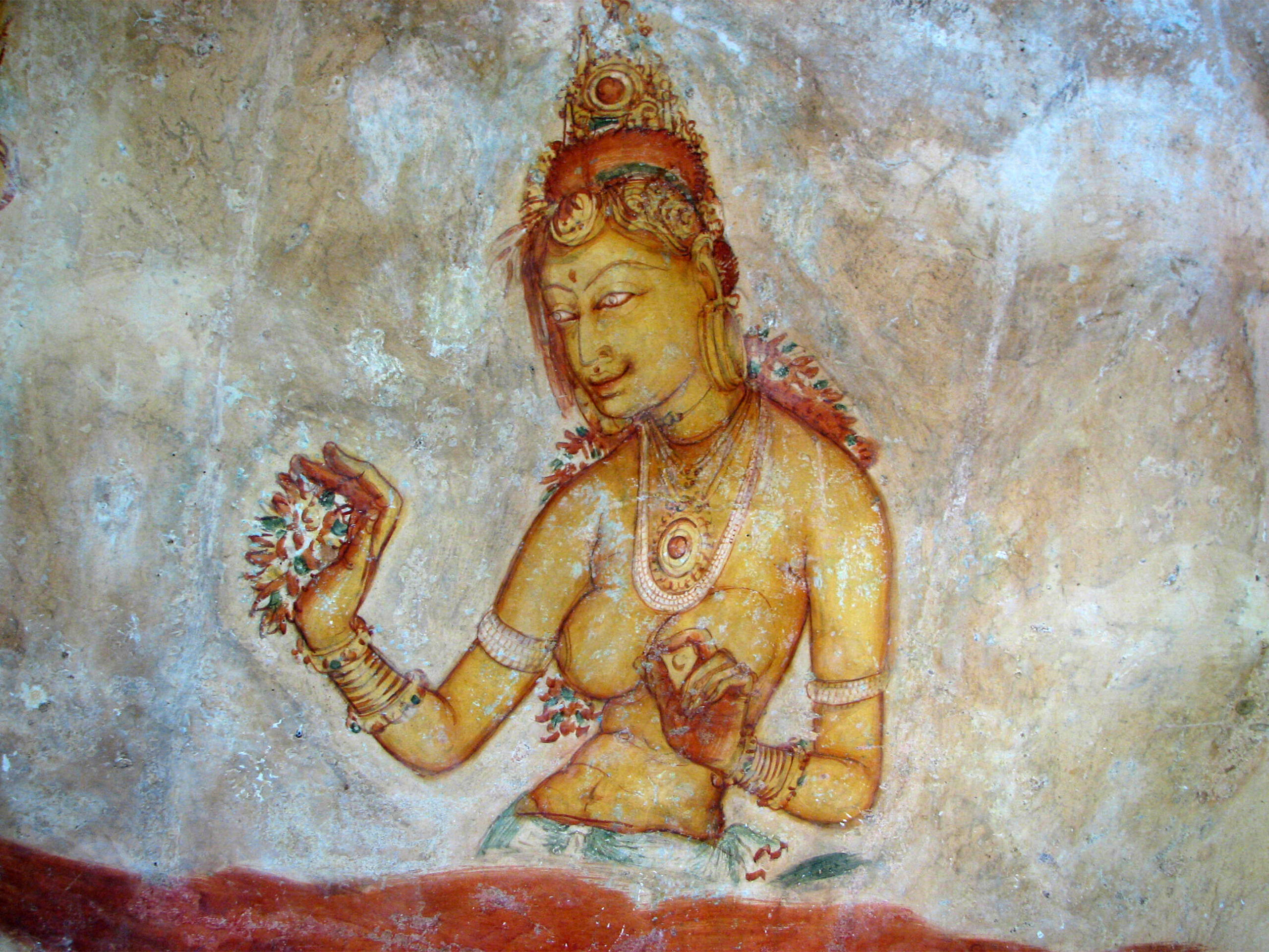
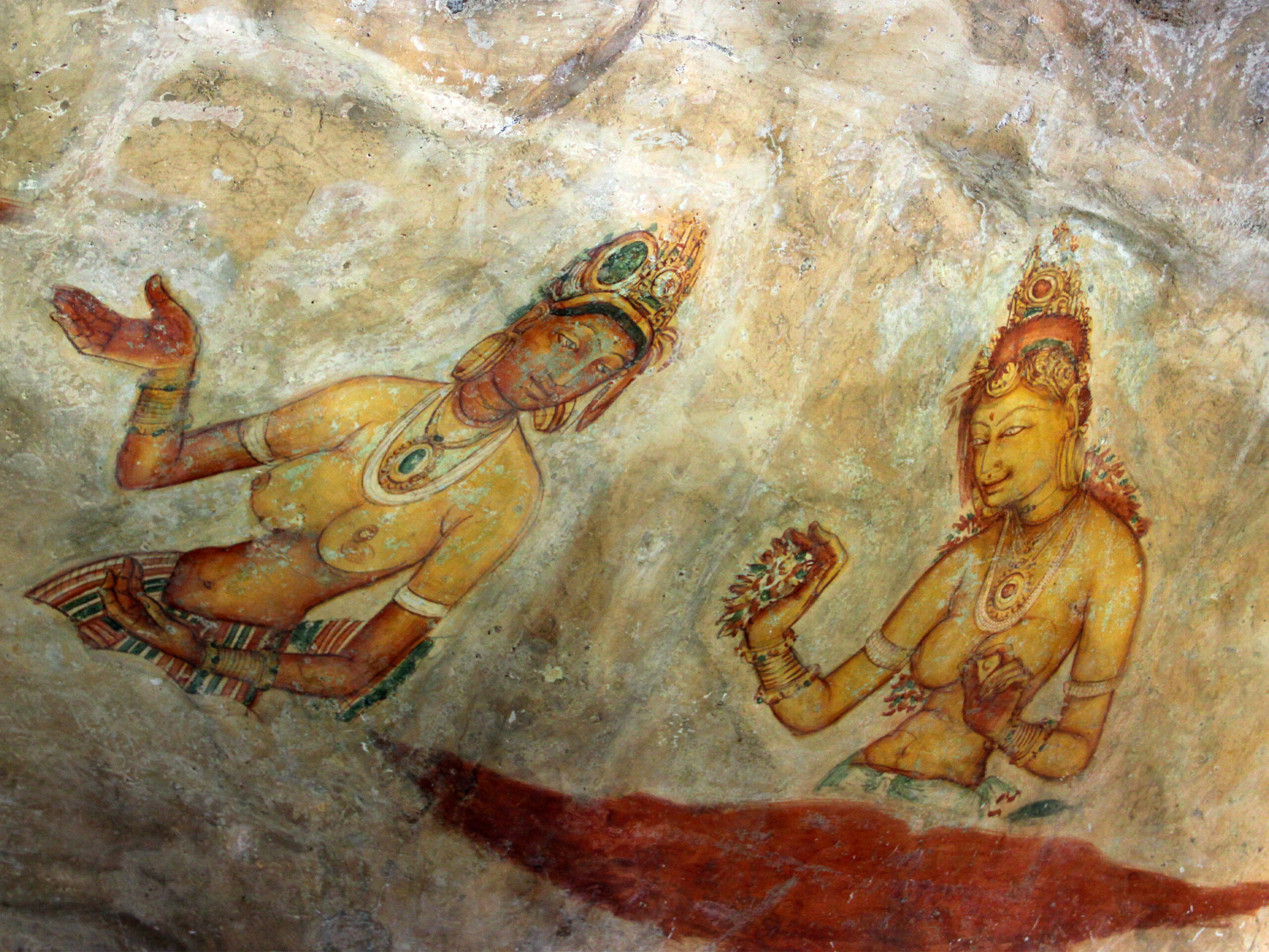
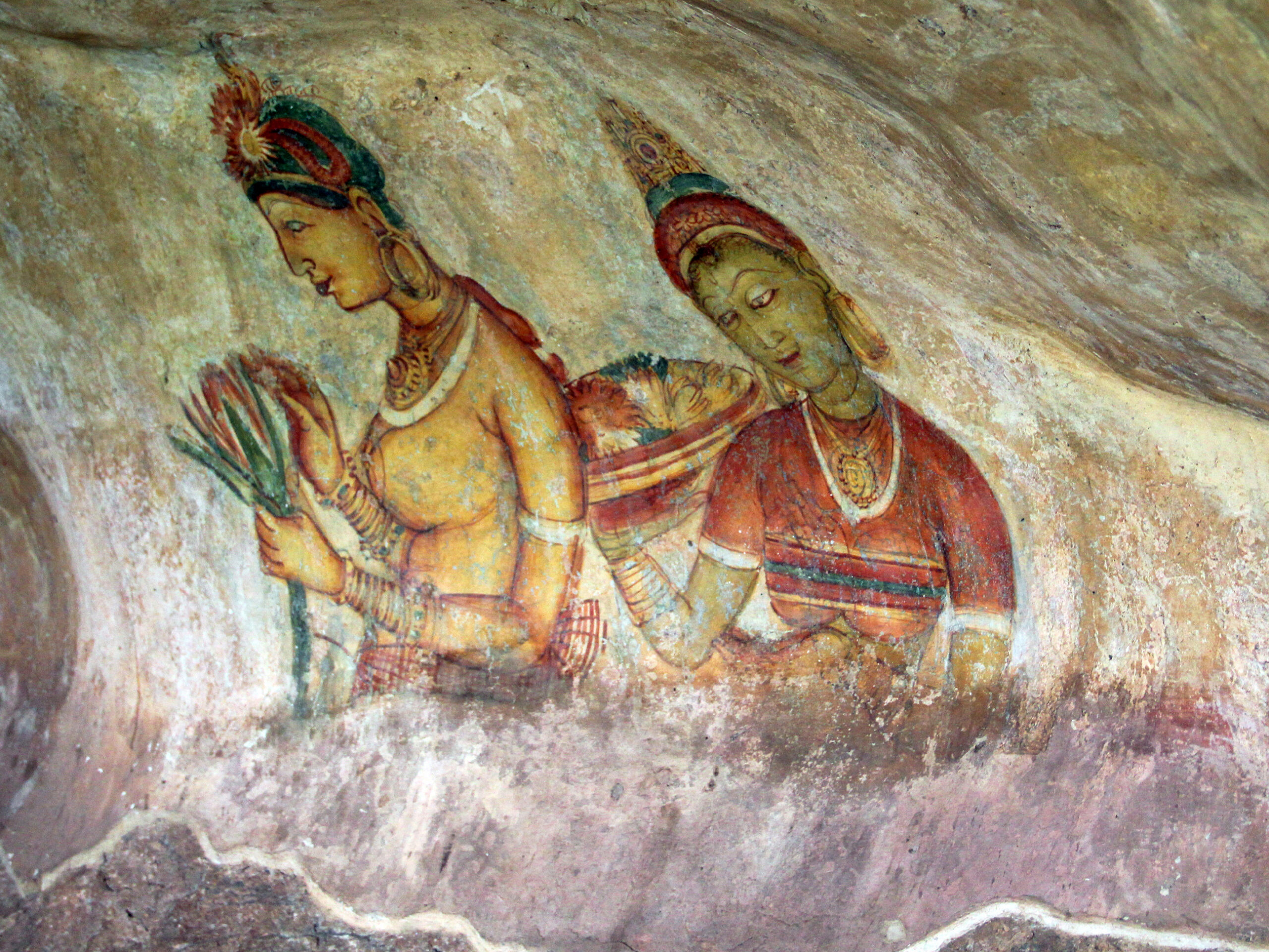
Out of the five hundred figures of women that were originally painted in the roughly 42 metre long mural, only twenty-two figures remain today, surviving because of their sheltered locations. The women are shown mainly from the hips up, emerging from clouds; while some are depicted wearing a blouse and a lower garment similar to a skirt, many are bare-bodied. They are rendered with long tapering limbs, rounded breasts, and narrow waists. Their facial features are soft, with elongated, almond-shaped eyes that appear half-closed, long noses, and mouths shaped in a half smile. They wear heavy jewellery — necklaces, large earrings, and bangles — as well as elaborately constructed crowns or diadems. The stylisation of the figures in the Sigiriya murals is also similar to the women portrayed in the murals at the Ajanta caves, dated to approximately the first century CE.
Some figures are depicted in pairs, with one figure shown with deep brown skin and the other with lighter, almost golden skin. Some scholars suggest that the former are meant to be meghalatas or cloud-princesses and the latter depictions of Vijukumari, ‘the lightning princess’ — both figures that often appear as decorative motifs in premodern Sri Lankan architecture. In many of the pairs, one holds a tray of flowers while the other is shown scattering flowers. The mural was painted on a lime wash over layers of ground comprising packed red alluvial soil strengthened with vegetable fibres, clay, sand, and lime mortar. The pigments used include red ochre, yellow ochre, carbon black, and the green pigment terre verte, which may have arrived at Sigiriya from sites in Central Asia like Badakhshan or Lake Baikal via India.
Terracotta figurines about 20 centimetres in height, some depicting female torsos, have been found at the base of the rock, apparently inspired by the murals. They are dated between the seventh and tenth centuries and were likely souvenirs for visitors to purchase, a rare phenomenon before modern tourism.
Interpretations
The images in the mural have garnered various scholarly and popular interpretations, with no conclusive theories. In the late nineteenth century, British archaeologist HCP Bell suggested that they depicted Kassapa’s many concubines on their way to a religious site. While most scholars disagree, Senake Bandaranayake has suggested that the costume, style, and jewellery of women may have been inspired by courtly life at Sigiriya. Senarath Paranavithana believed that the women were depicted as personifications of the dark clouds and lightning of Alakamanda. Ananda Coomaraswamy proposed that these images were likely representations of apsaras, a common motif in Asian art; this interpretation remains a popular one today.
Mirror Wall
The Mirror Wall abuts a narrow pathway along the rock face about 10 metres below the murals. It is made of brick covered with lime plaster, once highly polished, and has an average height of 3 metres. The wall carries around 1800 graffiti inscriptions — verses, couplets, and one-liners — likely etched with a Sri Lankan portable stylus or ul-pihiya. These inscriptions provide several readings of the paintings and shed light on how audiences across centuries have responded to them. Many inscriptions are signed — it appears that a wide variety of people visited the site, from members of the Buddhist clergy on pilgrimage to lay people.
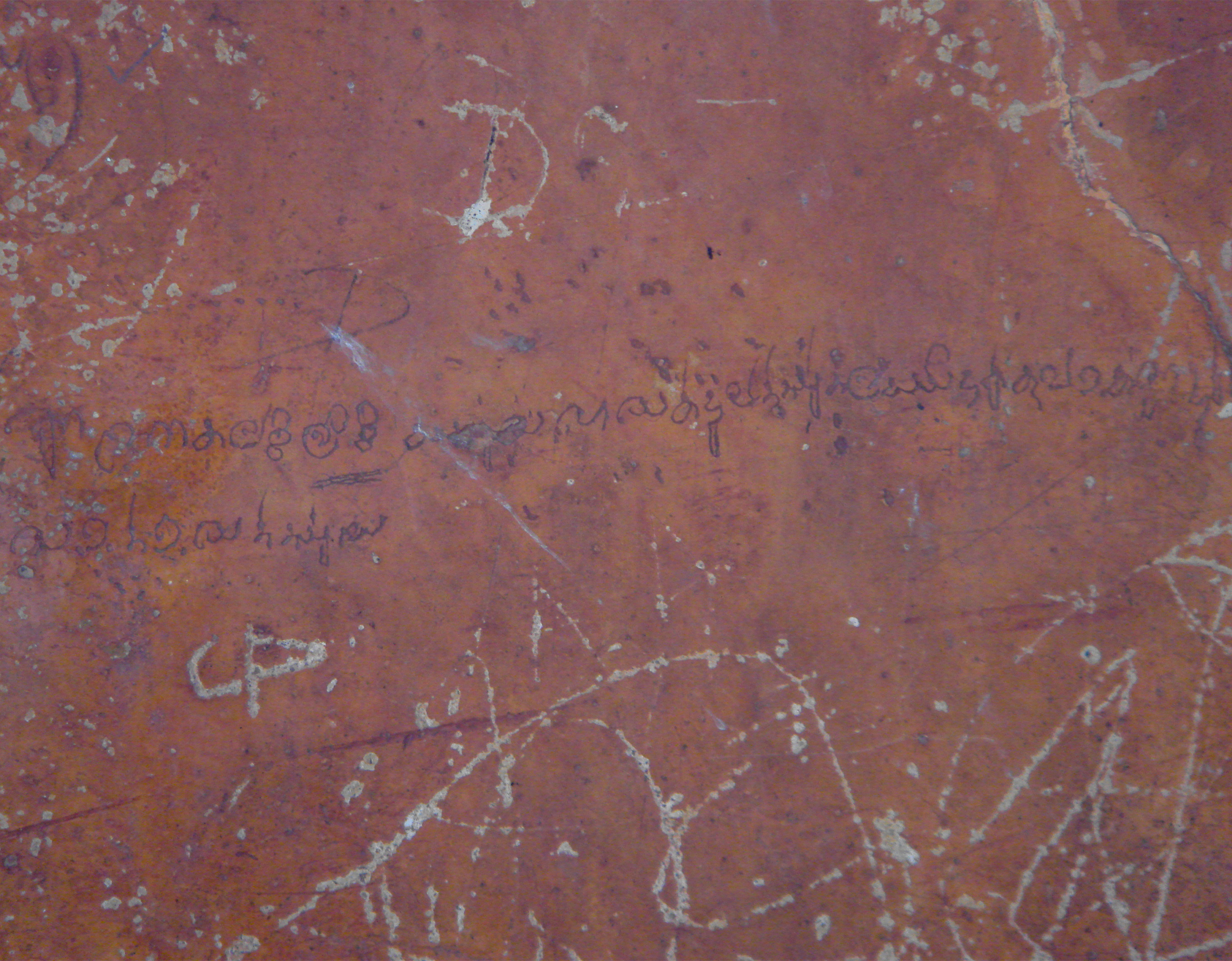
The inscriptions are also significant as one of the earliest records of Sinhala as a written literary language, given that Sanskrit and Pali were historically the languages of court poetry and Buddhist scripture in the region. Out of the 1500 poems that were inscribed on the wall originally, 685 were transcribed and translated by Paranavithana (published in 1956); the archaeologist Benil Priyanka published 800 more in 2010.
Modern developments
The Sigiriya complex has attracted the attention of archaeologists and scholars from the late nineteenth century onwards. In 1967, the murals were vandalised and damaged with green paint, perhaps as a reaction to the eroticism of the images. They were subsequently restored twice, first by Sri Lankan archaeological commissioner Raja de Silva and later by Italian scientist and conservator Luciano Maranzi. The monument complex at Sigiriya was designated as a UNESCO World Heritage Site in 1982. The conservation of the paintings, as well as archaeological research into the gardens and other structures of the complex, have been supported by UNESCO, the Sri Lankan government, as well as international agencies. It remains accessible to visitors at the time of writing.
First published: 9 March 2026
Image Gallery
Bibliography
Abeywardana, Nuwan. “Vandalized Paintings in Sigiriya, Sri Lanka, 1967.” Paper presented at 2nd International Research Symposium (IRSYRU), Rajarata University, Sri Lanka, 2014. http://repository.rjt.ac.lk/handle/123456789/1139?show=full.
Bandaranayake, Senake. Sigiriya: City, Palace and Royal Gardens. Colombo: Central Cultural Fund, Ministry of Cultural Affairs and National Heritage, 1993.
Central Cultural Fund. “Sigiriya.” Accessed October 25, 2024. https://www.ccf.gov.lk/tour-item/sigiriya/.
Epasinghe, Premasara. “Fresco Disaster at Sigiriya in 1967.” Daily News, November 1, 2003. Accessed December 5, 2023. https://archives.dailynews.lk/2003/11/01/fea06.html.
Murphy, Richard. “The Mirror Wall.” Grand Street 8, no. 3 (1989): 18–25. https://doi.org/10.2307/25007224.
Paranavitana, S. “The Significance of the Paintings of Sigiri.” Artibus Asiae 24, no. 3/4 (1961): 382–87. https://doi.org/10.2307/3249238.
Silva, Nimal De. “Sigiriya Mirror Wall and Graffiti.” The National Trust, Sri Lanka Public Lecture, Accessed December 5, 2023.
Somathilake, M. “Further Analysis on Fresco and Tempera: An Analysis of the Technique of Murals in South Asia.” Journal of the Royal Asiatic Society of Sri Lanka 53 (2007): 109–32. http://www.jstor.org/stable/23731202.
University of Bramberg. “Sigiriya Paintings: Digitisation, Documentation and Conservation of Endangered Wall Paintings in Sri Lanka.” Accessed December 4, 2023. https://www.uni-bamberg.de/en/restaurierungswissenschaft/forschung/current-research-projects/sigiriya-paintings/.
Feedback