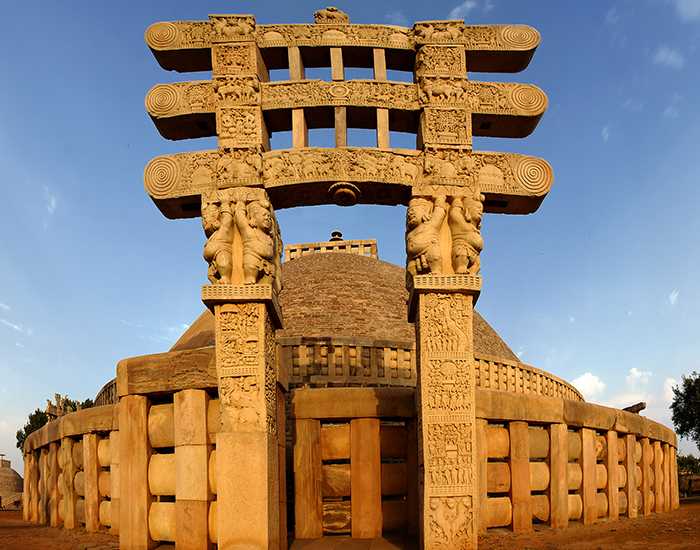
Meaning ‘gateway’ or ‘arched entrance’ in Sanskrit and Pali, torana refers to a free-standing gateway marking the entrance to a Buddhist shrine or stupa, or a Hindu temple. Usually made of stone, it comprises two pillars supporting two or three transverse beams extending beyond the pillars on both sides, or an ornamented arch forming a single structure. The oldest surviving Buddhist torana is at the Bharhut Stupa, dated to c. 250 BCE.
More Definitions
Zenana
A Persian term for private quarters in a house reserved exclusively for women. Originally an extension of the Islamic concept…
Sarvatobhadra
A type of Hindu temple architecture characterised by a door in each of the four cardinal directions of the sanctum.…
Dado
In architecture, it is the space between the base and the pedestal of a column. It is also used to…
Stucco
A type of fine plaster or coating material used to cover walls and ceilings with decorative patterns, it is also…
Peristyle
A row of pillars surrounding an enclosed space or enclosing an open space, taking the form of a porch or…
Tin Thal
A three-storeyed Mahayana cave temple in Ellora dating to the eighth century CE. Marked as Cave 12, it houses a…
Garbhagriha
Translating to 'womb chamber' from Sanskrit, it is the innermost sanctuary in Jain, Buddhist and Hindu temples, within which the…
Dormer
A triangular or cylindrical projection from a roof that usually contains a window. It is an architectural motif commonly found…