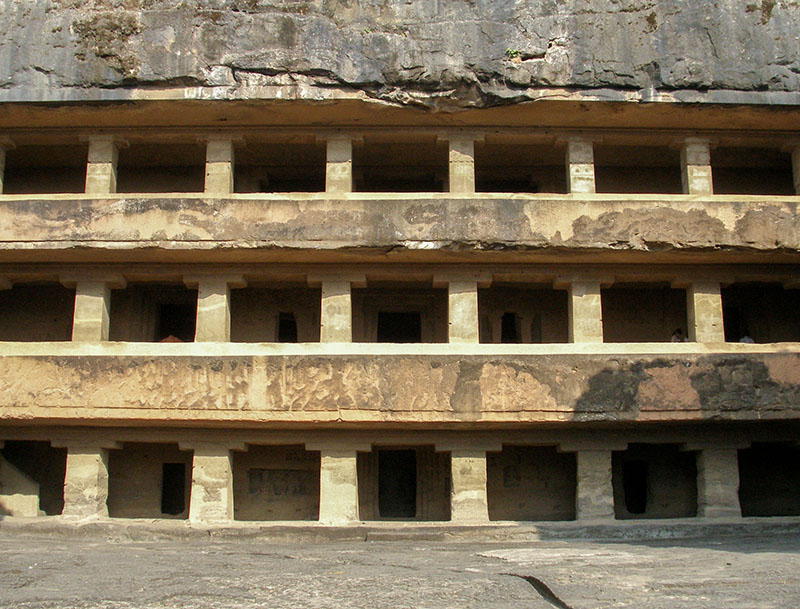
Referring to the act of leisurely strolling as well as a garden or dwelling place in Pali and Sanskrit, vihara is a Buddhist monastery and place of religious education. It typically comprises multiple residential cells for monks, connected to an open central court and an entrance porch. Initially serving as places of rest for wandering monks, the earliest surviving viharas are rock-cut structures accompanying early Buddhist cave temples in India dating to the second century BCE. These evolved into large centres of learning known as mahaviharas, such as Nalanda in India and the Shalban Vihara in Bangladesh.
More Definitions
Cushion Capital
In architecture, it is a type of crown, which is the top-most part of a column, pillar or pilaster. It…
Cornice Moulding
A horizontal decorative moulding applied to the edges at the top of an interior wall, ceiling or pedestal. They date…
Pindika
Sanskrit for 'stool' or 'pedestal', it is the platform on which idols are installed in the garbhagriha or innermost sanctum…
Collonade
A row of columns, typically equidistant from each other and joined by an entablature. A colonnade may be freestanding or…
Ratha
A spoked-wheel chariot or cart, usually drawn by horses. Evidence of their use and construction has been found in the…
Shamiana
A ceremonial tent or awning featuring removable walls that consist typically of decorated or coloured cloth. They were used by…
belfry
Bell tower; or the upper part of this or a steeple, which houses bells; or specifically the timber structure by…
Torana
Meaning ‘gateway’ or ‘arched entrance’ in Sanskrit and Pali, torana refers to a free-standing gateway marking the entrance to a Buddhist shrine or…