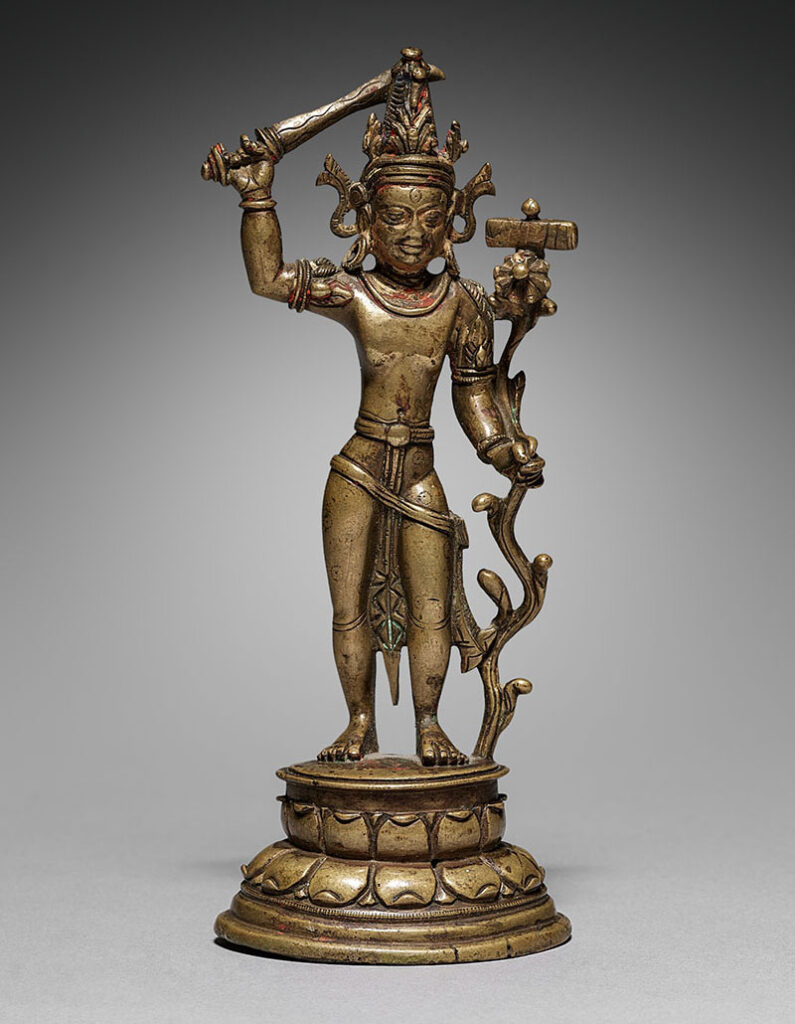
Also known as Manjughosa and Vaigsvara, he is a bodhisattva who is associated with prajna (wisdom) in the Mahayana and Vajrayana traditions of Buddhism. His name derives from the Sanskrit term manjusri, meaning “gentle glory.” He is conventionally depicted with a sword of wisdom in one hand and a manuscript of the Prajnaparamita Sutra in the other. Within Tibetan Buddhism, he is depicted in a triad along with Avalokitesvara and Vajrapani. In his wrathful form, he is known as Yamantaka or “the destroyer of death.”
More Definitions
Parashurama
The sixth avatar or incarnation of the Hindu deity Vishnu, he is known for his aggression, bravery, patience and serenity.…
Yoni
It symbolises the goddess Shakti as well as the feminine procreative power within Hindu iconography. The word itself literally translates…
Bhringi
In Hindu mythology, Bhringi is a sage and an attendant of the deity, Shiva. In iconographical convention, he is often…
Brahmanism
A later form of the Vedic religion developed by Indo-Aryan-speaking settlers who migrated from Central to South Asia in the…
Naranarayana
A term used to refer to both Arjuna and Krishna in the Mahabharata. It has also been used to refer…
Jataka
A large collection of approximately 550 stories about the Buddha’s former lives in both human and animal form. The stories…
Bharata (Jainism)
In Jain mythology, he is the first chakravartin ("universal emperor") and the oldest son of Rishabha Deva, the first Tirthankara.…
Mahakala
A deity common to Buddhism, Hinduism and Sikhism, whose name is composed of the Sanskrit maha, meaning "great," and kala…