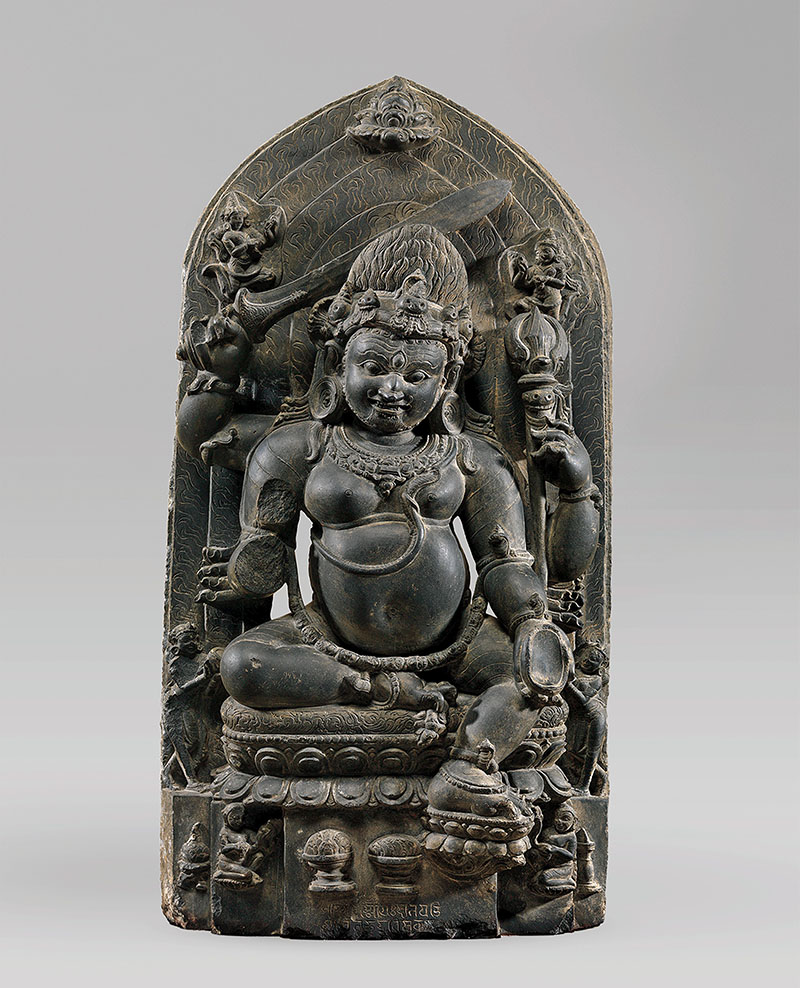
A deity common to Buddhism, Hinduism and Sikhism, whose name is composed of the Sanskrit maha, meaning “great,” and kala meaning “time” or death,” thus denoting “the one who is beyond time or death.” In Hinduism, he is considered to be a manifestation of the deities Shiva and Vishnu, as well as consort to the goddess Mahakali. Within Vajrayana Buddhism and Tibetan Buddhism, he is a protector deity and is also known as dharmapala, while in Sikhism, he is known by the name Kala.
More Definitions
Rama
The seventh of the ten incarnations of the Hindu deity Vishnu, Rama was the son of King Dasharatha and Queen…
Bhairava
A fierce form or manifestation of the Hindu god, Shiva, he is a guardian deity and one of the central…
Bharthari
Also known as Jogi Sant Bharthari, he is a popular king from the folk legends of northern and central India.…
Vayu
The god of wind in the Vedic pantheon, who represents the cosmic life-breath. He is one of the vasus (attendants)…
Bhairavi
The consort of Bhairava and a form of Devi, the supreme goddess in Hinduism. She is also one of the…
Korravai
One of the earliest documented deities in Tamil Sangam literature, she is the goddess of war and victory. She was…
Shaivism
One of the largest and oldest sects of Hinduism, with Shiva and his consort Shakti as the supreme deities —…
Amar Chitra Katha
A series of Indian comics begun in 1967 by Anant Pai, based on religious mythology, legends, folktales and biographies of…