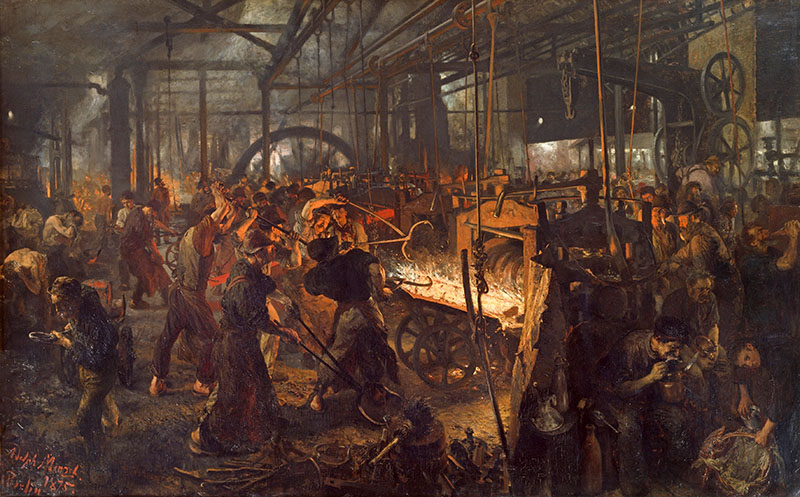
Historic period of rapid economic, technological, and social transformation that began in Britain in the mid-eighteenth century. The term was initially used to describe Britain’s transition from an agrarian to an industrial economy between 1760 and 1840; its use has since broadened to describe similar transitions later in other parts of the world, spanning to the mid-twentieth century, including parts of Europe, the United States, the former Soviet Union, China, and India. In Britain, the Industrial Revolution was characterised by the spread of factories that centralised production and led to a reorganisation of labour. Manufacturers and investors of capital owned factories and employed waged workers who only handled discrete stages of production, in contrast to the worker autonomy of the earlier handicraft economy.
The technological changes that supported the industrial economy into the twentieth century included new methods of iron smelting and steel production, and the invention of the steam engine, power loom, spinning jenny, and telegraph. It was also enabled by factors such as Britain’s substantial coal reserves and the British Empire’s exploitation of resources overseas, such as land and slave-grown American cotton. Transport developed rapidly; railways, roads and canals made moving people and goods cheaper and faster. Urbanisation accelerated and land was increasingly privatised with the enclosure of commons. Money became the primary means of economic exchange. Political influence shifted from an exclusively landed aristocracy to industrial and commercial interests. Scientific and technical knowledge circulated widely through print publications and the establishment of new institutes. Domestic relationships changed under the conditions of the Industrial Revolution, which increasingly separated the home from the workplace and hardened distinctions between men’s and women’s work; child labour was also widely used in factories. The displacement of skilled trades by new machinery provoked direct resistance, including the machine-breaking of the Luddite movement.