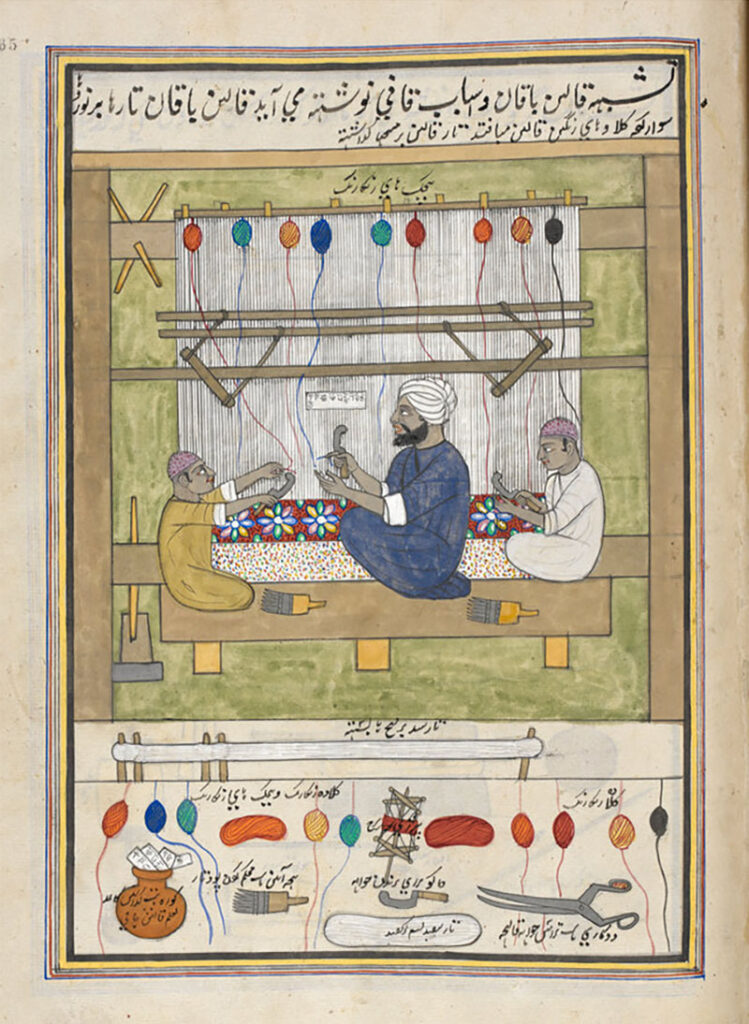
Upright handloom traditionally used for tapestry and carpet weaving, in which the warp threads are stretched vertically between roller-beams at the top and bottom, or, in early versions, suspended from a cross-beam at the top and weighted at the bottom. The shed or gap for the weft threads to pass through is opened by a hand-operated mechanism, making the weaving process slower than the treadle-operated low-warp loom. Facing the loom, the weaver works weft patterns into the back of the warp, ensuring consistency with the reference image by going around the loom or using mirrors. The high-warp loom is speculated to have originated in Syria or Mesopotamia.
More Definitions
ground glass
Glass that has been given a coarse surface finish, usually with a fine abrasive, to be used as the viewfinder…
Ari
An embroidery tool resembling a crochet needle, it comprises an elongated wooden handle and a long, fine needle tipped with…
Medium Format Camera
Film cameras that produce images larger than 24 mm x 36 mm but smaller than 4 inches x 5 inches.
Lamprey’s Grid
A grid system developed in 1869 by John H Lamprey that was used to photograph subjects for anthropological studies. It…
Brownie Camera
Also known as the Kodak brownie, it is a series of box cameras with a meniscus lens and roll film,…
fixed-focus lens
Camera lens whose focal distance is pre-determined at the time of manufacture and cannot be adjusted by the user. It…
Fixed Heddle Loom
Also known as rigid heddle looms, they feature a single shaft wherein heddles are fixed in place and resemble the…
Heald
Also known as a heald wire or heddle, it is the part of the loom through which warp threads are…