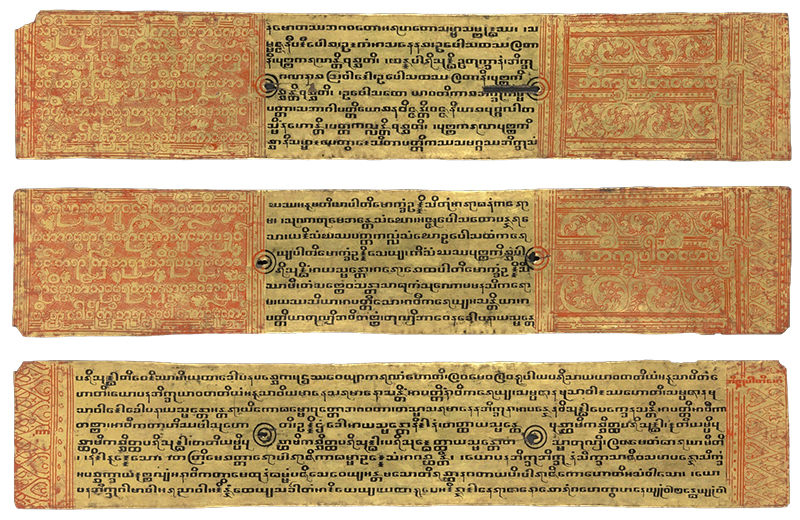
Collection of texts in the Pali language regarded in Theravada Buddhism as the authoritative account of the Buddha’s teachings. The Pali Canon is traditionally known as Tipitaka, or ‘three baskets’, referring to its three-part division into Vinaya, the rules governing monastic life; Sutta, the sermons attributed to the Buddha and his disciples; and Abhidhamma, scholastic and analytic treatments of Buddhist doctrine. Theravada tradition holds that the canon is a record of the Buddha’s words as recited by his disciples at a council held shortly after his death. Oral recitation remained its principal means of transmission for several centuries, during which the canon continued to be expanded and revised. In its present form it is first attested in the commentaries of Buddhaghosa, a monk and scholar who worked at Anuradhapura in Sri Lanka in the fifth century CE. The Pali Canon provides the scriptural basis for ritual and monastic practice amongst Theravada Buddhists in Sri Lanka, Myanmar, Thailand, Cambodia, and Laos.
Pali Canon
Link copied!