-
ChicagoBhattarai, Sushan. "The Tale of the Two Roofs and the Remaking of Kathmandu." Impart Perspectives, October 23, 2026. https://imp-art.org/perspectives/features/remaking-kathmandu-the-tale-of-the-two-roofs/
-
MLABhattarai, Sushan. "The Tale of the Two Roofs and the Remaking of Kathmandu." Impart Perspectives, Oct. 23, 2026, https://imp-art.org/perspectives/features/remaking-kathmandu-the-tale-of-the-two-roofs/. Accessed 31 Oct 2026.
-
HarvardBhattarai, S. (2026) The Tale of the Two Roofs and the Remaking of Kathmandu, Impart Perspectives. Available at: https://imp-art.org/perspectives/features/remaking-kathmandu-the-tale-of-the-two-roofs/ (Accessed: 31 October 2026).
The Tale of the Two Roofs and the Remaking of Kathmandu
In quake-prone Kathmandu, heritage reconstruction by the state has symbolically mirrored Nepal's political eras.
By Sushan Bhattarai
Link copied!
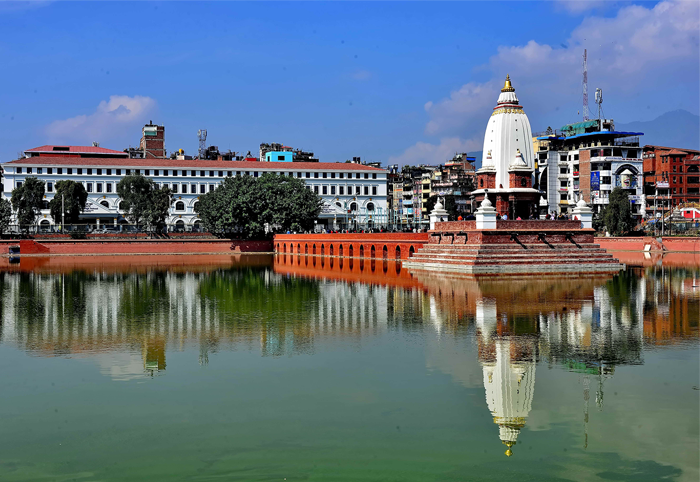
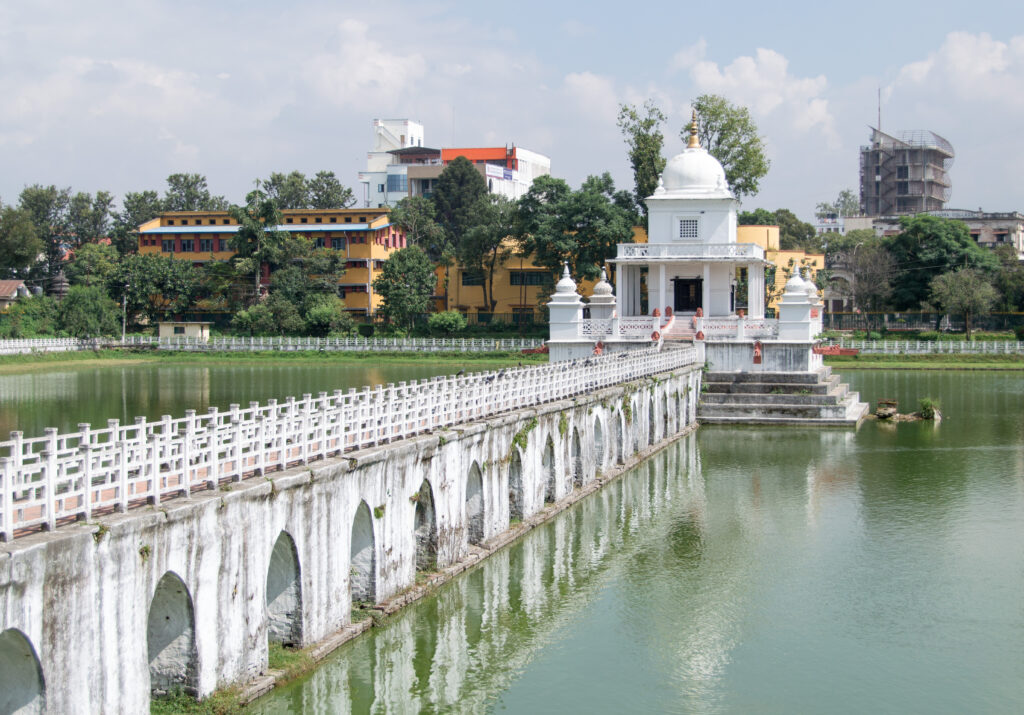
The reconstructed Rani Pokhari in 2021. Photograph: Rajesh Dhungana, Wikimedia Commons
In October 2020, Nepal’s president inaugurated the restored Rani Pokhari (Queen’s Pond), one of Kathmandu’s most famous landmarks. It marked the final chapter of a heritage architecture dispute over which type of roof structure would crown the temple at the centre of the historic artificial pond as part of the restoration work after the devastating 2015 Nepal earthquake.
Pratap Malla (r. 1641-1674) had commissioned the great water tank at the city’s centre in 1670, to console his queen after their young son died. The king would then have holy water collected from 51 sacred sites across the Indian subcontinent, such as Gosaikunda, Muktinath, Badrinath, Kedarnath, and poured into the pond to sanctify it. This act effectively transformed the artificial pond into a sacred site of worship for locals. It also became an important part of the growing city’s water infrastructure, recharging groundwater and managing runoff during the monsoons.
A grand temple was constructed at the centre of the pond and its roof was constructed in the granthakut or shikhara style, a tall spire above the central shrine (garbhagriha). Known as the Bal Gopaleswor Temple, it stood that way for a century and a half, until an earthquake in 1833 badly damaged it. This was more than a decade before the Rana clan would seize control of the government as hereditary prime ministers, while the existing Shah monarchy was reduced to serving an honorary, ceremonial role in the mountain nation’s state affairs.
Soon after Jung Bahadur Rana founded the hereditary premiership in 1846, he would use state funds to rebuild Rani Pokhari’s temple. The spire was not reconstructed and was instead replaced with a gumbaz, a whitewashed, Mughal-style dome — an architectural feature he favoured — and one that would be replicated in the riverside temples and palaces his dynasty went on to build.
The Bal Gopaleswor Temple would be rebuilt again with the same Rana-style domed roof after it was damaged in the 1934 earthquake — this time by Juddha Shumsher (r. 1932-1945), the head of the Rana family and Nepal’s prime minister during this period. That domed temple remained standing till the 2015 earthquake brought it down once again.
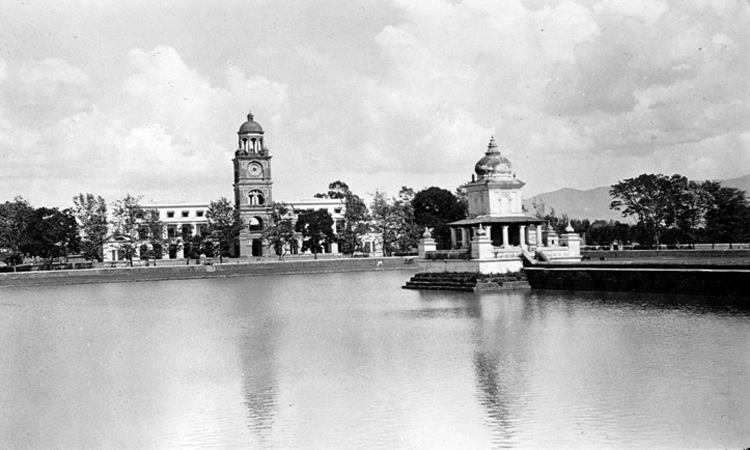
When Nepal’s Department of Archaeology initially moved to rebuild the temple, the plans were to recreate the same stucco-dome built twice under the Rana regime. Under the supervision of the Kathmandu Metropolitan City (KMC), work began. But the plans to ‘modernise’ the complex to serve as a tourist site and the use of materials and methods like cement and reinforced concrete columns to ‘strengthen’ the temple structure, led to widespread protests by locals, heritage protection activists and conservation experts. The misguided reconstruction efforts ground to a halt and the KMC was forced to form an expert committee in 2018 to guide Rani Pokhari’s rehabilitation, headed by conservation architect and historian Sudarshan Raj Tiwari. The committee, after much debate, recommended returning the temple to Pratap Malla’s original spire. Sustained public pressure would push through the committee’s recommendations, widely noted as a win by conservation architects who put their weight behind traditional materials and construction methods that were region-specific and had evolved over centuries to suit the earthquake-prone terrain. But why did campaigners after the 2015 earthquake insist on undoing a dome well over a century old, rather than treating it as one era’s style in the evolving architecture of Bal Gopaleswor Temple? The answer lies in Kathmandu’s history — one marked by repeated cycles of rebuilding and restoration.
The Kathmandu Valley takes its name from its largest city, but the basin in fact holds three old cities — Kathmandu, Patan and Bhaktapur. Each was once its own walled kingdom, ruled by its own line of Malla kings, until the Shah dynasty conquered and unified them in the eighteenth century.
The reconstruction that Juddha Shumsher oversaw after the 1934 earthquake was the most sustained architectural intervention any Nepali state had made across the three cities since that unification. Most accounts treat it as an act of relief, but streets, monuments and building facades can do more than repair a city. They can project and contest political authority, in the way a flag or a public ceremony does, and 1934 is one of the clearest cases of a state using architecture as a way to demonstrate their power and authority to rule a country.
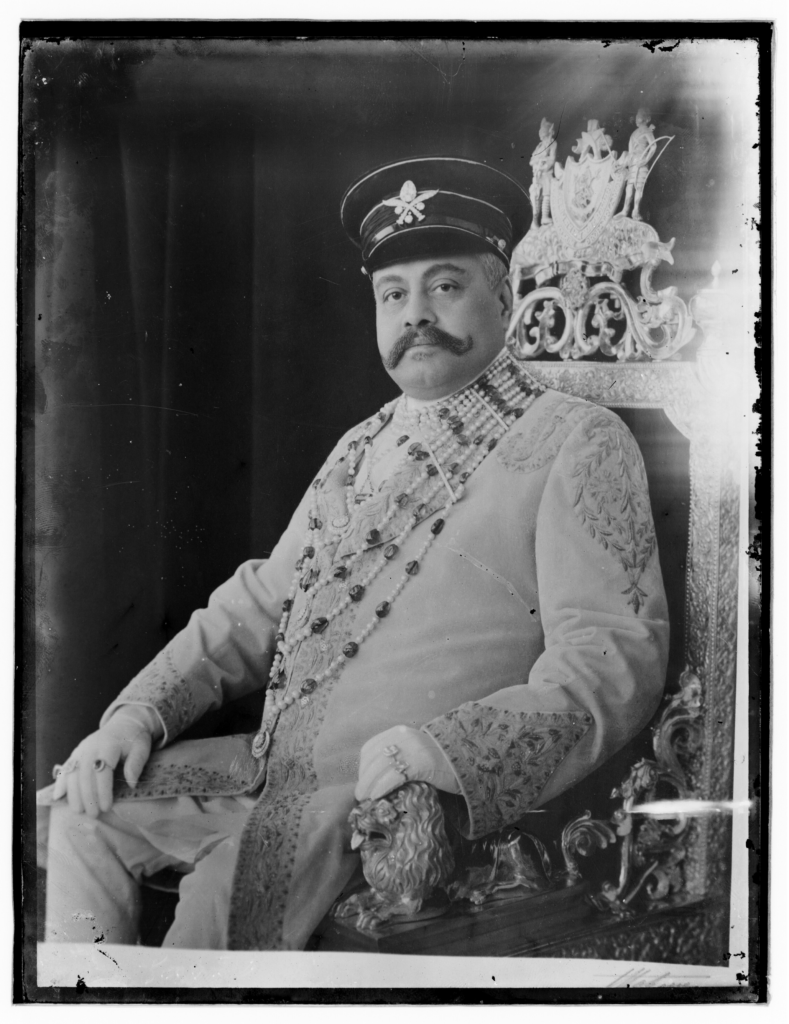
Yogesh Raj, a historian based at Kathmandu University, has traced part of the reason. He has shown that for six decades, almost everything written about the 1934 disaster and the subsequent relief and reconstruction projects, references a single book — Nepalko Mahabhukampa (Nepal’s Great Earthquake) — published in 1935 and written by Brahma Shumsher Jung Bahadur Rana, a member of the ruling Rana family. Its account matches the one already given by Gorkhapatra, then the country’s only newspaper.
The 1934 Disaster
The Bihar–Nepal earthquake on January 15, 1934 struck northern India and eastern Nepal at around two in the afternoon. Different surveys assign it magnitudes between 8.0 and 8.4. Seismologists now place the rupture beneath eastern Nepal, and not under the plains of north Bihar as the colonial Geological Survey of India had first concluded. The name that survives in most scholarship — the ‘Bihar earthquake’ — still preserves this misinterpretation. At the time, Nepal’s closed borders meant the country admitted almost no foreign diplomats, officials, travellers or journalists, so few outsiders saw the extent of the damage caused by the quake — the worst in the country’s recorded history.
Nepal’s death toll was severe, with estimates ranging from roughly eight thousand to seventeen thousand. Temples, palaces, the nine-storey tower at Sundhara, and a large percentage of ordinary domestic housing came down across all three cities in Kathmandu Valley. Brahma Shumsher’s Nepalko Mahabhukampa, however, does not present the reconstruction that followed as a necessary duty fulfilled by the state in the aftermath of a disaster. Instead, it portrays the Rana prime minister Juddha Shumsher as a generous ruler and the funds spent on rebuilding the city as an act of charity towards his subjects.
But if one were to analyse the decisions Juddha Shumsher took in the earthquake’s aftermath — beginning with his refusal to accept aid from British India — it is clear to see his actions as more calculated and aimed at preserving the Rana family’s control over Nepal at a critical moment in history. British historian John Whelpton, having examined the correspondence of British officials in Kathmandu, London, and Delhi after the disaster, argues that Juddha Shumsher’s refusal had less to do with self-reliance as a principle than with a question of Nepal’s standing as a sovereign state. Many in the Indian nationalist movement held that Nepal, despite Britain’s formal recognition of its independence, was in practice no different from any other Indian princely state, subject to British paramountcy.
Juddha Shumsher’s decision to manage the disaster without British money, engineers or expertise sent a very clear message about Nepal’s sovereignty at the very moment when the colonial apparatus in Patna was running a visible relief operation across the border. Nepal paid for its own reconstruction, lending money to householders interest-free, and in 1938 wrote the loans off entirely. The choice obliged the state to run the recovery itself, not just fund it.
British Colonial State vs Rana Autocracy
The 1934 reconstruction effort in Kathmandu has to be viewed in the light of two important factors. One, Juddha Shumsher framed the exercise as a way to establish both the competence of his ‘modern’ governance in the eyes of the British Raj and cultivate goodwill among his subjects. Two, he used the reconstruction to assert Rana authority through architecture, as rulers before him had done.
With no colonial machinery to lean on, Juddha Shumsher would direct state officials to quickly build the administrative framework required to manage the reconstruction efforts. The Bhukampa Piditoddharak Sanstha (Earthquake Victims Relief Organisation) had a damage assessment form in the field within three days. Yogesh Raj’s research in the National Archives yielded survey records that listed the dead by gender and recorded the size and storey count of every damaged house. Surveyors asked each householder whether they could rebuild unaided, wanted materials at a discount, wanted a loan, were destitute, or wished to relocate. One surviving tally lists 167 households claiming 46,355 rupees. Thirty of those households requested 136,000 bricks, 2,406 pieces of timber, 407 corrugated sheets, and the labour of 824 carpenters and 748 masons. These records show how the state’s response went beyond just cash funds. It involved the procurement, pricing, and distributing of construction materials, the very fabric of the rebuilt city. In addition to arranging cut timber and running its own woodcutting offices in the hills and the plains, the state operated a materials godown from Singha Darbar, the Ranas’ principal residence and, in practice, the seat of government.
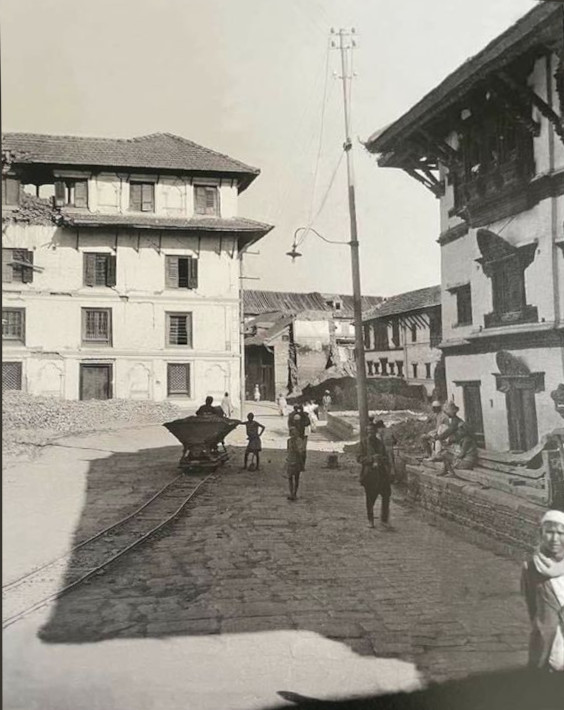
On both sides of the border, the two governments moved quickly, but they differed in how much of the recovery they were willing to run themselves. Eleonor Marcussen, a historian of South Asian disasters, has written a detailed account of the earthquake’s aftermath on both sides of the border and the contrast she draws is instructive. The colonial government in Bihar restored normal market prices for building materials within months. The reasoning was that stimulating ordinary trade mattered more than supplying cheaply. It left the market largely to function without any kind of state control over prices — this meant traders and relief societies competed to sell scarce bricks and timber at inflated prices because of shortages. Nepal took the opposite approach, fixing supply and price by government order. Marcussen identifies this contrast, state control against reliance on the market, as the clearest difference between how the two governments managed the same disaster.
Another example was how both state powers tackled congestion in the old city areas. Records in Nepal show that the state relocated eighteen households from the crowded Indrachok to Khichapokhari near the old palace. Seventeen were ordinary Newar families with no ties to the Rana clan. They were shopkeepers and residents of the old city rather than anyone with influence; one was Marwari. The state redistributed vacated land to these Newar and Marwari traders, in addition to civil servants and generals. Several of those families still trade cloth on the same street today.
Across the border, the British widened roads in Monghyr, Muzaffarpur and Darbhanga, the worst-hit towns of north Bihar. In Monghyr, bazaar roads of twenty to twenty-five feet became forty feet, and the main road became fifty feet wide. FC Temple, the colonel and engineer who ran the scheme, calculated that Monghyr’s bazaar held 47.4 families to the acre, against the ‘ideal’ figure of twelve. He argued that with the “whole civilised world” working toward slum removal, rebuilding the bazaar as it had been before the quake was not a serious option for a government that owned the land. The beneficiaries, as Marcussen shows, were largely the leaseholders, who were compensated with extra land for the tenants they would lose. The government told sub-tenants who actually lived and worked in the bazaar that it owed them nothing.
Rohit Ranjitkar, the Nepal Program Director of the Kathmandu Valley Preservation Trust, directed much of the organisation’s work after the 2015 quake. As part of his research into previous restoration work in the Valley, he interviewed Dilli Jung Thapa, 93, the engineer who had overseen much of the original rebuilding after the 1934 disaster. Thapa told Ranjitkar that the state set strict timeframes by which work had to be completed on structures. Restoring temples to their exact pre-1934 appearance was never really possible with the paucity of both time and building materials. So materials from peripheral temples went toward finishing priority buildings faster. The pattern shows up across all three cities of the Valley. Struts in Kathmandu’s Narayan temple, east of Kaal Bhairav, turn out on closer inspection to have come from other temples nearby. The same is true of Patan’s Taleju Temple and the wings of Sundari Chok.
One case crossed city lines entirely. Bhaktapur’s Chyasalin Mandap collapsed nine hours after the earthquake. Workers carried thirty-two of its roof struts, carved with scenes of Krishna, to Kathmandu and used them to build the New Road Gate, which still stands at the entrance to New Road. Restorers working there decades later, post-2015, and lacking the original designs, rebuilt the roof in plain, undecorated timber rather than copy a template that had been looted.
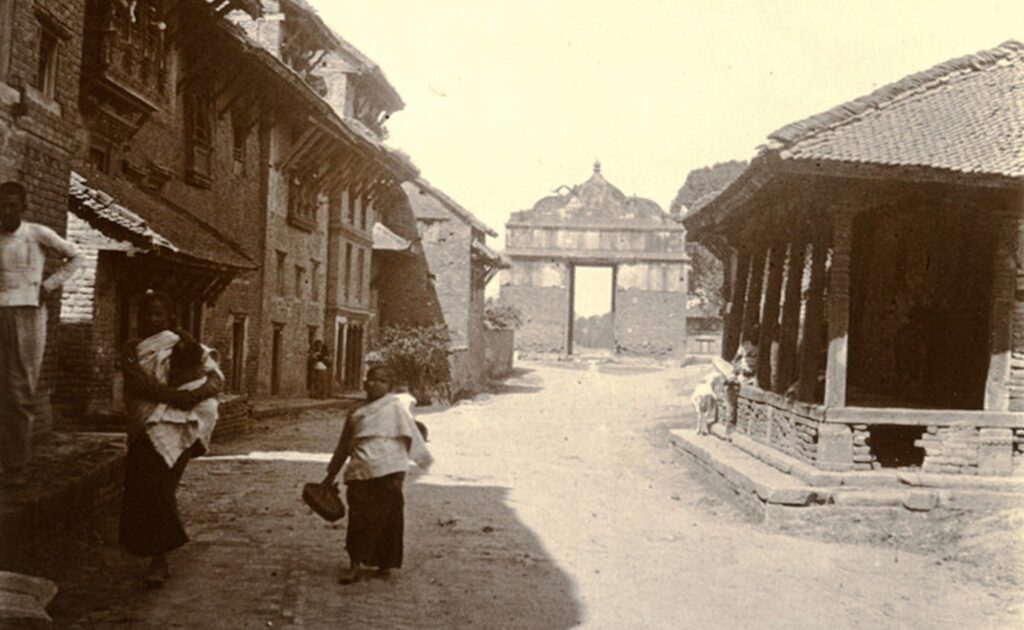
A state willing to strip a rival city’s temple to finish the gate of its own new street showed that speed, not style, drove reconstruction efforts in Nepal. The emphasis was placing whatever could be assembled fastest in priority, highly-visible areas at the heart of Kathmandu city over peripheral territories. Therefore, existing monuments near the seat of power were rebuilt first. For instance, at Sundhara, near the palace and the Tundikhel parade ground, the nine-storey tower commissioned by Bhimsen Thapa (Nepal’s erstwhile prime minister), almost a century earlier for Queen Lalit Tripura Sundari, collapsed partially in the earthquake. Juddha Shumsher’s government restored it promptly and without perceivable alterations.
Modernity and Rana-era Architecture
Architecture carried immense symbolic importance for the Ranas because of the peculiar nature of their rule. Since they held office without ‘divine sanction’ or royal rights over the kingdom of Nepal, unlike the Shah kings, they had to find other ways to validate their rule, particularly to the British across the border. In their diplomatic dealings and foreign policy overtures, they had to sell the appearance of a modern, competently-run state and Kathmandu as the seat of that state.
Katharina Weiler, an art historian who has written the only sustained study of Newar neoclassical residences, argues that for the Rana rulers, European-style buildings represented modernity. By introducing Western neoclassical architecture to the city, they created the “visual articulation of their political power.” The whitewashed Rana palaces with their grand porticos distanced them from ordinary residents of Kathmandu Valley for whom the brick-lined, Newari-style homes was the default architectural style. Even though the Rana family rejected colonial political authority, they absorbed colonial building materials for these new structures in the city — from imported lime mortar and stucco to cast iron shipped from Glasgow and Calcutta. Chandra Shumsher, one of Jung Bahadur’s many nephews, built Gaddi Baithak in 1908, a white neoclassical hall raised inside Kathmandu’s own royal square, among its Newar pagodas, specifically to receive British officials.
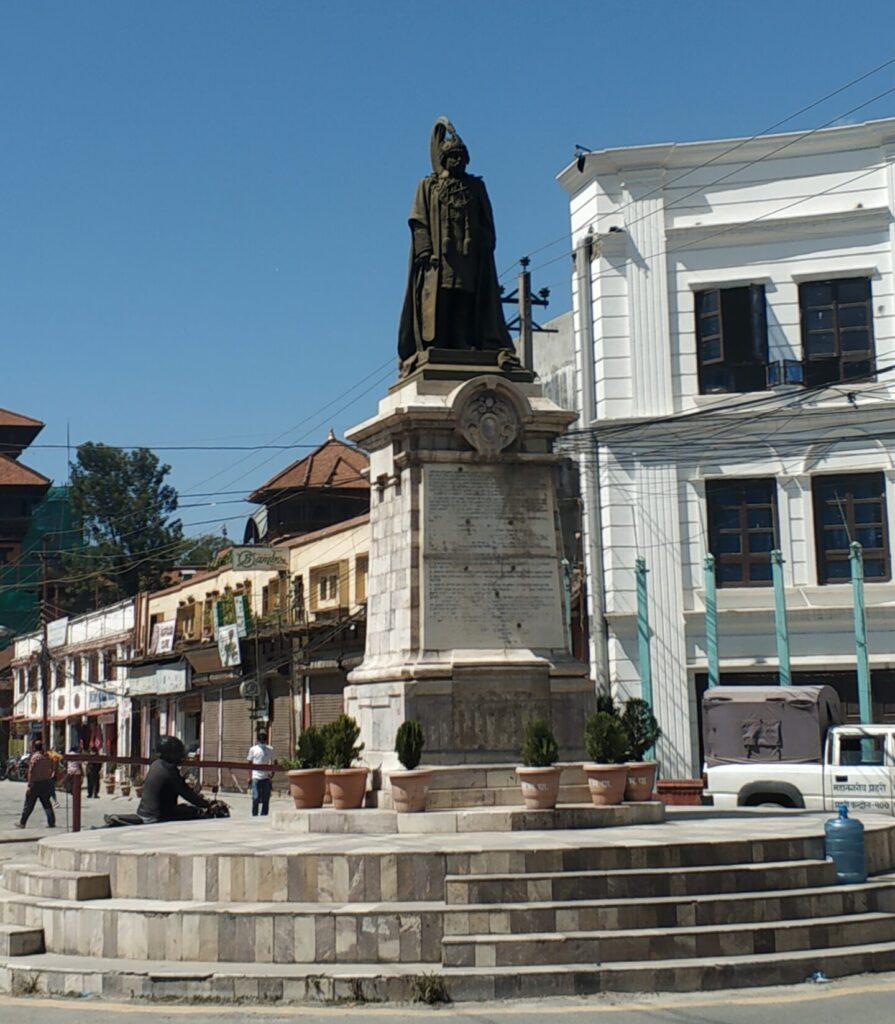
Juddha Shumsher would use the 1934 reconstruction efforts to further reshape the heart of old Kathmandu using European-style layouts, buildings, and facades. To start with, he would commission a boulevard — this plan included building a broad avenue east from the parade ground at Tundikhel towards the old royal palace at Basantapur, and ending at a crossroads where three more streets met it. The avenue took his name — Juddha Sadak — with a statue of him, visible down all four approaches, at its western end.
Along the new street, the state assembled the institutions of modern capital in quick succession. These included the offices of Gorkhapatra, the headquarters of Nepal Bank Limited, the country’s first fire brigade, and Jana Sewa Hall, Nepal’s first cinema. The state prescribed the frontages itself, calling for white-plastered walls, three storeys, and a common parapet. Drawing on a 1971 aerial survey of the area, architectural historians Niels Gutschow and Hermann Kreutzmann, in their book Mapping the Kathmandu Valley with Aerial Photographs by Erwin Schneider, describe these new buildings, folded into the reconstruction of the old city, as the arrival of a “self-conscious urban modernity.”
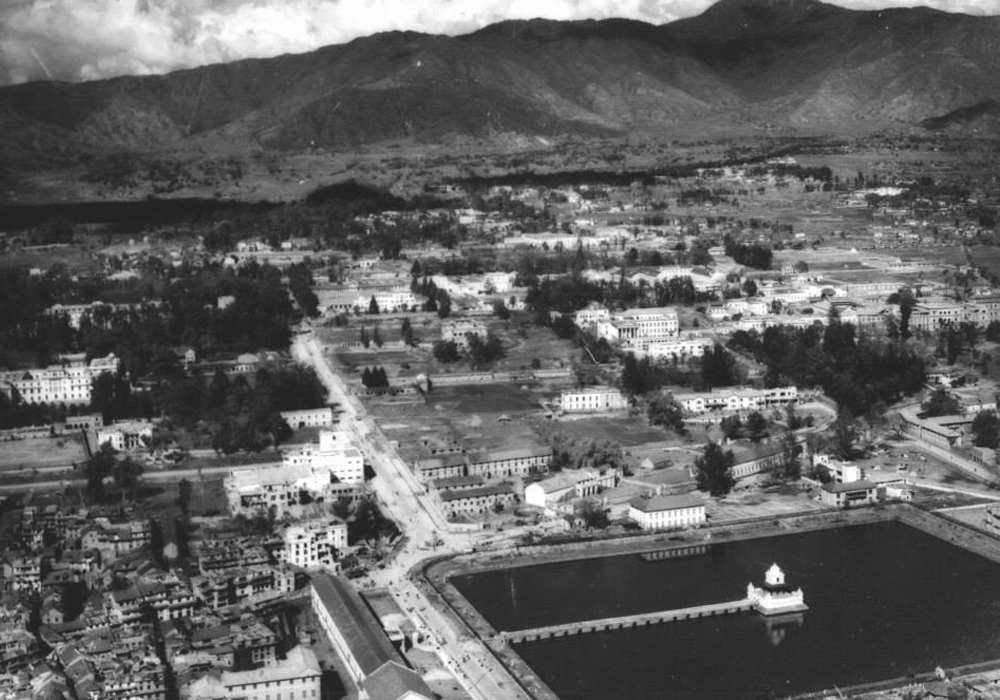
To build a new street complete with bank, fire brigade, cinema and boulevard, with a ‘modern’, whitewashed facade was a show of power that demonstrated that the Ranas had accumulated enough authority to rule the state and bring it into the modern era.
Reconstruction Styles
The 1934 reconstruction drew on an architectural vocabulary the Valley had built up over centuries, largely under two regimes: the Malla kings and, later, the Ranas. The Mallas ruled from the thirteenth century until 1769, presiding over a prosperous Newar civilisation linked by trade to Tibet and northern India. Their legacy still defines the Valley: red-brick walls, carved timber windows and struts, stone and wood sculpture, and temples that blend Hindu and Buddhist traditions. Tiered, pagoda-roofed temples dominate, with stone shikharas among them. The Shah kings who followed largely kept to this Newar idiom, building on a grander scale, with more storeys and larger doors and windows, and with touches of Mughal influence.
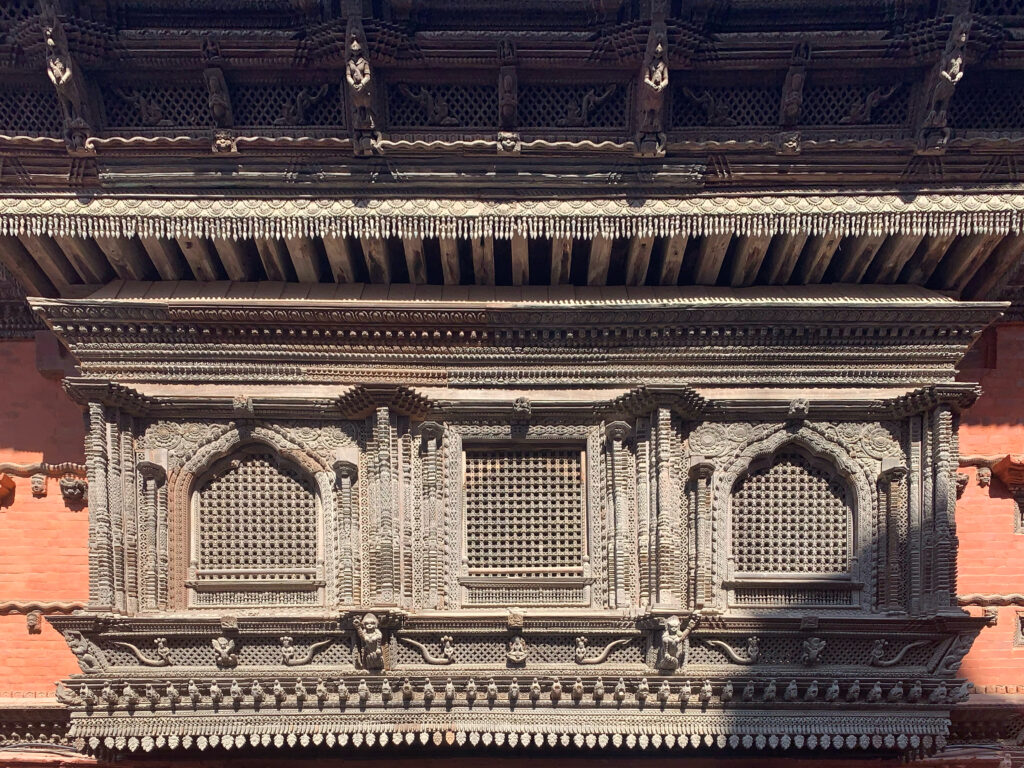
The next wave of state-funded building was under the Ranas. Through the nineteenth century, domed temples in the gumbaz style became the signature idiom of Rana patronage in the city’s architectural landscape. They clustered specifically along the Bagmati river, south of the old city, where rulers and senior officials built them in preference to older Malla forms. Jung Bahadur’s own contribution to that riverside programme was the Kalmochan temple at Thapathali (officially known as the Janga Hiranya Hemnarayan Mandir), built in the Mughal-influenced style he favoured and dedicated to the Hindu deity Vishnu. He is said to have built it seeking release from the guilt of the bloody coup d’état that brought him to power. By then he had already rebuilt Rani Pokhari’s temple using the same gumbaz architectural style.
Gutschow has argued that this riverside programme in stucco was meant to replicate the appearance of the sacred city of Kashi (now Varanasi) and influenced, more broadly, by the elite architectural stylings of Indo-Islamic courts south of Nepal. The second import during the Rana period came from further west — namely the European architectural elements.
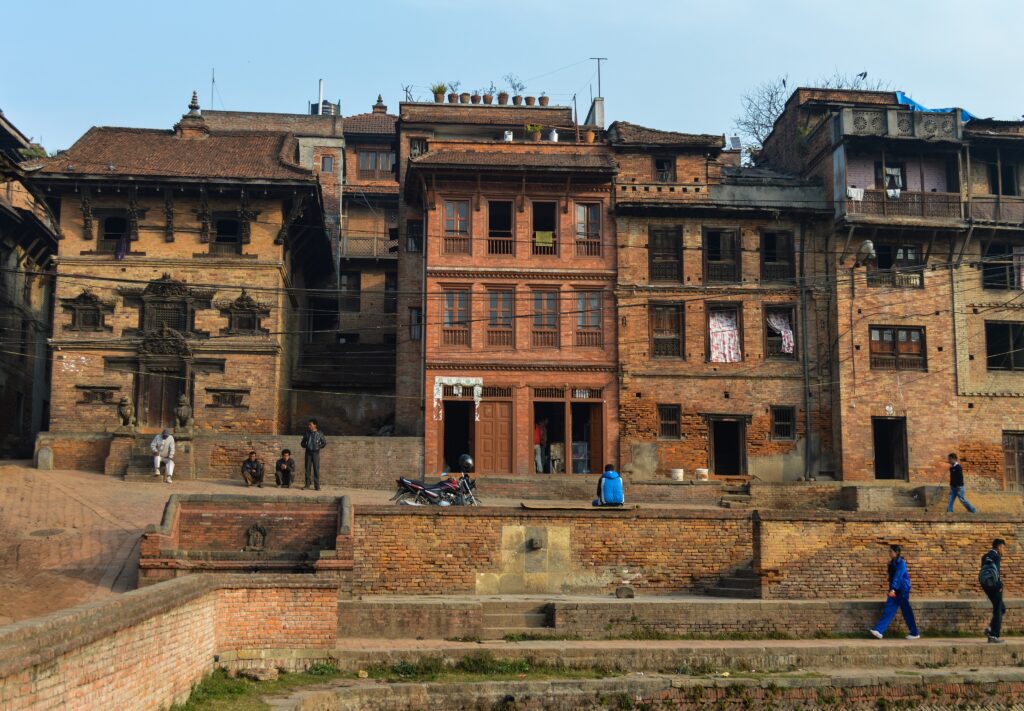
Newar urban architecture across the Valley stood in sharp contrast to the European neoclassical residences and the buildings that represented the state’s power and the gumbaz-style, domed temples. Newari-style homes and temples represented a culture built by its indigenous inhabitants over centuries. Robert Levy, an American anthropologist who conducted fieldwork in Bhaktapur in the 1970s, describes the Valley’s urban landscape in his book, Mesocosm, as an interlocking world, running from household to lineage, from neighbourhood to city. Houses within a tol (residential quarter) shared walls, courtyards and drainage. Traditionally, there had been no requirements for formal divisions because the residents already knew how the space was shared. But this informal ‘understanding’ posed problems during the 1934 reconstruction.
The state archives, for instance, records the case of Hiradevi, forty-five years old and from the Phasikeva quarter in Kathmandu, who had petitioned the state’s relief organisation over a dispute with her neighbour. Government engineers had drawn a map of her home and her neighbours that shared a wall. However, in the original building, she explained in her petition, there were actually two walls of different thickness. Her beams and her neighbour’s rafters ran through each other at different floors. A shared roof beam rested on a post that the engineer’s map had placed on the wrong storey. As a result, she had to cover a section of drainage with her own roof to keep her neighbour’s water off her timbers. The survey also recorded her neighbour’s doorway as a cupboard. This was because the original house had been raised by one man. But his heirs had since sold off separate sections to separate buyers who had closed doorways or built walls where none existed. The reconstruction however demanded clean categories — of house, wall, roof, drain. But these were categories that the organisation of the old city had never required — they became relevant only during the Rana-era reconstruction work.
Rani Pokhari’s 2015 Restoration Debate
The clash of styles, from the Malla period and the Rana period, became a significant point of debate again decades later, after the 2015 earthquake, and Rani Pokhari’s dome was not the only place this argument surfaced. In Patan, the earthquake of 1934 had flattened the Bhaidega Temple, which was then rebuilt with a Mughal-style stucco dome, the Rana’s preferred style for temple roofs. That dome stood for eighty years, until the 2015 earthquake brought it down again.
Restorers would rebuild the temple — but they reverted to its Malla-era form. They worked from a set of 1930s-era photographs in a private German collection and an 1853 watercolour of the temple’s woodwork by Henry Ambrose Oldfield, held in the British Museum. The original carved struts and pillars, discovered still sitting in the Patan Museum’s storeroom, filled in the rest.
At the Taleju temple in the same square, the team that restored the tiled cupola did not simply repair the new damage. By their own account, they corrected what they judged a faulty reconstruction from 1934. These are just two examples where the 2015 earthquake reconstruction became the occasion to undo what was done during the rebuilding phase under the Ranas after the 1934 earthquake.
In Rani Pokhari’s case, the Tiwari-led committee followed the same logic and recommended returning to the original spire design for the Bal Gopaleswor Temple. Tiwari’s essay, Material Authenticity and Conservation Traditions in Nepal, presents the broader argument behind this decision — Nepali building traditions treat periodic rebuilding as the norm rather than an exception, and authenticity in this framework is not fixed to a single point of construction. Replacing a weathered window with a freshly carved one constitutes continuity, not loss. By Tiwari’s account, no layer of Kathmandu’s history, as preserved in its monuments — from their construction and reconstruction to their most recent restoration — is more original than the other.
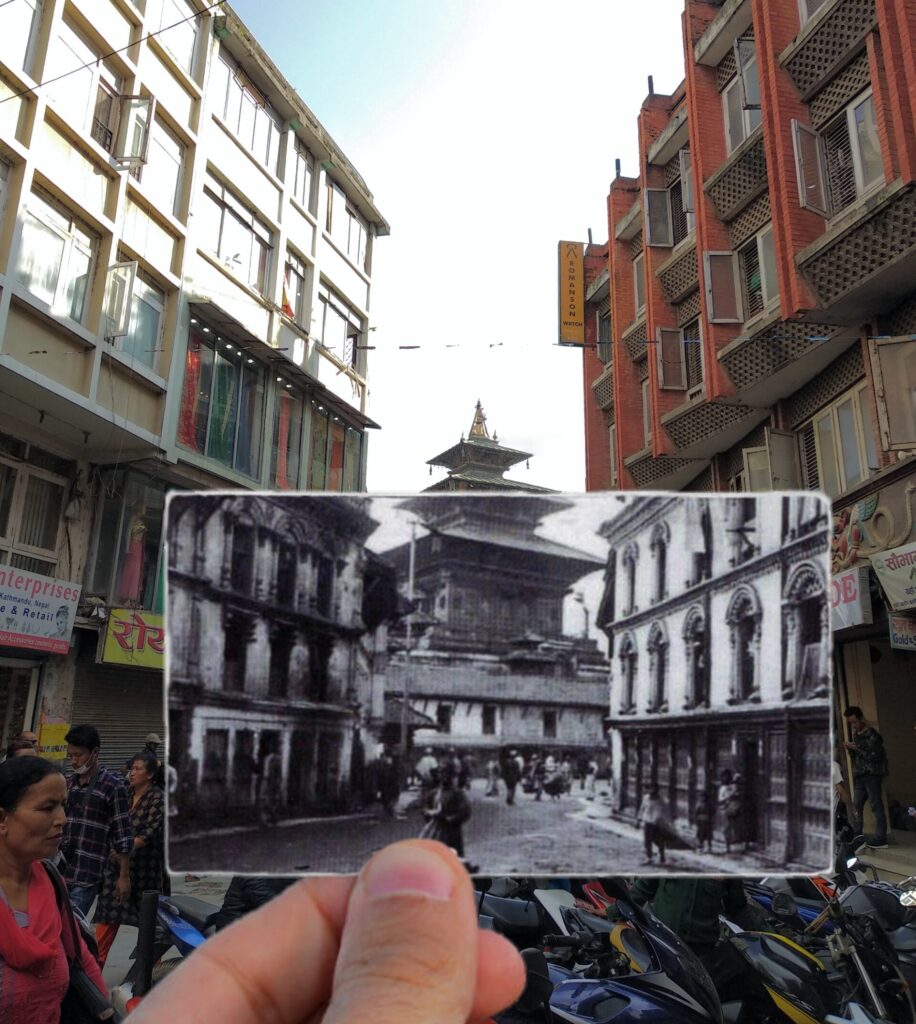
Rather than the conservation standard that privileges a fixed point of origin and a linear reckoning of time, the 2015 restoration work derives instead from romantic historicism as applied to building culture. Therefore, it was not organised around a single ‘authentic’ moment in history.
Removing the dome in 2020 had the same fundamental raison d’être of the 1934-reconstruction — only this time it established the authority of ordinary citizens of Nepal in its modern, democratic era. The dome went up as a decision taken under Rana rule, and its absence today reflects a different one. A committee of heritage professionals, not a hereditary prime minister, decided what the temple should look like. Nepal has moved through a Rana oligarchy, a Shah monarchy, a Maoist insurgency, and a federal republic since Juddha Shumsher’s reconstruction. Each of those transitions has been legible, in part, through what the state chose to build or tear down. Rani Pokhari’s spire is the latest instance of that pattern.
First published: October 23, 2026