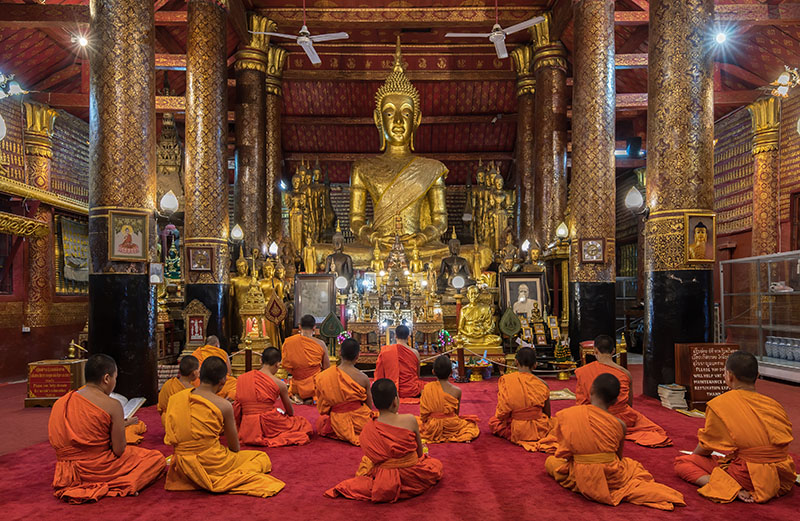
Religion originating around the fifth century BCE in the Magadha and Kosala regions of northeastern India, founded by Siddhartha Gautama, the historical figure known as the Buddha. During his lifetime, the Buddha established a religious community of renunciants and laypersons; in the centuries after his death, his work and teachings were developed by his disciples into the doctrine that came to be known as Buddhism. Buddhism emerged in a religious context dominated by Brahmanism, whose tenets — including caste, karma, and ritual sacrifice — it subverted or appropriated. It was part of the heterodox, non-Vedic renunciant Shramana tradition, along with Jainism and sects such as the Ajivika, with likely older roots. By the third century BCE, Buddhism had attracted members of the social and political elite, notably the Maurya king Ashoka, whose pillar edicts are the earliest texts that attest to Buddhist practice and teachings. Three scriptures known as the Pali canon, transmitted orally before being written down in the first century BCE in Sri Lanka, comprise the earliest extant Buddhist scriptures. In the ancient period, Buddhist monuments such as the stupas at Sanchi and Bharhut were built and monasteries established, often patronised by wealthy elites who sought to challenge Brahmanical influence. By the first centuries of the common era, Buddhism began to spread towards Central and East Asia via the Silk Road — with Gandhara being a significant northwestern stronghold — and towards Southeast Asia via maritime trade routes.
Though there is wide variation in belief and practice across Buddhist sects due to Buddhism’s historical adaptation to local religions and cultural influences, core Buddhist teachings centre on the Four Noble Truths: dissatisfaction or suffering; its causative origins in desire or attachment; the possibility of its cessation (nirodha, leading to nibbana or nirvana); and the path towards nirvana, known as the Eightfold Path. The application of the term ‘religion’ to Buddhist doctrine has been debated because it rejects the idea of an eternal substance or godhead. Around the fourth century BCE, an ideological split in the Buddhist community or sangha laid the ground for the development of two major sects: Theravada (‘way of the elders’) and Mahayana (‘greater vehicle’); and later the Vajrayana (‘Diamond Vehicle’) offshoot from the latter, with the influence of Tantric thought, in northeastern India and Tibet. In China, the influence of Taoism led to the development of Zen and Pure Land Buddhism. Following the collapse of the Pala dynasty in the twelfth century, Buddhism declined sharply in India, experiencing a revival only in the nineteenth and twentieth century. Buddhist teachings continued to be developed and disseminated in other parts of South, East and Southeast Asia; today, it is the majority religion of Sri Lanka, Myanmar, Bhutan, Cambodia, Thailand, Laos and Mongolia.