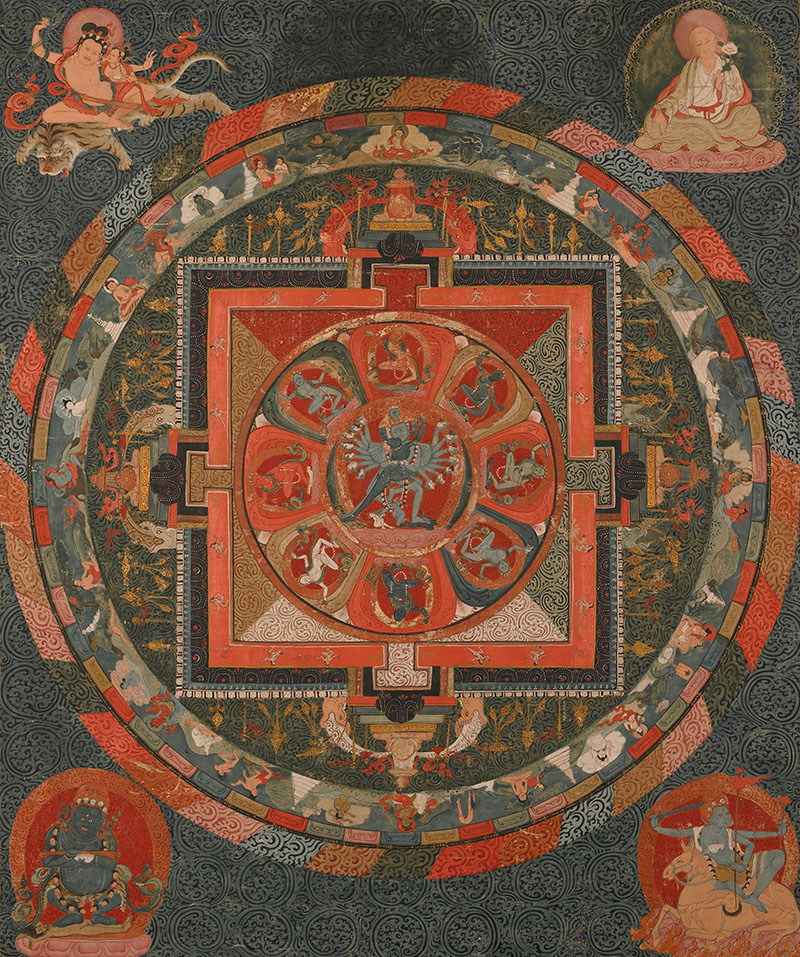
Heterodox spiritual doctrine and body of knowledge that originated around the sixth and seventh centuries CE in the Indian subcontinent, largely in Kashmir and Nepal, but also in Bengal and Assam, later spreading further south. The basic premise of Tantra is the body’s divinity and the senses as means to spiritual bliss. Some key features of Tantric ritual include the use of mantras (sacred chants), mandalas (symbolic geometrical drawings), and mudras (hand gestures). Tantra developed out of non-Vedic cultures, drawing much of its material from earlier Shaivism, though Tantric sects emerged in Vaishnavism, Buddhism and Jainism too. Important Tantric deities include Bhairava and Kali. There is huge variation in belief and practice across Tantric sects. Despite many of these sects being historically at odds with elite forms of Brahmanism, Tantrism has been enormously influential in mainstream Hinduism as it is practised today; its followers are known as Tantrikas. The term tantra is Sanskrit for loom or warp.
More Definitions
Anandatandava
Meaning “dance of bliss,” it is a cosmic dance performed by the Hindu deity, Shiva, in his Nataraja form.
Bhagavad Gita
Section of the Sanskrit epic Mahabharata, composed as a dialogue between the Pandava prince Arjuna and his charioteer and companion…
Gajasamhara
A form of Shiva as a samharamurti (destructive aspect), which shows him vanquishing the elephant-demon Gajasura. In the iconographic depiction,…
Jaya
In Hindu religious mythology, he is an attendant of the deity Vishnu. Along with Vijaya, he is a dvarapala or…
Amar Chitra Katha
A series of Indian comics begun in 1967 by Anant Pai, based on religious mythology, legends, folktales and biographies of…
Atisha
Atisa Dipankara Srijnana (b. 982; d. 1054) was a religious leader and master who is considered a major figure in…
Mahayogi
An epithet for the Hindu god Shiva where he is represented as an ascetic, sitting with his legs crossed and…
Chakravartin
A title referring to an ideal ruler in Buddhist, Jain and Hindu traditions and often used for the Mauryan emperor…