Rajarajeshvaram Temple: Chola Ambitions in Stone
An exploration of an outstanding example of the Dravida temple architecture style, co-developed with author and historian Anirudh Kanisetti as part of a Research Grant awarded by Impart.
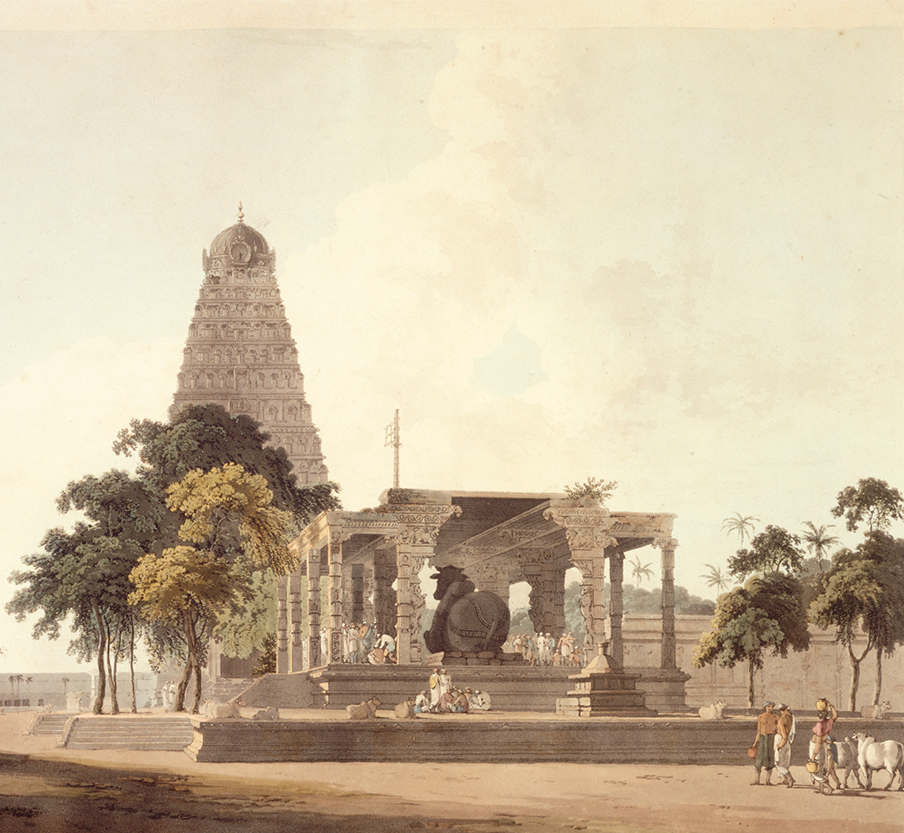
The Great Bull, an Hindoo Idol, at Tanjore (detail); Thomas Daniell; 1798; Coloured aquatint print; 54.6 x 74.7 cm. British Library P957
The Rajarajeshvaram Temple at Thanjavur in Tamil Nadu, also known as the Brihadishwara Temple, towers over its surrounding landscape — its central spire reaches 66 metres into the sky.
When it was commissioned by the king Rajaraja Chola I in the early eleventh century, the temple surpassed most other tall structures in the world — from the Iron Pagoda in Kaifeng, China, at 55 metres to the spiral minaret of the Great Mosque of Samarra in Iraq that petered off at about 52 metres.
Even the legendary Leaning Tower of Pisa, whose construction began in 1173 CE, reached a height of only 56 metres when it was completed in the fourteenth century.
It is still by far the tallest structure in the region.
Due to its scale and grandeur, the Rajarajeshvaram is often celebrated as an iconic example of a Dravida temple — the temple architecture style prevalent in Southern parts of the subcontinent and one of three styles that dominates the Indian landscape.
The other two are the Nagara style temples of North India and the Karnata Dravida style that developed in the Deccan — especially in present-day Karnataka — drawing freely from the architectural styles of various regions.
The earliest temples in South India were modest brick and wood shrines that have since vanished. We find echoes of their existence in scant archaeological remains, written records like the Sangam era texts (c. 100 BCE–250 CE), and inscriptions on stone temples rebuilt on the same grounds between the ninth and tenth century.
Architectural details like ornamentation, joineries and fastenings that mimic the earlier brick-and-timber construction can also be found in cave-temples, such as the sixth century complex at Badami, built under the patronage of the Chalukya rulers of Badami (sixth to twelfth century).
Over time, cave-temples gave way to freestanding structures, as we see in the seventh century monolithic rock-cut temples at Mamallapuram. These were constructed by the Pallava rulers of Tondainadu – present-day parts of northern Tamil Nadu and southern Andhra Pradesh.
From then on, we see successive architectural leaps in craftsmanship, complexity, and overall design.
Over the centuries, the Dravida architectural style has become synonymous with sprawling, distinctive walled temple complexes that house multiple shrines, pillared halls, or mandapas, sacred water tanks, distinctive sky-high, tiered gateways, or gopurams, and pyramidal spires, or vimanas above the central shrine.
Across southern India, temples display some local variance, but collectively, they share distinct architectural elements.
Scholars debate exactly how the congruence in architectural elements was transmitted across the centuries. While most construction-knowledge appears to have been transmitted orally rather than through formal scriptures, the architects or sthapatis were also closely connected to courtly theoreticians who compiled the Shilpashastra texts such as the Mayamatam, Manasara, and Brihat Samhita.
Although these texts have standardised instructions about the layout, measurements, proportions, orientation, iconography, and ritual practices to be followed in temples, the Shilpa shastras also contain the first textual mentions of the terms ‘Nagara’ and ‘Dravida’, suggesting that the classification of temples based on typology came after these styles had already coalesced.
The word Dravida derives from ‘Dravida-desha’ — an ancient Sanskrit term referring to the southern part of the Indian subcontinent, which is dotted with temple ruins, and temples that remain in use even today.
The most imposing examples of Dravida temples were commissioned to reflect the imperial aspirations of powerful patrons. As such, they also display the dominant religious, cultural, and sociopolitical regimes of their time.
The Chola dynasty (c. ninth – thirteenth century) came after the Pallavas (c. seventh – ninth century) and developed a variant of Dravida architecture local to the Kaveri floodplain, with an eye to the prestigious temple designs of the former Pallava dominions.
By integrating elements like the mandapa, shrine, and a tiered vimana crowned with an octagonal ribbed dome into a unified temple complex, the Pallavas had established a royal architectural grammar for the Cholas to adopt.
Building on this foundation, the Cholas introduced significant innovations, elevating temple architecture to a grandeur previously unseen in South India.
The Rajarajeshvaram temple, like other temples built during this period, was designed to support the Chola state apparatus, but at an unprecedented scale. It was intended to link king and god through its rituals and icons. It also functioned as a courtly social space, integrating Chola-linked communities, collectives and castes into a single sacred complex.
The core of the complex was built within a single decade, marrying the best and latest innovations in temple architecture of that period.
Once located near the royal palace grounds, everything about the temple was outsized in both conception and execution. Consider this — the main temple spire, or vimana, used 130,000 tonnes of granite, all floated upriver from 45 kms away.
Rajaraja brought in architects from Vengi and Tondai-Nadu, present-day Godavari-Krishna river delta of Andhra Pradesh, and northern Tamil Nadu). The design departed from the standard Dravida vocabulary at places, to suggest a deliberately transregional design, drawing on architectural elements from across Chola‐conquered territories. Such innovations appear to have been introduced solely for the patron’s political requirements.
The extent of resources used, the interaction between regional styles, and the vast scale of the temple reflects the scale of the Chola imperial formation dynasty under Rajaraja I.
It continued to attract patronage from the later rulers of Thanjavur, such as the Nayakas and Marathas. Even now, visitors can spend hours exploring their subsidiary buildings and structures around the main temple.
An aerial view of the complex reveals that it has three boundary walls or prakaras — two later outer fortifications and one inner, enclosing wall around the central temple area.
The outermost wall is the newest — a colonial-era addition from the late eighteenth century, complete with bastions and gun-holes.
The next line of defence is a Maratha period rampart – a structure built to replace the crumbling prakara that had been part of Rajaraja’s original blueprint for the Rajarajeshvaram temple.
Like most Hindu temples, the Rajarajeshvaram is approached from the east and arranged along the east-west axis. A visitor moving towards the temple enters through a small brick and mortar gateway – a Maratha-era (late seventeenth-early eighteenth century) addition – to arrive at the compound.
Just within the compound stand the two successive monumental gopurams.
Heavily ornamented with sculptures depicting gods and scenes from mythologies, as well as minor shrines in hollowed niches, the Rajarajeshvaram’s gopurams also reflected the systematic linking of the temple, the state and the king.
The first one, the five-storeyed Keralantakan gopuram, was built to commemorate Rajaraja’s victory over the Cheras of Kerala in the early 11th century. Keralantaka, “Kerala-Destroyer”, was one of Rajaraja’s titles, and was also borne by a Chola administrative district.
The next entrance is three-storeyed Rajarajan gopuram, guarded by two large monolithic dvarapalas – protective sculptures, placed on either side of the entranceway. Thought to be the divine guardians of the temple itself, they look suitably intimidating.
While dvarapalas are a key feature of nearly all Dravida temples, they also flank doorways in Buddhist, Jain and other Hindu temples.
This second Rajarajan gopuram serves as a sculptural amuse-bouche before visitors step into the central complex. Even more intricately ornamented than the first Keralantakan gopuram, the lower tiers of the Rajarajan gopuram are crowded with carvings illustrating Puranic and Saivaite legends. The gateway is topped by a shala-type pavilion (a rectangular structure with a barrel-vaulted roof) with five stupis (decorative finials).
At the Rajarajeshvaram, the gopurams are significantly taller than those of older temples. But they still adhere to a clear spatial hierarchy that becomes apparent as you pass through the gopurams towards the towering vimana — the tallest and grandest structure of the complex.
However, on approaching many Dravida temples today, the tallest structure seems to be the gopuram gateway, and not the central spire. This is because, during the Vijayanagara (thirteenth – sixteenth century) and Nayaka (fifteenth – seventeenth century) eras, a reversed hierarchy was established, with elaborate gopurams towering over the temple spires.
Through the addition of such ‘amplified’ gopurams, adorned with carvings denoting religious and political influence, the ruling dynasties of later eras communicated political continuity with previous dynasties that contributed to the construction of these temples.
After passing under the gopurams, a temple visitor finally approaches the temple’s courtyard enclosed by the innermost wall, also known as the Krishnan Raman wall, named after Rajaraja Chola’s Brahmin minister who built it.
Attached to the wall’s inner side is a covered walkway that encircles the main temple complex and allows devotees to circumambulate it, an act known as pradakshina. Devotees move in a clock-wise direction, while offering their prayers, to connect with the deity’s presence — a ritual walk that is also practised in Buddhism and Jainism.
At the four corners of the Krishnan Raman wall, and at the mid-points of each of the remaining three cardinal directions, are double-storeyed shrines dedicated to the ashtadikpalas — holy guardians of the eight directions. The shrines at the mid-points of these walls also serve as smaller gateways to the complex, and seem to have been inspired by Pallava royal antecedents.
The northern entrance was most likely used by royalty, as it was the closest to the palace that was once situated north of the complex.
The temple’s courtyard also houses a number of structures and shrines, built to serve a range of ritual, communal and socio-political purposes over time.
These structures, which were built at different times, reveal a complex intertwining of both religiosity and power play of the patrons who funded their construction.
The most noticeable structure is an open, pillared pavilion that houses a 12-foot-high monolithic statue of Nandi, Shiva’s mount. It has its back to the viewer, and its face is pointed toward the deity, and the main shrine, demonstrating a single-point focus on the deity that it models for pilgrims visiting the temple.
The Nandi itself sits on a base that is dated to the Chola period, however, its pillared mandapa with a richly painted ceiling was added in the sixteenth-seventeenth century, reflecting continued patronage by the successive ruling dynasties of Thanjavur. This pillared hall is named the ‘Nandi-mandapam’.
Past this mandapam, is the main temple. Standing on an upapitham, or pedestal, with a moulded base over six feet high, the temple appears significantly raised from the ground-level.
This base is covered in inscriptions on land grants, donations, loans, festivals, and rituals. The detailed nature of these records indicate that the temple functioned as much as an administrative hub as a cultural and ritual one. Inscriptions suggest the temple distributed Chola revenues both from agriculture and war, to bind communities to the king through participation in the temple-economy.
Two bands of leonine vyala or fantastical composite animals encircle the base, serving as a decorative as well as protective feature, much like the gopuram’s dvarpalas.
Visitors today enter the temple through an east-facing, wide staircase that winds through a succession of pillared spaces – the mandapas.
At the very top of the stairs is a small pillared portico. This is the mukha-mandapa, serving as a porch area that leads to the inner parts of the temple. The pillars, roof and the stairs of this mandapa are all later additions, built during the Nayaka era.
Through the pillared portico lies the maha-mandapa, a Chola-period hall that predates the mukhamandapa. It can also be approached from two flights of stairs on either side, on the north and south. It is likely that these stairs were once the original entryways to the main temple.
Two towering dvarapalas stand at the top of each of these north and south staircases, guarding the entrance to the mahamandapa.
From inside the mandapa is a long hall, with two rows of ten pillars placed on raised platforms on each side. The pillars visible today are Nayaka-period additions. The space historically hosted religious gatherings, cultural performances and rituals.
From the maha-mandapa, one moves further inward towards another pillared space, known as the ardha-mandapa, with two more dvarapalas guarding its entrance.
This space has six rows of six carved pillars each.
Whilst the present roof on the ardha-mandapa makes it a single-storeyed structure, originally this was intended as a tiered, three-storeyed space. The upper storeys were not completed and seem to have collapsed at an unclear date. Only the four bull figures placed in the four corners demarcate the space where these levels once existed.
Beyond the ardha-mandapa lies a narrow, three-storeyed pillared passage that connects the mandapas to the main shrine. To set the main shrine–crowned by the vimana–apart as a distinct sacred space, separate from the worshippers’ realm–mandapas, this shallow recess was created in a slightly thinned out wall. This recessed link is known as a ‘false antarala’ or niskramana mandapa.
The topmost storey or the third tala of the niskramana mandapa acts simply as a bridge connecting the larger mandapas to the main shrine. The second tala is connected to the main temple spire. Neither of these two levels are accessible to the public.
The ground floor of this mandapa, shaped like a crossroad of sorts, connects the main shrine to the ardhamandapa in the east and two entry-ways on the north and south that wind through heavily ornamented, double flights of steps guarded by huge dwarapalas on either sides of the gates.
The southern gate is known to have been used by Rajendra Chola I, based on an inscription that still exists over the doorway.
The parapet along the southern staircase that Rajendra Chola I must have climbed on his way to the main shrine is covered in engravings of the Buddha under a pipal tree, surrounded by apparently-royal devotees.
While this could be read as Rajaraja Chola’s tolerance for other religions, it is more likely a nod to the Tripurantaka tale where Vishnu as Buddha tries to convert Shaiva asuras so that it is easier for Shiva to destroy them.
Only after stepping through the niskramana mandapa, does the sanctum sanctorum — the inner core of the temple — reveal itself to a visitor. This passage is once again presided over by yet another set of massive dvarapalas.
The sanctum sanctorum, which is centred underneath its main spire or vimana has a massive 100 sq ft square-base and is called the garbhagriha. This section is constructed in what is known as the kadalika-karana method, where the core is a tall hollow of reducing width. And it is surrounded by two storeys of circumambulatory paths encircling the core.
The core houses the deity — a huge monolithic Shiva linga. Only male priests are allowed to enter this space.
The ground floor walls of the circumambulatory path were once covered in frescoes depicting Rajaraja, as well as scenes from the Tripurantaka legend and Tamil Shaivite tales, integrating the Cholas into these older traditions.
But they were painted over by Nayaka era-murals. This fact was only re-discovered in 1931 when a peeling layer of paint revealed part of the underlying fresco. Since then multiple preservation, restoration and documentation efforts have been undertaken by the Archaeological Survey of India to protect and study these paintings.
Tripurantaka is believed to be the personal deity of Rajaraja Chola. Scholars suggest that the generous use of the imagery and legend of Tripurantaka across the temple complex was a conscious artistic choice made to consolidate Rajaraja’s image as a conqueror and reinforce his divine legitimacy.
Carvings of dancers demonstrating karanas from the Natyashastras decorate the second storey of the circumambulatory path. This is the first instance of these poses being carved on a Chola temple, with similar depictions appearing in later temples as well.
On the outer side, the main temple spire, or vimana, begins with two storeys of straight walls that encase the garbhagriha. From the third storey, these walls begin to taper upwards, narrowing to form the distinctive pyramidal shape.
Multiple intricately carved stone sculptures of Shiva in various manifestations, including as Dakshinamurti, Chandrashekarar, Nataraja, Pasupatamurti, and Ardhanarishwara are installed in niches or panjaras on the first tier of this wall, on all four outer-sides.
The sculptures in the niches on the second tier of the vimana walls are of Shiva as Tripurantaka, the conqueror. As mentioned earlier, this form of Shiva is given special focus, carved repeatedly and in different poses.
From the third storey onwards, the walls begin to form a towering structure of thirteen storeys. Every one of these stories is adorned with miniature shrine-like niches, in varying shapes — shalas with a wagon-vault roof, square alcoves and horseshoe-shaped arches.
Owing to the then-unprecedented proportions of the vimana, the number of these shrines per tier is irregular, whereas they would typically reduce regularly in number. This same pattern is repeated on all four faces of the vimana on the outside.
Inscriptions suggest the entire shikhara may once have been plated in gold. While often considered a monolithic unit weighing 80-tonn, the shikhara is in fact composed of eight massive interlocking pieces. Nandis in pairs adorn the four corners of this granite base.
In the wider courtyard surrounding this main temple, earlier there were smaller-shrines for eight parivara-devatas around the main shrine in the courtyard. Of these only the Chandesvarar shrine’s original structure, situated north of and close to the vimana, facing the sanctum, still remains.
Subshrines like those of Brihannayaki, added by the Pandyans in the thirteenth century and Subrahmanya, added by the Nayakas between the sixteenth and seventeenth century, reflect the temple’s continued importance in the political and ritual landscape.
However, during the Chola reign, few among the subsequent Chola rulers preferred to add on to the Rajarajeshvaram. Instead, they went on to build their own great temples, such as the Gangaikondacholeshvaram, and the Darasuram Airavateshvaram.
Many Dravida temples include a temple tank or pushkarini, integral to ritual purification. The Rajarajeshvaram shrine also had one, outside its north-western wall, but it no longer survives.
Madurai’s Meenakshi Temple’s tank is a famous surviving example of such temple tanks.
As a political, and religious epicenter, Rajarajeshvaram temple functioned as an economic, educational, and performance hub, employing hundreds of dancers, musicians, priests, servants and record-keepers. The temple is testament to how Dravida temples did not just transform structurally over the centuries but also evolved functionally, from sacred sites of ritual practice to royal political, cultural and socio-economic hubs.
It was intended as the core of the city of Thanjavur and the wider Chola empire, which by the 11th century controlled much of South India, parts of Sri Lanka, and extended to Burma, the Malay Archipelago, Cambodia, and Indonesia. Throughout these imperial expeditions, the empire’s grandeur and imperial prowess were reinforced through temple-building as a means to consolidate Chola-rule.
Produced by the research team at Impart, in consultation with historian Anirudh Kanisetti, this Journey builds on a Research Grant awarded to him by Impart in 2024 towards the development of his book Lords of Earth and Sea.
Anirudh Kanisetti is a public historian, columnist, and speaker specialising in ancient and early medieval India. He is the author of Lords of Earth and Sea: A History of the Chola Empire (Juggernaut, 2025) and Lords of the Deccan: Southern India from the Chalukyas to the Cholas (Juggernaut, 2022).
Balasubrahmanyam, S. R. Early Chola Temples: Parantaka I to Rajaraja I (A.D. 907–985). New Delhi: Orient Longman, 1971.
Balasubrahmanyam, S. R. Middle Chola Temples: Rajaraja I to Kulottunga I (A.D. 985–1070). Faridabad: Thomson Press (India), 1975.
Branfoot, Crispin. “The Tamil Gopura: From Temple Gateway to Global Icon.” Ars Orientalis 45 (2015): 78–112. http://www.jstor.org/stable/26350209.
Brown, Percy. Indian Architecture. Bombay: D. B. Taraporevala & Co., 1959.
C Sivaramamurti. The Great Chola Temples: Thanjavur, Gangaikondacholapuram, Darasuram. New Delhi: Directorate General, Archaeological Survey of India, 2007.
“Notes on Certain Aspects of Brihadisvara Temple | Sahapedia.” Sahapedia, 2024. www.sahapedia.org/notes-certain-aspects-of-brihadisvara-temple. Accessed April 29, 2025.
Encyclopaedia of Indian Temple Architecture: South India, Lower Dravidadesa, 200 B.C.–A.D. 1324. Edited by Michael W. Meister and M. A. Dhaky. 2 vols. New Delhi: American Institute of Indian Studies in association with Manohar Publishers & Distributors, 1999.
Grover, Satish. The Architecture of India. New Delhi: Vikas Publishing House, 1981.
Harle, J. C. The Art and Architecture of the Indian Subcontinent. New Haven: Yale University Press, 1994.
Menon, Arathi. “Rajarajesvara Temple, Tanjavur.” Smarthistory.org, May 8, 2020. smarthistory.org/temple-tanjavur/. Accessed April 12, 2025.
Schwindler, Gary J. “Speculations on the Theme of Śiva as Tripurāntaka as It Appears during the Reign of Rājarāja I in the Tanjore Area ca. A.D. 1000.” Ars Orientalis 17 (1987): 163–178. http://www.jstor.org/stable/4629360.
Srinivasan, K. R. “Temples of the Later Pallavas.” In Studies in Indian Temple Architecture, edited by Pramod Chandra, 197–239. New Delhi: American Institute of Indian Studies, 1975.
Talwai, Preeti. “Praying through Politics, Ruling through Religion: The Rajarajeswaram as an Instrument of Economic and Political Unification in the Chola Empire.” Escholarship.org, November 2010. https://escholarship.org/uc/item/70v1v9dh.