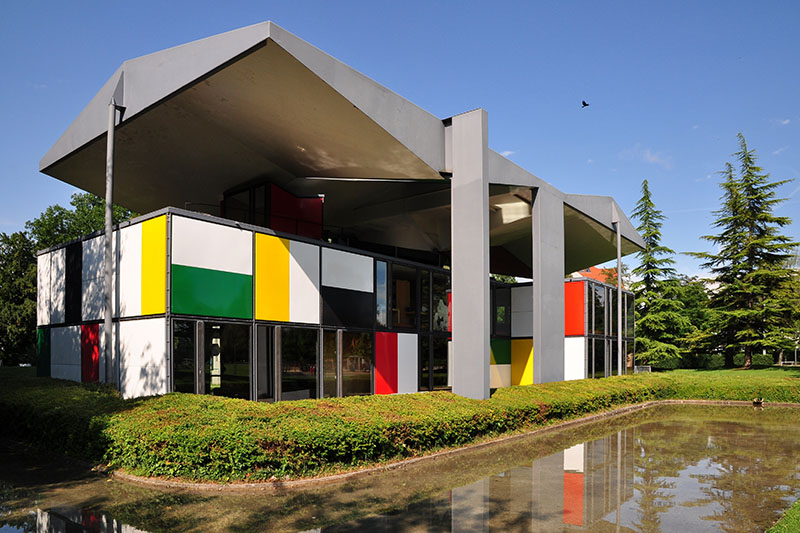
A cultural and philosophical movement that originated in western Europe and sought new paradigms in art and socio-cultural discourse to reflect the transformations brought on by industrialisation in the late nineteenth and early twentieth centuries. It was the dominating current of artistic practice until the 1970s and spread out globally, comprising a diverse set of stylistic movements such as Realism, Post-Impressionism, Cubism, Futurism, Surrealism and Dadaism, among others.
More Definitions
Formalism
An approach to art which emphasises aspects of form, such as line, shape and colour. Formalism engages with the visual…
Indian Modernist architecture
The adaptation of Western Modernist principles — functionalism, minimal ornamentation, and the use of industrial materials like reinforced concrete —…
Pointillism
Also known as Divisionism or Chromoluminarism, it is a technique in painting that involves applying small, distinct dots or strokes…
Conceptual Art
An artistic movement that emerged in the 1960s which prioritised the concept behind an artwork over the finished work itself.…
Art Informel
Coined by French art critic and curator Michel Tapie in 1952, the term signifies French artistic and painting styles of…
Academic Realism
A style of painting that was influenced by European academies of art from the sixteenth century onwards. It was characterised…
Photorealism
A genre of painting, drawing and graphics where the image is produced after studying a photograph and rendering a reproduction…
Abstract Expressionism
An art movement that developed in New York in the 1940s and led to the formation of the New York…