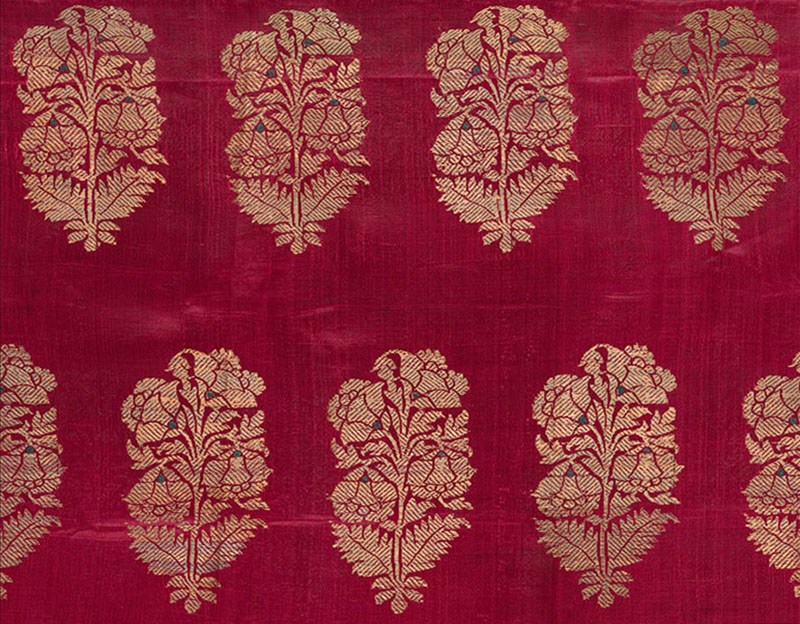
Meaning “little dream,” it is a woven brocade, characterised by a dense and rich zari work on the surface that renders the underlying silk fabric almost invisible. The complex weave was popular in the Mughal era, at which time production was centred in present-day Gujarat and the city of Benaras (Varanasi). Benaras remains an important centre of kinkhwab-weaving today.
More Definitions
Gelatin Dry Plate
A method of producing photographic negatives that emerged in the 1880s, using a glass plate coated with silver salts in…
Kashikari
Painted and glazed ceramic ware, particularly tiles, common in the Islamic world, typically featuring colourful arabesques, floral and geometric motifs,…
Plain Weave
Also known as tabby weave, it is the most common weave in textiles. In this weave, each weft yarn passes…
Kajli Siyahi
A technique associated with the Patna School, where paintings are rendered directly by paintbrush on the surface, without using pencilled…
Stem Stitch
A needlework technique in embroidery where successive, overlapping stitches produce a corded appearance, resembling the stem of a plant.
Offset Oleography
A process of producing multicoloured prints using the offset technique. The inked image is printed on a rubber cylinder, then…
Rekh
Derived from the Hindi and Urdu word for “outline,” it is a step in some Indian block-printing processes, in which…
Kani
A term referring to both the weaving technique and the final textile created by this method. It may also refer…