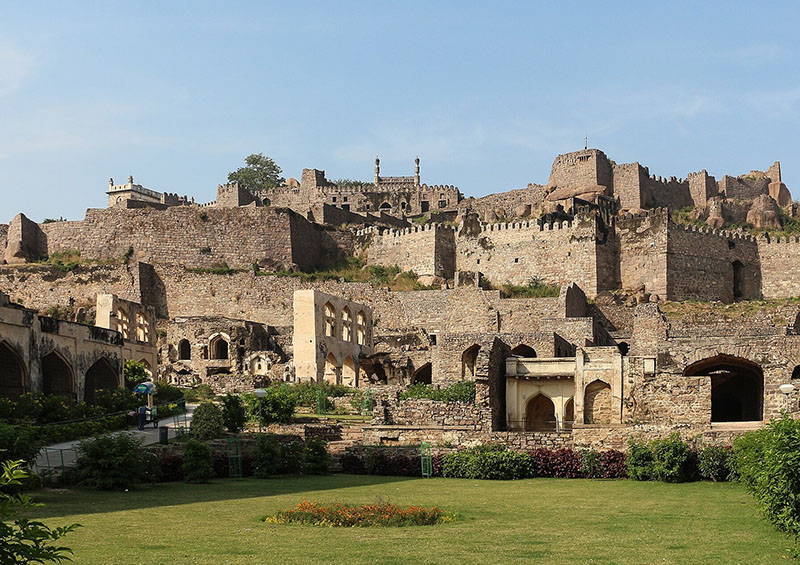
Muslim kingdom of the Deccan in India, founded in 1518 by Khawas Khan Hamadani, a Baharlu Turk who governed the region of Telangana under the Bahmani Sultanate (1347–1518), and ascended the throne as Sultan Quli Qutb-ul-Mulk. One of the five successor kingdoms of the Bahmani Sultanate, it spanned present-day Telangana and parts of Andhra Pradesh, with its capital in Golconda and later in the city of Hyderabad, built in 1591. Under the Qutb Shahi dynasty, who were Shia Muslims, the Golconda Sultanate flourished as a diverse centre for art, culture and commerce, resisting attacks from neighbouring sultanates, and later allying with Bidar, Bijapur and Ahmadnagar in overthrowing the Vijayanagara kingdom in the battle of Talikota (1565). Mughal pressure on the sultanate increased steadily from the early seventeenth century onwards, and the kingdom was annexed through treason by Aurangzeb in 1687.
More Definitions
Driglam Namzha
Code of public etiquette in Bhutan, based on the founding principles of Bhutanese culture, namely humility, compassion and respect. It…
Wajid Ali Shah
Wajid Ali Shah (b. 1822; d. 1887) was the eleventh and final ruler of Awadh, whose reign lasted from 1847…
Lichhavi dynasty
Clan that ruled the Kathmandu Valley of Nepal between 450 and 750 CE. The Licchavis originate in the ancient region…
Berar Sultanate
Small Muslim kingdom of the Deccan in India founded in 1490, covering the northeastern corner of present-day Maharashtra, and one…
Gonandiya
An ancient dynasty from Kashmir that is referred to in the twelfth century CE text Rajatarangini, by the historian Kalhana.…
Nayaka
The governors of the Vijayanagara Kingdom, who declared independence after the Battle of Talikota in 1565 CE and they ruled…
Kshatrapas
The title given to local governors who administered territories in several parts of north-western, northern, western and central India during…
Magadha Empire
A kingdom that ruled over large parts of the Indian subcontinent between the sixth century BCE and the eighth century…