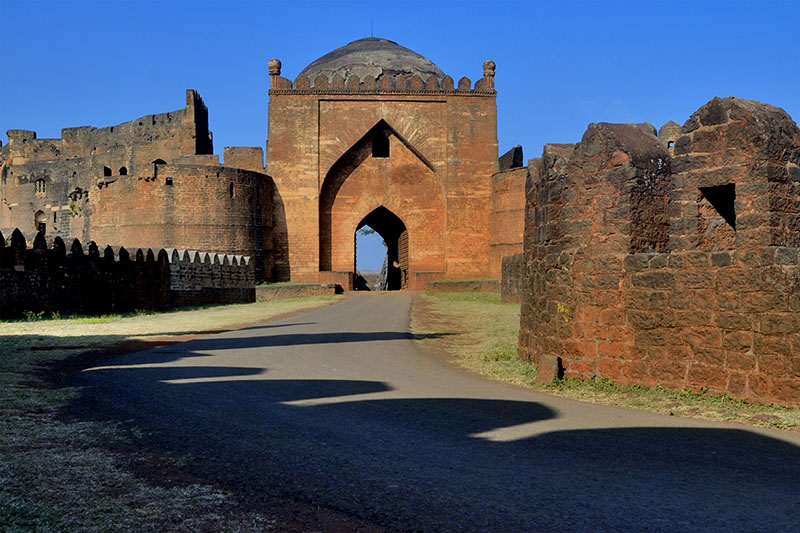
Muslim kingdom of the northern Deccan in India, founded in 1347 by Zafar Shah, a soldier in the service of Muhammad bin Tughlaq of the Delhi Sultanate, who seized Daulatabad (near present-day Aurangabad) in rebellion and ascended the throne as Ala-ud-Din Hasan Bahman Shah. At its height the kingdom spanned south-central India, across areas of present-day Maharashtra, northern Karnataka, Telangana, and northern Andhra Pradesh, with its capital at Ahsanabad (present-day Gulbarga) and later Muhammadabad (present-day Bidar), both in present-day Karnataka. It vied for control of the Deccan with the Vijayanagara kingdom and the Gajapatis of Odisha. The sultanate declined in the late fifteenth century, splintering into the successor states of Bijapur (ruled by the Adil Shahis), Ahmadnagar (ruled by the Nizam Shahis), Golconda (ruled by the Qutb Shahis), Berar (ruled by the Imad Shahis) and Bidar (ruled by the Barid Shahis).
More Definitions
Bhonsle dynasty
Indian dynasty founded in the sixteenth century by Maloji Bhonsle (b. 1552, d. 1605), a general who was granted land…
Krishnaraja Wadiyar
Krishnaraja Wadiyar (b. 1884; d. 1940) was the ruler of the Mysore principality between 1894 and 1940. He was a…
Pushyamitra
Pushyamitra (r. c.185 BCE–c.149 BCE) was the founder of the Shunga Dynasty, which emerged after the end of the Maurya…
The Partition
The division of British India in 1947 into India and Pakistan, spurring a great migration of people from and to…
Gajapati
A dynasty that ruled over territories corresponding to parts of present-day Odisha and the northern part of Andhra Pradesh during…
Tughluq dynasty
Indo-Turkic dynasty (r. 1320–1413 CE), third of the Delhi Sultanate, preceded by the Khaljis and followed by the Sayyids. Its…
Narasimha II
Narasimha II (b. n.d. ; d. 1505 ; r. 1491-1505) was a ruler of the Saluva dynasty, who governed the…
Delhi Durbars
Three large-scale events (durbar, Urdu: ‘royal court or gathering’) held in Delhi, in 1877, 1902–3 and 1911, to celebrate Britain’s…