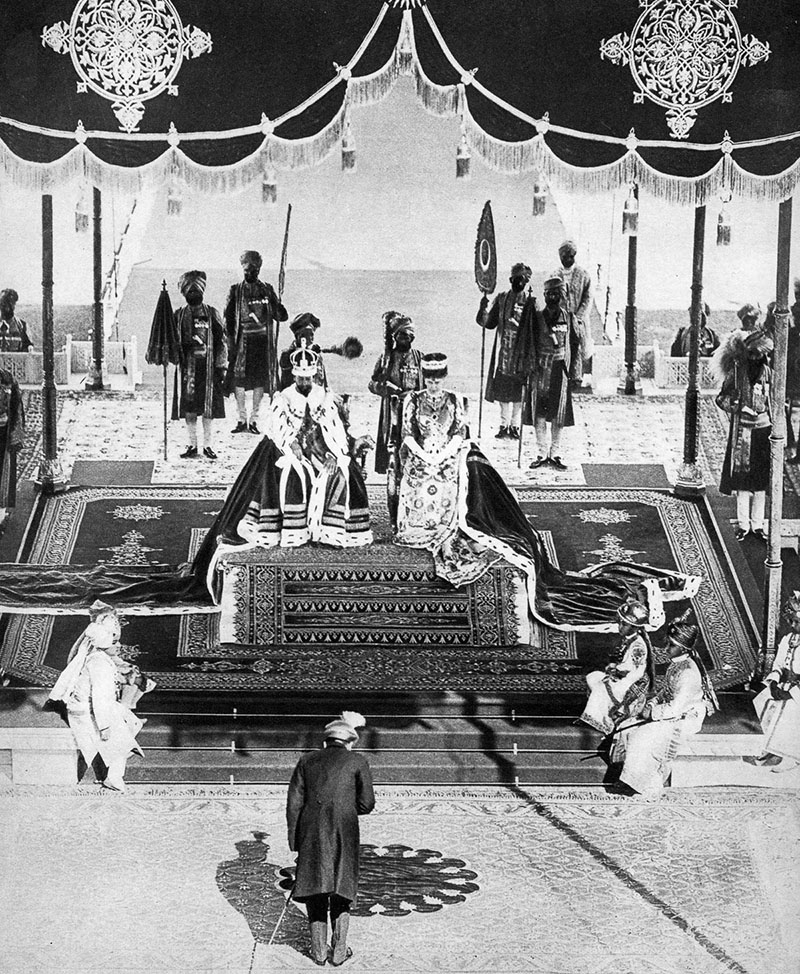
Three large-scale events (durbar, Urdu: ‘royal court or gathering’) held in Delhi, in 1877, 1902–3 and 1911, to celebrate Britain’s imperial position in colonial India. The first celebrated the British queen Victoria’s recent title as the Empress of India; and the latter two the ascension of Edward VII and George V respectively to the throne — only the last was attended by the monarch. The Delhi Durbars displayed the wealth and power of the British empire in a bid to legitimise British sovereignty over the Indian subcontinent, especially by positioning it as a successor to Mughal rule. They comprised grand processions, ceremonies, banquets, and other events, which combined Indian and British cultural traditions. Importantly, the rulers of India’s princely states were invited to ceremonies where they were given honorary titles, and thereby absorbed into the British colonial and monarchic hierarchy in subordinate positions. Delhi, chosen as the site for its historical significance, was announced as India’s capital at the third Durbar. Also: Delhi Darbar.
Delhi Durbars
Link copied!