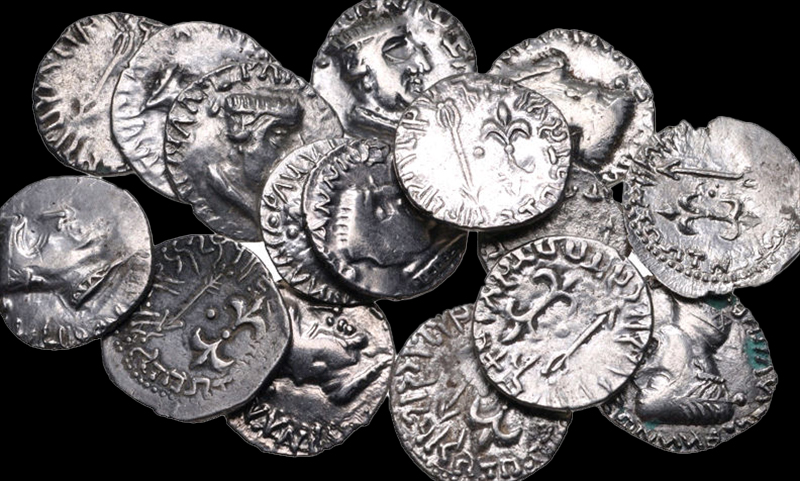
The title given to local governors who administered territories in several parts of north-western, northern, western and central India during the first centuries of the common era. They were administrative feudatories — first of the Indo-Scythian rulers (first century BCE to first century CE) and, later, the Kushan dynasty (first century CE to third century CE) — who enjoyed considerable autonomy over their territories and are documented in several inscriptions and coins from the period. One such dynasty of rulers gained control in parts of northwestern, western and central India from the second to the fourth centuries CE and is known as the Western Kshatrapa dynasty.
More Definitions
Deva Raya II
Deva Raya II (b. n.d.; d. 1446) was a ruler of the Sangama dynasty, which founded and governed the Vijayanagara…
Harisena
A ruler of the Vakataka Dynasty who reigned in the late fifth century CE. He and his court are believed…
Hoysala
A dynasty that ruled over the southern Deccan in India between the eleventh and mid-fourteenth centuries. At its peak, the…
Khmer empire
Southeast Asian state that was founded in 802 CE and declined in 1431 CE. At its height, the Khmer empire…
Vrishni
Ancient Indian chiefdom extant around the fifth century BCE in Mathura, that traced its lineage to an ancestor named Vrishni.…
Eastern Ganga Dynasty
Also known as the Rudhi or the Prachya Gangas, this is an early medieval dynasty that ruled over Kalinga (present-day…
Dhamma Mahamatta
A class of officers instituted by the Indian emperor Ashoka during his reign in the third century BCE whose chief…
Khanzada Begum
Khanzada Begum (b. c.1478; d. 1545) was the elder sister of the Mughal emperor Babur. She finds mention in his…