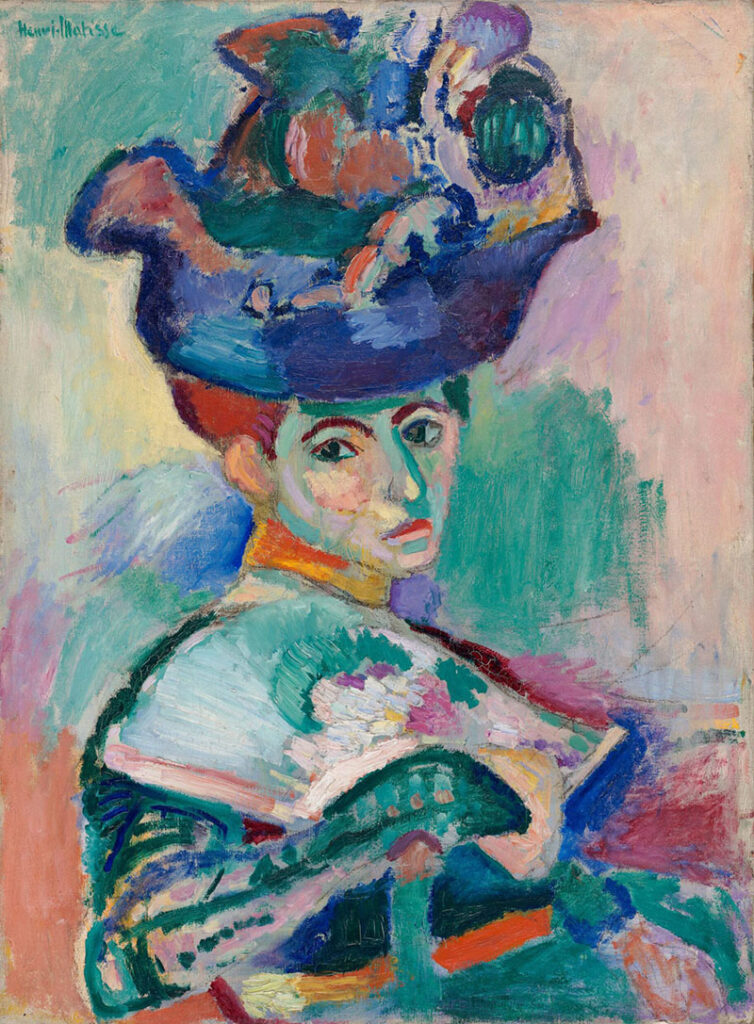
A style of painting popular in France in the early years of the twentieth century, led primarily by the artists Henri Matisse and Andre Derain. It is characterised by the bold use of colour (often applied directly from the tube), a simplified depiction of forms and strong brushwork. Influences on fauvism include Post-Impressionism, Neo-Impressionism and scientific colour theories prevalent in the late nineteenth century. The style derives its name from the French term les fauves (the beasts), used in 1905 by the French art critic Louis Vauxcelles to describe the expressive works of Matisse and Derain in this style. Other artists related to the style include Georges Braque, Raoul Dufy, Georges Rouault and Maurice de Vlaminck.
More Definitions
Academic Realism
A style of painting that was influenced by European academies of art from the sixteenth century onwards. It was characterised…
Pop Art
An art movement that originated in the 1950s and 1960s in Britain and the United States of America, it challenged…
Nagara Style
A style of Hindu temple architecture commonly found in northern and central India and characterised by a curvilinear or rectilinear…
Art Brut
An art movement that emerged after World War II in reaction to academic aesthetics and in favour of obscene and…
European Realism
A movement originating in France in the 1840s, which rejected then-prevalent ideals of Romanticism in French art and literature in…
Literalism
A term often used synonymously with minimalism, it refers to a style of art and literature characterised by the portrayal…
Ionic Style
One of the three canonical orders of Western Classical architecture, it originated in the mid-sixth century in Ionia (present-day Turkey).…
Modern Regionalism
Architectural approach that adapts Modernist principles to the unique cultural, climatic, and material conditions of the specific region. Modern Regionalism…