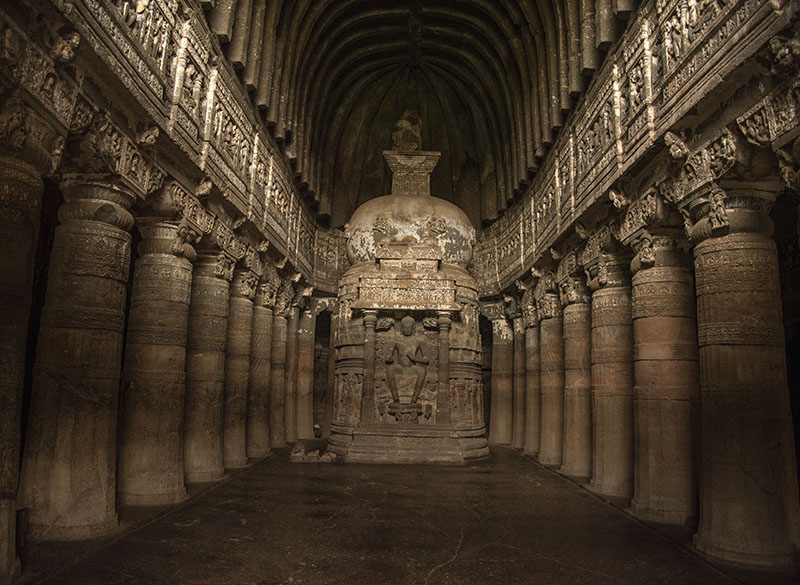
Meaning ‘shrine’ or ’sanctuary’ in Sanskrit, chaitya or chaitya griha (‘chaitya hall’) refers to a pillared hall in Buddhist architecture, which usually houses a votive stupa in an apse at its end. It is typically a long and narrow structure with a high roof. The stone ceiling has carved beams in imitation of the original wooden construction, or attached timber ribs, as seen in the earliest surviving chaityas in the rock-cut caves of Karle and Bhaja in the Western Ghats of India. The term is also used in Buddhism, Hinduism and Jainism to refer more generally to a temple or sacred monument.
More Definitions
Shah Maqsud Shrine, Khakriz
Shrine north of Kandahar in Afghanistan, dedicated to Shah Maqsud, a companion of Ali ibn Abi Talib — cousin of…
Ikshvaku Architecture
Architecture patronised by the Andhra Ikshvakus (c. fourth to third century BCE) (not to be confused with the legendary Ikshvaku dynasty…
Peristyle
A row of pillars surrounding an enclosed space or enclosing an open space, taking the form of a porch or…
Mandapa
A pillared hallway characteristic of Dravida temple architecture, used for rituals, gatherings and marriage ceremonies. A temple may have one…
Cornice Moulding
A horizontal decorative moulding applied to the edges at the top of an interior wall, ceiling or pedestal. They date…
gopuram
Towering, multi-storeyed gateway characteristic of South Indian Dravida temple architecture. A temple may have several gopurams, or gopuras, punctuating the…
stringcourse
Horizontal band running along the exterior surface of a building or a boundary wall, serving aesthetic and sometimes functional purposes.…
Mahendra Style
The style of cave temple architecture developed under the patronage of the Pallava king Mahendravarman I, characterised by simplicity of…