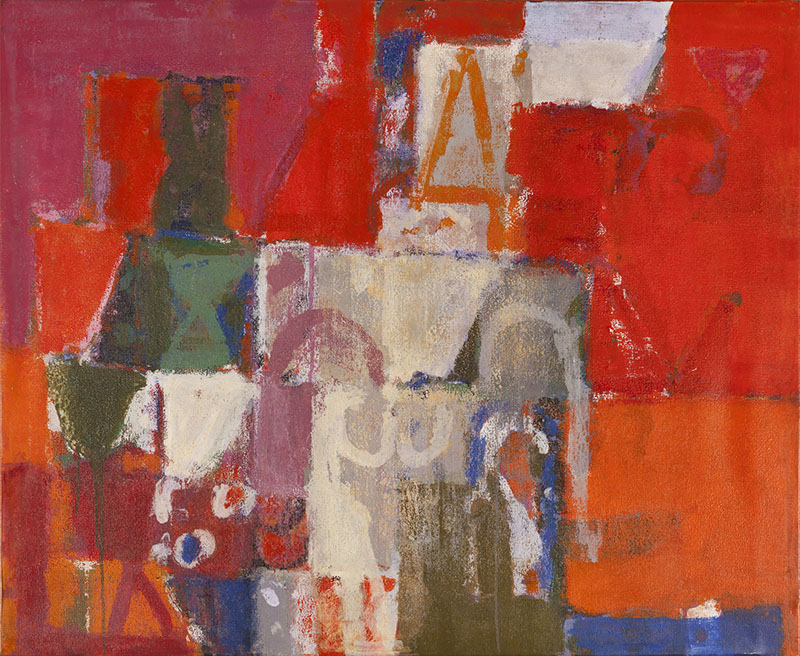
An art movement that developed in New York in the 1940s and led to the formation of the New York School, eventually becoming a dominant influence in Western painting by the 1950s. The movement included artists working across styles that depicted unrealistic and abstract forms, characterised by spontaneous expression.
More Definitions
Neo-Romanticism
A cultural movement in Britain during the 1930s and '40s which was influenced by eighteenth-century Romanticism and emphasised individualism and…
Colour Field Painting
An abstract painting style categorised within American Expressionism, it is characterised by large-scale canvases painted expansively with flat, solid colour…
Fauvism
A style of painting popular in France in the early years of the twentieth century, led primarily by the artists…
German Expressionism
An art movement that emerged in early twentieth-century Germany, characterised by irregular brushstrokes and gestural marks which eschewed realist depictions…
Victorian Salon Painting
A number of painting styles that gained popularity in English salons during the reign of Queen Victoria (1837–1901), such as…
Primitivism
A tendency in European and American modern art where artists explored the visual vocabulary of the cultures of Africa, Oceania…
Open Sculptures
Sculptures which have an opening and are not a solid mass. These sculptures are usually made with intersections of lines…
Futurism
An avant-garde artistic movement that emphasised speed, technology, violence and youth. It originated in Italy in the early twentieth century,…