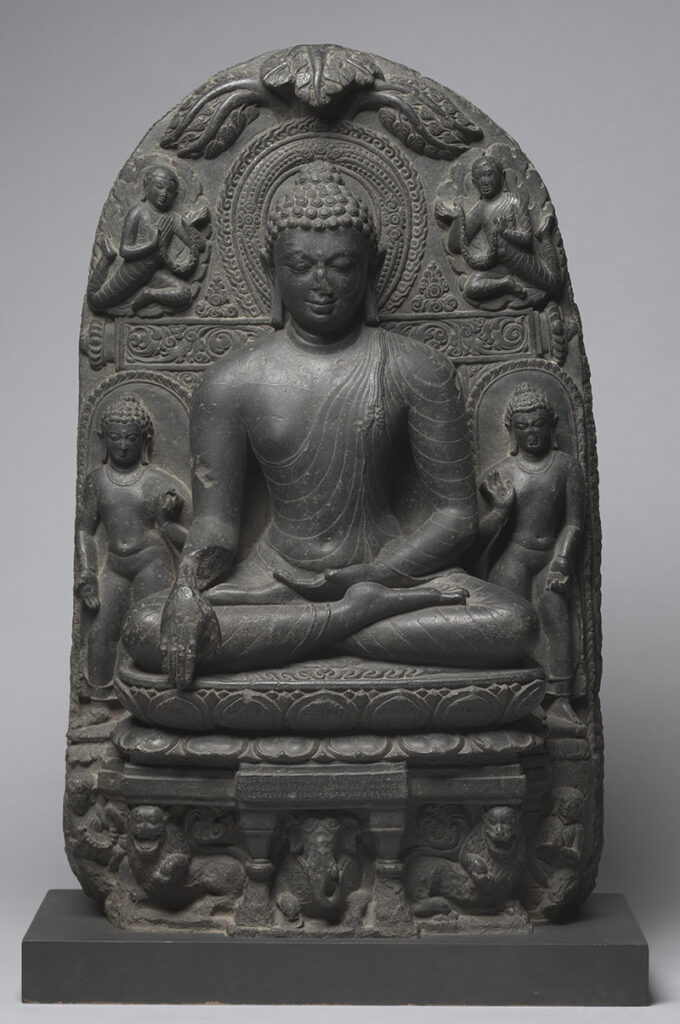
A term used by the Gautama Buddha to refer to himself or other Buddhas in the Pali canon. It is used to define someone who knows and sees reality as it is and is beyond all transitory phenomena. Early Pali texts refer to seven Tathagatas or great Buddhas, whereas Vajrayana Buddhism refers to five Tathagata Buddhas. The etymology of the term is widely contested, but it is generally thought to have derived from the Pali words tatha and gata, meaning “one who has thus gone” or “one who has thus come.”
More Definitions
Tathata
A central concept in Buddhism that denotes the essential or true nature of reality, which is beyond the range of…
Chakrapurusha
The personification of Vishnu's discus, the Sudarshan Chakra, as a male figure. It is an example of the Ayudhapurusha tradition…
Rudra
Minor deity in Vedic religion, generally associated with terrible or destructive natural forces, but also with various benevolent aspects. Rudra…
Shiva
Major Hindu deity with non-Vedic origins, and the principal deity of the Shaivism sect. In mainstream Hinduism, Shiva appears in…
Vrishabhavahana
A benevolent form of the Hindu deity Shiva in which he appears with the bull Nandi, his mount or vahana.…
Harihara
A deity who represents the combined aspects of Vishnu (Hari) and Shiva (Hara). Also known as Shankaranarayana, the fused body…
Axis Mundi
A Latin phrase meaning “world axis” and referring to the centre of the earth or the point at which the…
Varuna
A Vedic deity associated with the moral values of rita (justice) and satya (truth), he also represents the natural elements…