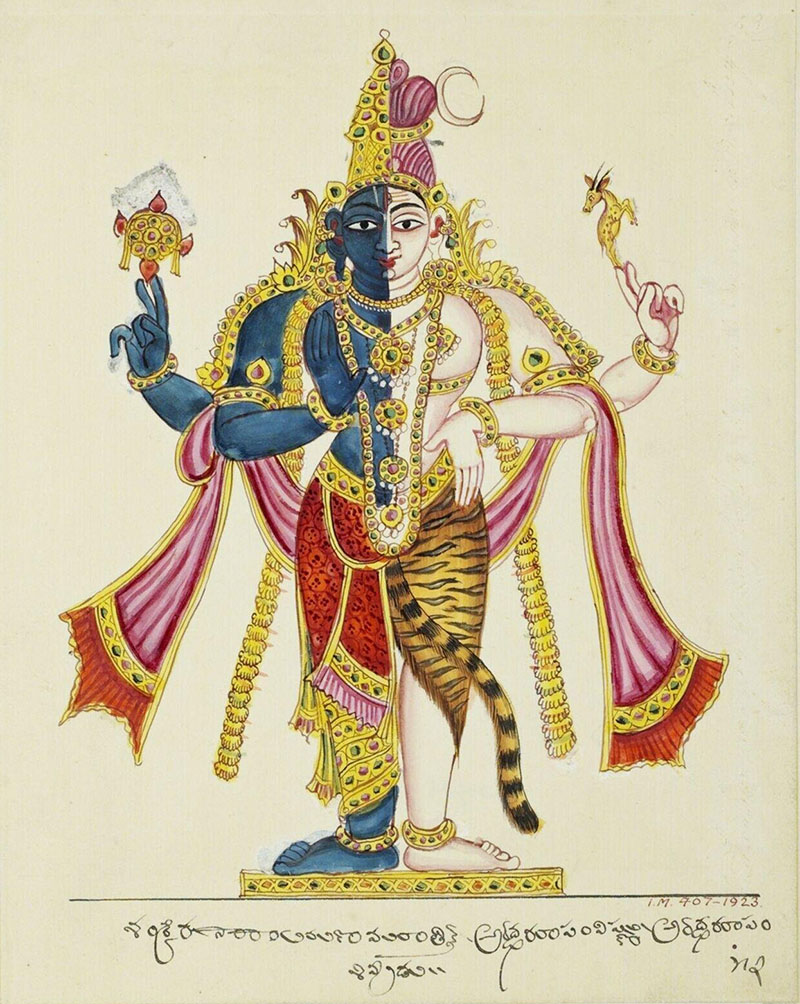
A deity who represents the combined aspects of Vishnu (Hari) and Shiva (Hara). Also known as Shankaranarayana, the fused body of the deity represents the dark-skinned Shiva on the right with a crescent moon in his matted hair and trishula (trident), and a pearlescent Vishnu on the left wearing a crown and holding a conch and the sudarshan chakra.
More Definitions
Mandhata
According to Hindu mythology, Mandhata was the son and heir of Yuvanshva, a king belonging to the Ikshvaku Dynasty. Also…
Shaivite Upanishads
A body of fourteen Upanishadic texts dedicated to Shaiva traditions and practice, which expound on the worship of the Hindu…
Padmapani
Literally meaning the "lotus bearer," it is another form of the bodhisattva Avalokiteshvara. He is usually depicted with a lotus…
Shadaksari Lokeshvara
A form of the bodhisattva Avalokitesvara, the Shadakshari Lokeshvara is associated with Tibetan Buddhism. He is typically depicted in white…
Yama
The Hindu god of death, also known as Pretaraja (King of Ghosts), Dharmaraja (King of Justice) and Daksinasapati (Lord of…
Devi Upanishad
A minor Upanishad often classified as one of the eight Shakta Upanishads, it is one of the nineteen late-Vedic texts…
Mahabali
A Daitya king and the grandson of Prahalad, he is mentioned in a number of texts and myths within Buddhism,…
Tumburu
Tumburu is a divine being in Hinduism and Jainism. In Hindu mythology, he is the leader of the Gandharvas, the…