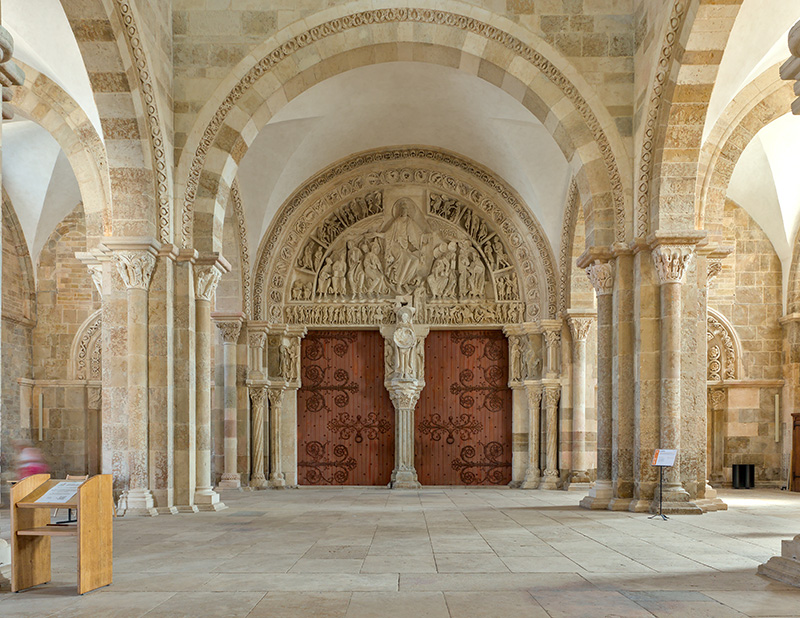
A narrow, vestibule-like area just inside the entrance of a church, spanning its full width, and demarcated from the nave by a colonnade or partition. The narthex (Greek, ‘forecourt of a church’) has historically served as a transitional space between the entrance porch and the ‘body’ of the church, hosting those not (yet) properly admissible into the Christian Church, such as catechumens (those awaiting baptism or confirmation) or penitents. It was an important architectural feature of early Christian and especially Byzantine churches, appearing in the latter as deep, three-bayed spaces divided into an outer or exonarthex and an inner or esonarthex, and at times featuring a second storey over its entire width. In these Byzantine churches, it also gave onto smaller chapels and served to host a variety of activities and functions, both ceremonial as well as non-ceremonial, including funerals and council meetings. It was incorporated into later Anglican churches, most prominently missionary churches in Africa and India, where it could serve as a demarcated space for potential converts and onlookers to the restricted religious proceedings inside. Also called, in various contexts: galilee, antechurch, antenave, chalcidicum, or chalcidic.
narthex
Link copied!