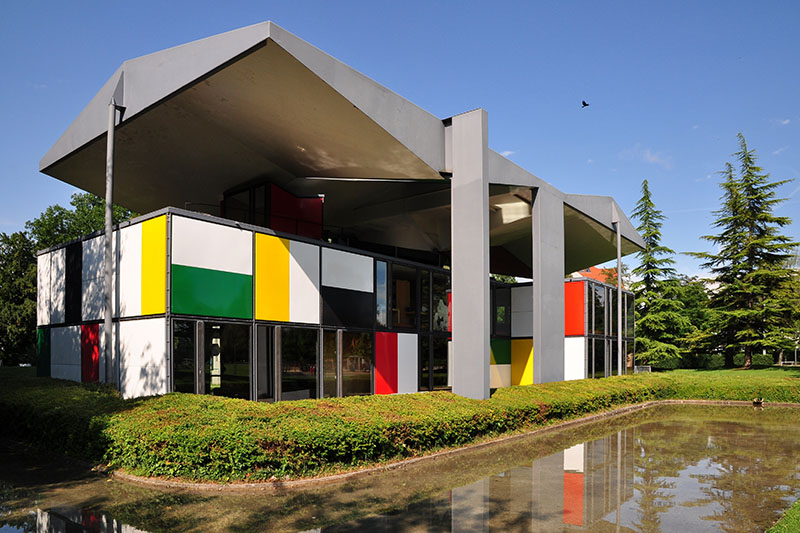
A cultural and philosophical movement that originated in western Europe and sought new paradigms in art and socio-cultural discourse to reflect the transformations brought on by industrialisation in the late nineteenth and early twentieth centuries. It was the dominating current of artistic practice until the 1970s and spread out globally, comprising a diverse set of stylistic movements such as Realism, Post-Impressionism, Cubism, Futurism, Surrealism and Dadaism, among others.
More Definitions
Formalism
An approach to art which emphasises aspects of form, such as line, shape and colour. Formalism engages with the visual…
Constructivism
An early twentieth century artistic and architectural movement that was started in Russia by painter and architect Vladimir Tatlin and…
Neoclassicism
An eighteenth century cultural movement that drew inspiration from the arts and culture of classical antiquity. It embraced classical themes…
manorath paintings
In the Pushtimarg sect of Vaishnavism, manorath paintings were made as temple records or pilgrimage souvenirs, typically depicting individual devotees…
Indo-Greek Sculpture
Sculptural art characterised by the merging of Indian and Hellenistic traditions, it overlaps with the reign of the Indo-Greeks in…
Tachisme
A French style of abstract painting, characterised by random splotches and dabs, it gained popularity in the 1940s and 1950s…
Bauhaus
A school of art and design founded by German architect Walter Gropius in 1919, which emphasised an interdisciplinary approach to…
Indian Modernist architecture
The adaptation of Western Modernist principles — functionalism, minimal ornamentation, and the use of industrial materials like reinforced concrete —…