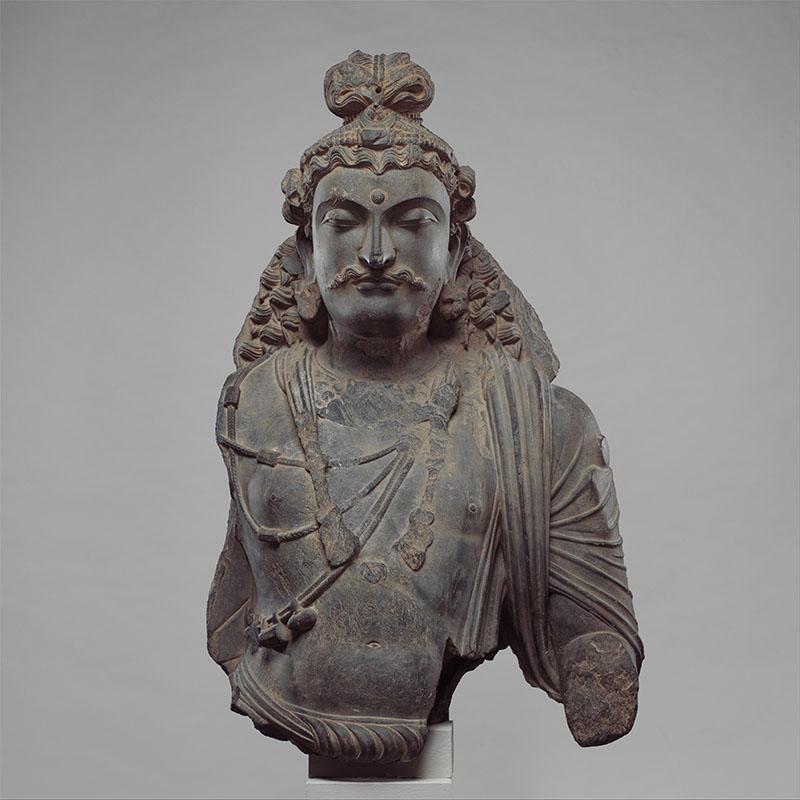
Sculptural art characterised by the merging of Indian and Hellenistic traditions, it overlaps with the reign of the Indo-Greeks in Bactria and the Indian subcontinent, beginning c. 200 BCE. Sculptural pieces from Mathura are believed to display Indo-Greek features such as realistic physiological details, frontal perspectives, iconographic details and the display of folds in sculpted drapery. The Gandhara school, particularly its earliest statues of Buddha, are considered to embody some of the last traces of this tradition of sculpture.
More Definitions
iconic representation
Representation of a deity or divine figure in a personified form or generally figurative mode, as opposed to aniconic representation…
Pop Art
An art movement that originated in the 1950s and 1960s in Britain and the United States of America, it challenged…
Neo-Impressionism
A late nineteenth-century movement in French painting that opposed the empirical realism of Impressionism. It used the scientific principles of…
Action Painting
A style of abstraction where paintings are produced through vigorous and spontaneous application of paint over the canvas, in sweeping…
Indian Modernist architecture
The adaptation of Western Modernist principles — functionalism, minimal ornamentation, and the use of industrial materials like reinforced concrete —…
Happenings
A precursor of performance art, they are events or situations where the artwork is created by the conditions produced by…
Tropical Modernism
Architectural style that adapts Modernist architectural principles and materials for thermal comfort in the hot and humid climate of the…
Abstract Expressionism
An art movement that developed in New York in the 1940s and led to the formation of the New York…