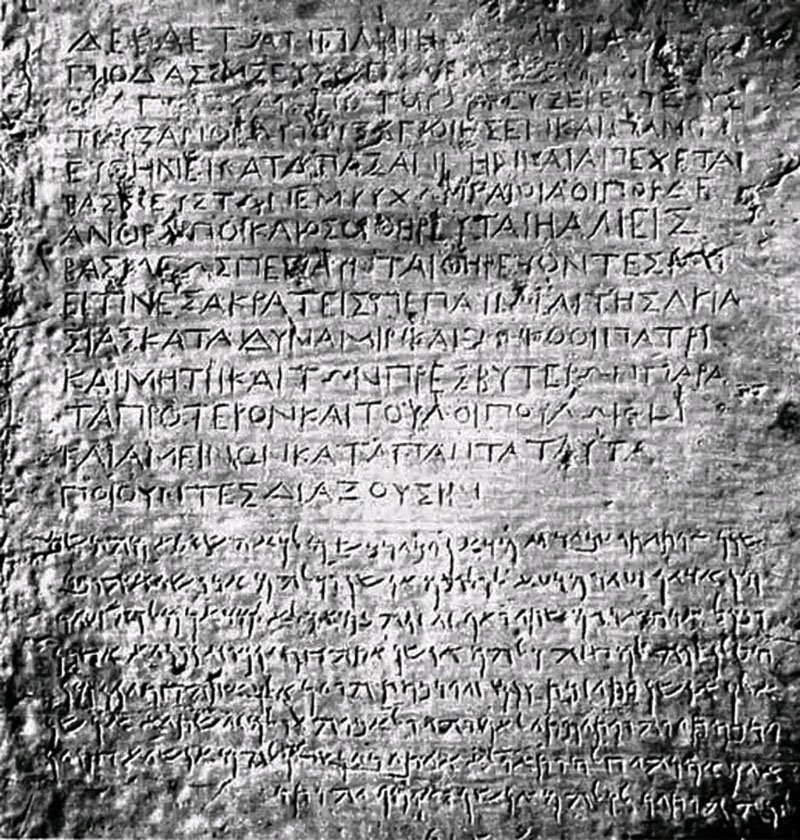
A bilingual edict, written in Greek and Aramaic, dating to c. 260 BCE. It is the earliest known rock edict of the emperor Ashoka, preceding all other known inscriptions of the ruler by ten years. The edict was discovered during excavation work near the site in 1958.
More Definitions
Mahavastu Avadana
A text of the Lokottaravada school of early Buddhism, it was written in Sanskrit, Pali and Prakrit between the second…
Alvar
A group of twelve Vaishnavite Tamil poet-saints who advocated for personal devotion (bhakti). Their poetry and devotional songs were based…
Puranas
A genre of ancient and religious texts written in Sanskrit, Tamil and other languages. The texts are encyclopaedic and cover…
Domingo Paes
Domingo Paes (b. n.d.; d. n.d.) was a Portuguese horse trader who visited Vijayanagara, the capital of the Vijayanagara empire,…
Hiranya
A Sanskrit term meaning “golden.”
Kufic Script
The earliest extant Islamic script, historically preferred for use in the Quran. The calligraphic script is angular and slow-moving, with…
Baburnama
The memoir of Zahiruddin Babur, the founder of the Mughal Empire. Written in the Chagatai language in an autobiographical style,…
Ramayana
One of the two major ancient Indian epics written in Sanskrit, it is believed to have been composed by Valmiki…