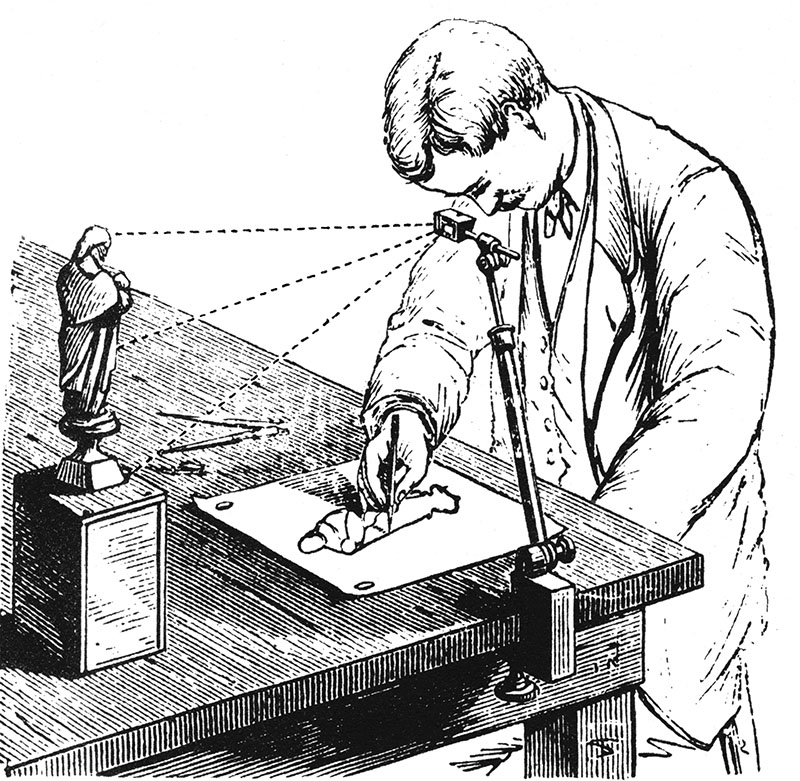
An optical device and precedent to the camera, which was used as an aid for drawing and sketching. Developed in 1806 by William Hyde Wollaston, it featured a prism with four faces set on a stand above a sheet of paper, which superimposed the reflection of the subject in front of the artist onto the drawing surface. From the Latin, meaning “light chamber.”
More Definitions
Large Format Camera
Film cameras that produce images that are 9 cm x 12 cm or larger.
Collodion Wet Plate
A nineteenth-century method of producing photographic negatives using a glass plate coated with a silver emulsion. While relatively inexpensive and…
Lease Rod
A tool used to separate warp yarn threads and keep them in their place in a hand loom. It is…
Non-Fungible Tokens
A unique digital certificate or token that authenticates the ownership of a virtual or physical asset such as a collectible,…
Hollowed Bone
A tool made from shaping human or animal bone and used by prehistoric people as tools as well as to…
Paper Negative
A photographic negative created on paper, rather than on modern cellulose film or a glass plate. William Henry Fox Talbot's…
Magic Lantern Projector
An early image projector developed in the seventeenth century, where pictures were showcased through transparent plates, typically made of glass.…
fixed-focus lens
Camera lens whose focal distance is pre-determined at the time of manufacture and cannot be adjusted by the user. It…