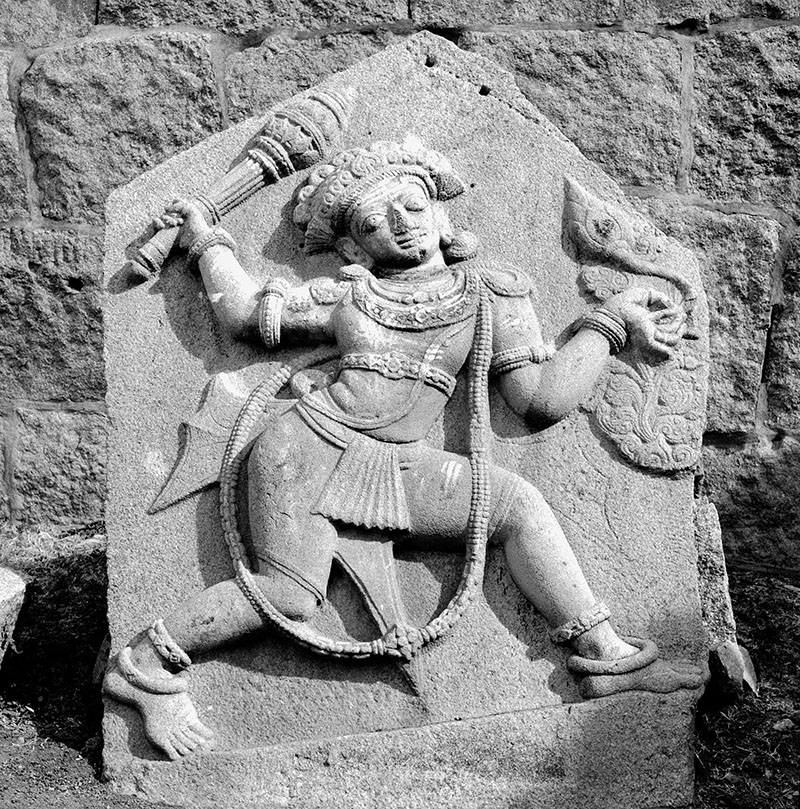
Second of the five mythical Pandava brothers and protagonists of the Sanskrit epic Mahabharata, known for his heroism, exceptional skills as a warrior, passionate loyalty, and voracious appetite. Bhima in Sanskrit means ‘formidable’ or ‘fearsome’. His superhuman strength is at times attributed to his conception through his mother Kunti’s invocation of Vayu the wind god. Early in the Mahabharata, Bhima marries the rakshasi Hidimbi and has a son, Ghatochka, who also becomes a great warrior. Bhima plays a pivotal role in the epic’s narrative: he effectively ends the Kurukshetra war by killing all hundred Kaurava antagonists. Notably, he fulfils a vow to kill Dushasana, drink his blood, and wash Draupadi’s hair with it, as vengeance for her humiliation at the Kaurava court; this episode in particular has been widely depicted in Indian art. Outside South Asia, legends of Bhima are especially popular in Indonesia.
More Definitions
Vittala
A Hindu deity who is considered to be a form of Vishnu and is popularly worshipped in present-day Maharashtra and…
Bhogashakti
A form of the Hindu goddess Parvati or Parameswari, who is the consort of the deity Shiva.
Tumburu
Tumburu is a divine being in Hinduism and Jainism. In Hindu mythology, he is the leader of the Gandharvas, the…
Brahma
A deity in the Hindu pantheon regarded as the creator of the universe, he is a part of the trimurti…
Animism
It is a belief system that attributes a spiritual essence to plants, animals and inanimate objects.
Mahavidyas
A group of ten goddesses from the Tantric Hindu pantheon, consisting of Kali, Tara, Shodashi, Bhuvaneshvari, Chhinnamasta, Bhairavi, Dhumavati, Bagalamukhi,…
Chin Mudra
A mudra or gesture in South Asian iconographic traditions, in which the thumb is held close to the palm and…
rakshasa
Type of mortal being associated with evil and mischief, appearing first in Vedic texts and throughout later Brahmanical mythology. Typically,…