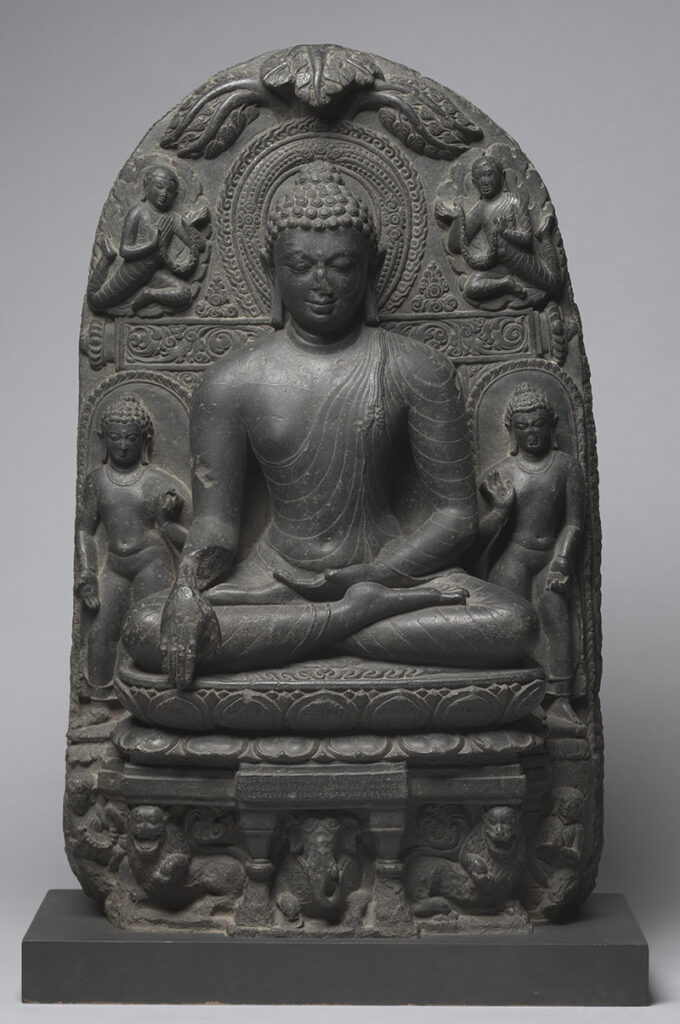
A term used by the Gautama Buddha to refer to himself or other Buddhas in the Pali canon. It is used to define someone who knows and sees reality as it is and is beyond all transitory phenomena. Early Pali texts refer to seven Tathagatas or great Buddhas, whereas Vajrayana Buddhism refers to five Tathagata Buddhas. The etymology of the term is widely contested, but it is generally thought to have derived from the Pali words tatha and gata, meaning “one who has thus gone” or “one who has thus come.”
More Definitions
Pithora Dev
A deity of marriage, worshipped in parts of Madhya Pradesh and Gujarat, and the principal deity in Pithora paintings.
Madhu
A demon in Hindu mythology who is said to have originated from the earwax of Vishnu. He is believed to…
Mahavastu Avadana
A text of the Lokottaravada school of early Buddhism, it was written in Sanskrit, Pali and Prakrit between the second…
Tirthankara
Also known as jinas, Tirthankaras are teachers and guides in Jain devotional practices who lead their followers on the path…
Jaya
In Hindu religious mythology, he is an attendant of the deity Vishnu. Along with Vijaya, he is a dvarapala or…
Chandesanugrahamurti
A benevolent form (anugrahamurti) of the Hindu deity Shiva, in which he is depicted bestowing his blessings upon his devotee,…
Kuladevata
The tutelary deity of a family or a clan. The term is derived from the Sanskrit words kul, meaning "family"…
Shiva
Major Hindu deity with non-Vedic origins, and the principal deity of the Shaivism sect. In mainstream Hinduism, Shiva appears in…