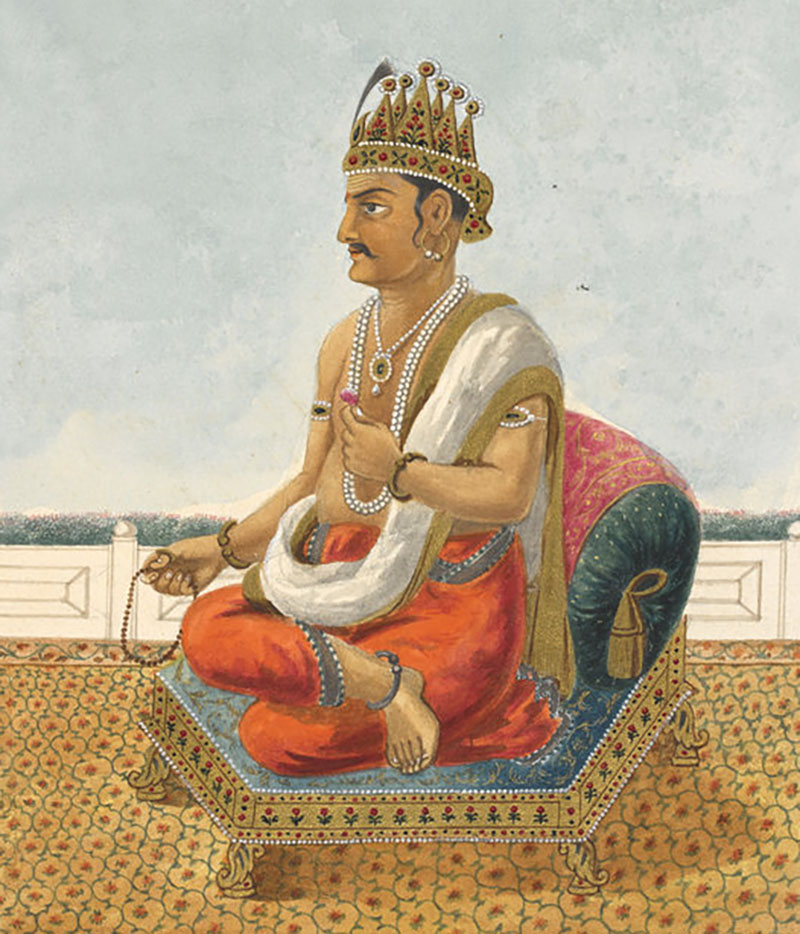
In the Indian epic Ramayana, the father of Sita and father-in-law of Rama. In later Vedic texts, Janaka is stated to be a ruler of Videha, a region corresponding to parts of present-day Bihar and Nepal, and historians suggest a possibility of him having been a historical figure who may have lived and ruled between the ninth and seventh centuries BCE.
More Definitions
Srishti
Meaning "creation" in Sanskrit, it is one of the cosmic acts of deities in the Hindu religious tradition. It is…
Apasmara Purusha
Also known as Muyalaka or Muyalakan, he is a dwarf within Hindu mythology who represents spiritual ignorance and has the…
Shakyasimha
Another name for one of the mortal Buddhas, it literally translates to "the lion of the Shakyas," the clan to…
Samhara
Meaning "destruction" or "withdrawal" in Sanskrit, it is one of the cosmic acts of deities in the Hindu religious tradition.…
Vashishtha
In the Hindu religious tradition, one of the seven maharishis (great sages). In the Indian epic Ramayana, he is a…
Devi-Bhagavata Purana
Also known as Devi Bhagavatam, it is often categorised as a Mahapurana and revolves around the figure of the Devi…
Prakriti
In the Hindu religious tradition, it is a theological concept that describes the primary principle, or source, of matter. In…
Shakti
The primordial cosmic energy that represents the dynamic forces of the universe in the Shaktism sect. The figure is the…