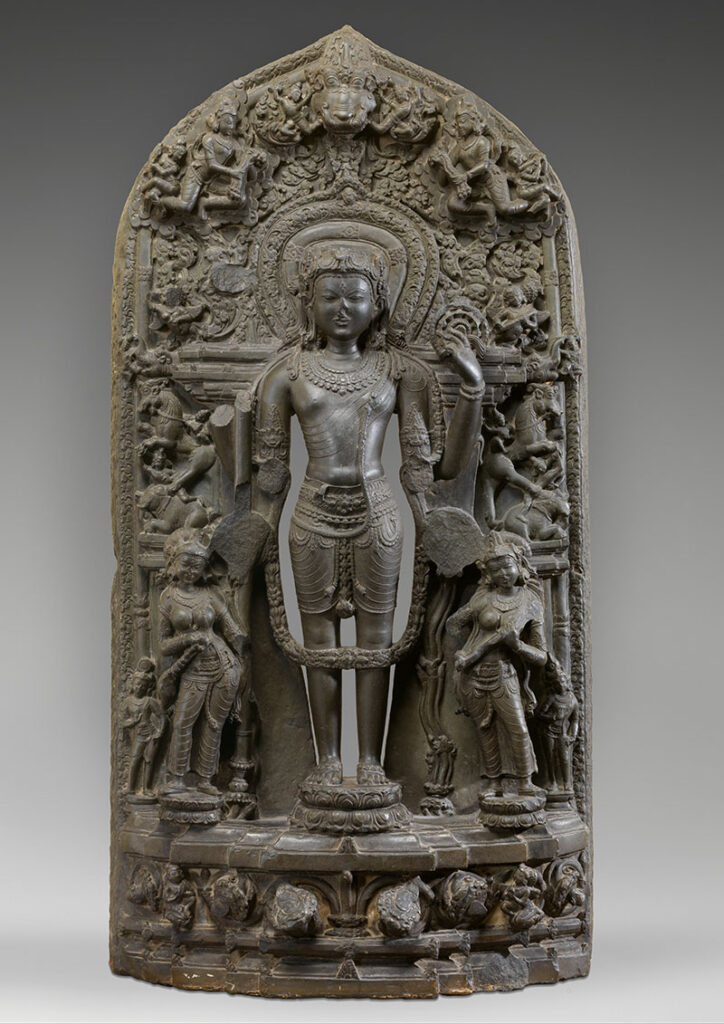
Largest major Hindu sect — followed by Shaivism and Shaktism — centred on the worship of Vishnu and his ten avatars (Dashavatara). The origins of Vaishnavism lie in the syncretic fusion of various non-Vedic cults, particularly the complex of Bhagavata cults of the Vrishni hero Vasudeva and Vasudeva-Krishna, and the Vedic cult of Narayana. In the medieval period Vaishnavism was reshaped by the spread of Bhakti, a devotional movement that emphasised a personal relationship between devotee and deity. Its principal sub-sects centre on two prominent avatars of Vishnu, Rama and Krishna. Central texts of Vaishnavism include the epics Mahabharata (fourth century BCE to third century CE) and Ramayana (seventh to fourth centuries BCE), the Bhagavata Purana (fifth to tenth centuries CE), the Bhagavad Gita (second century BCE to second century CE) and the Tamil hymns of the Alvar poet-saints (sixth to ninth centuries CE). Vaishnavism attracted royal patronage across centuries, from the ancient Gupta dynasty, whose rulers styled themselves parama-bhagavata (‘most supreme devotee of Vishnu’), to the medieval Gajapatis and Tuluvas. Major Vaishnava temples include the Dashavatara Temple at Deogarh, the Ranganathaswamy temple at Srirangam, the Venkateshwara Temple at Tirumala, and the Jagannatha Temple at Puri.
Vaishnavism
Link copied!