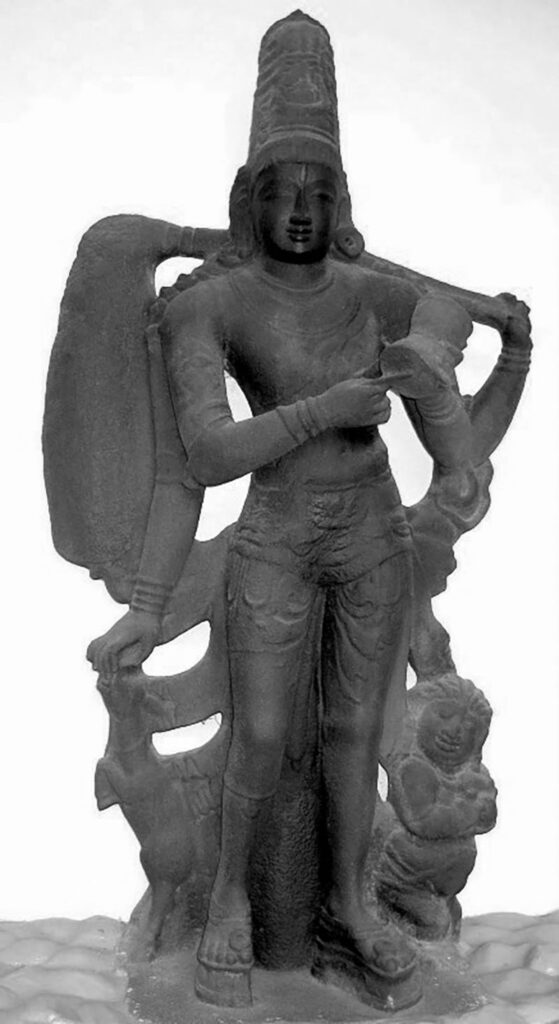
A form of the Hindu deity, Shiva, in which he is shown with a kankala-danda (a staff bearing the bones of a dead being). In iconographical representations, an ornamented Shiva is shown with his right leg bent, to suggest walking, and the kankala-danda held on his left shoulder. He is surrounded by women, bhutagana (his attendants), as well as sages, semi-divine beings and deities. This form is primarily found in southern India. A depiction of it can be found at the Gangaikondacolisvaram Temple in Tamil Nadu, India.
More Definitions
Rishyasringa
A sage in Hindu mythology portrayed in the Mahabharata as the harbinger of rains and in the Ramayana as the…
Ganas
In Hindu mythology, they are attendants of Shiva who live with him on Mount Kailasa. They are usually depicted alongside…
Puranas
A genre of ancient and religious texts written in Sanskrit, Tamil and other languages. The texts are encyclopaedic and cover…
Shi’ism
The second largest denomination of Islam after Sunnism, Shi'ism is believed to have originated in 632 CE in Medina, present-day…
Vajrapani
A bodhisattva from Mahayana Buddhism and the protector and guide of the Gautama Buddha as well as a manifestation of…
Devadushya
Meaning “divine cloth” in Sanskrit, it is an upper body garment. In Jainism, it is believed that the deity Indra…
Madrassa
An institution of higher learning in the Islamic thought. In its earliest form, it was an extension of mosques and…
Indra
A major Vedic deity, he is believed to be the king of the realm of gods within Hinduism and Buddhism,…