-
ChicagoMunipella, Aparna. "Reading Rajasthan Through Textiles: A Conversation with Dr Madan Meena." Impart Perspectives, July 31, 2026. https://imp-art.org/perspectives/interviews/reading-rajasthan-through-textiles-a-conversation-with-dr-madan-meena/
-
MLAMunipella, Aparna. "Reading Rajasthan Through Textiles: A Conversation with Dr Madan Meena." Impart Perspectives, Jul. 31, 2026, https://imp-art.org/perspectives/interviews/reading-rajasthan-through-textiles-a-conversation-with-dr-madan-meena/. Accessed 15 Oct 2026.
-
HarvardMunipella, A. (2026) Reading Rajasthan Through Textiles: A Conversation with Dr Madan Meena, Impart Perspectives. Available at: https://imp-art.org/perspectives/interviews/reading-rajasthan-through-textiles-a-conversation-with-dr-madan-meena/ (Accessed: 15 October 2026).
Reading Rajasthan Through Textiles: A Conversation with Dr Madan Meena
Having spent the past 15 years deeply immersed in the art of Rajasthani block prints, the folk researcher unpacks the visual language of textiles from the region.
By Aparna Munipella
Link copied!
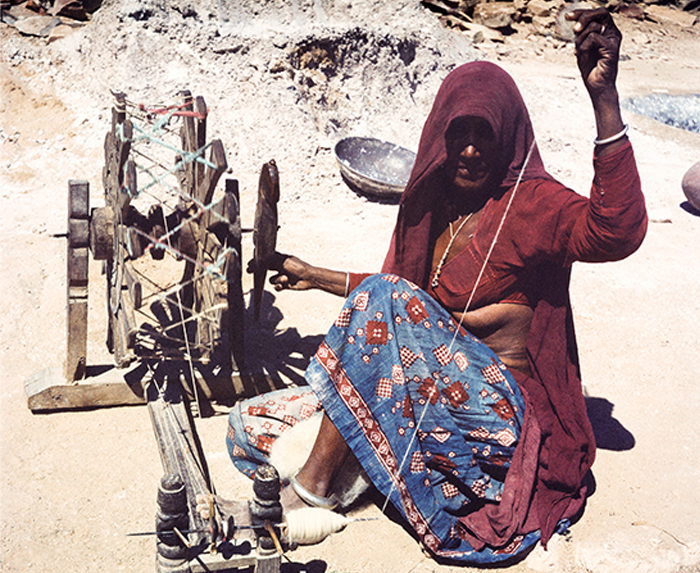
Raika widow from Borunda, Jodhpur; Rajasthan, India; 1982. Photograph: Elizabeth Simson
For most scholars, textiles are studied in the context of design and aesthetics, techniques and materials, or commerce. For folk researcher Dr Madan Meena, however, a textile is an archive — of community memory and rituals, traditional networks of patronage, ecological diversity, and social histories, such as migrations and cultural adaptations.
The foundations of this approach emerged through an unlikely object — the broom. While documenting traditional broom-making communities, Meena realised that a broom was not just a household tool. The plants used to make one came from specific ecological environments, and the ways of collecting and processing them was inherited knowledge. The object also occupied an important place within domestic and ritual life — it was surrounded by a body of customs and beliefs. This experience transformed how he understood craft objects. To him, they became visible expressions of a larger cultural ecosystem. This insight would later shape his research on textiles, pottery, folk culture, and community knowledge systems.
Another important influence was the work of linguist and cultural activist Dr GN Devy. While participating in projects documenting the linguistic diversity of Rajasthan, Meena became increasingly aware that language preserves the intimate histories of communities. Vocabulary and local classifications often revealed cultural distinctions invisible in conventional historical accounts. This encouraged him to read textiles not simply as objects but as repositories of knowledge embedded within larger systems of language, memory, livelihoods, and place.
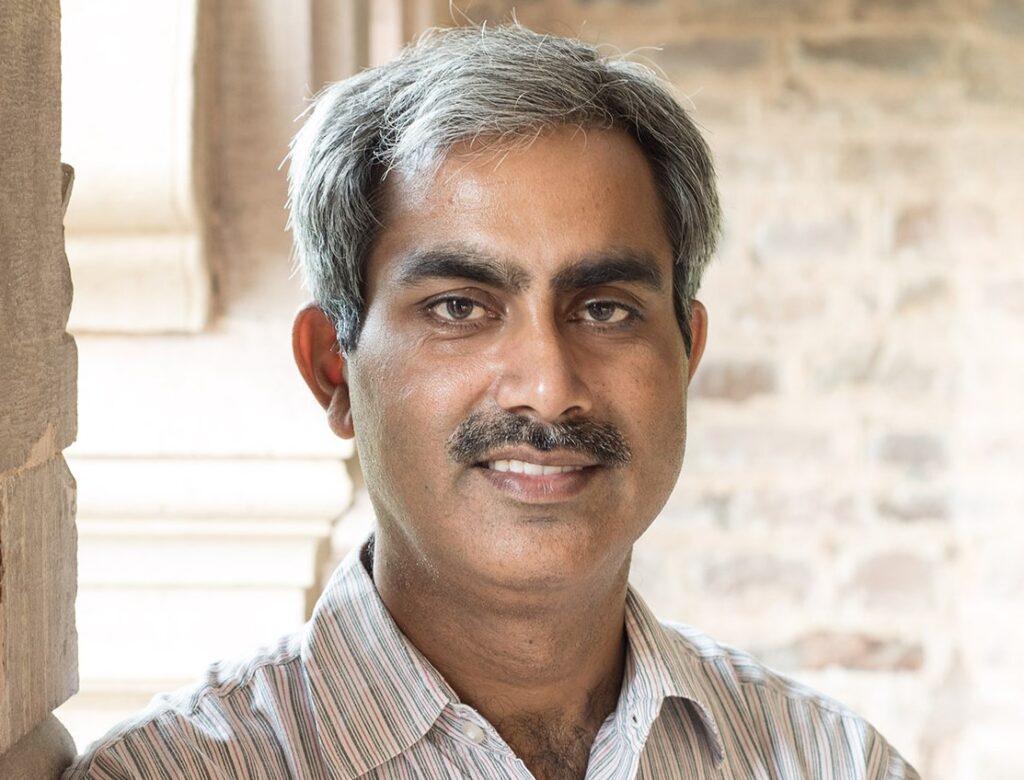
Meena gradually moved beyond studying objects in isolation. Textiles led him to songs and communities. Communities led him to landscapes. Landscapes led him to language, migration, and history. What emerged was a method of reading culture as a web of interrelated stories.
Aparna Munipella: Your research argues that textiles once functioned as a visual language of identity. What can traditional textiles tell us about the communities of Rajasthan?
Dr Madan Meena: Communities identify themselves through textiles, and textiles, in turn, identify communities. This applies to both — the artisans as well as user communities. Traditionally, textiles communicated far more than aesthetic taste. They could indicate community affiliation, geographical origin, marital status, and social position. Clothing functioned almost like a language.
For instance, in one photograph I took, there were two widowed women from the Raika community wearing completely different prints. One of them wore a kappa print from the Godwar region, paired with a deep maroon odhni, while the other had clothes with a rabari-ro-phetiyo print associated with Marwar. Even though they shared the same community identity and marital status, regional identity had produced different textile traditions.
In another photograph, three women from the same household wore different prints. One was a widow, one a married woman (suhaagan), and one newly married (beendani). Each wore a distinct print. The married woman wore makoda print, inspired by an insect motif. The newly-married woman wore qatar print, a dagger-shaped motif, and the widow wore her designated print called rabari-ro-phetiyo. Clothing functioned as a visual language that communicated status, age, and social position. This kind of ‘textile literacy’ was once widespread across Rajasthan. Communities recognised themselves through prints, colours, and garments. Such visual records are still present with the block carvers, printers, and traditional merchants.
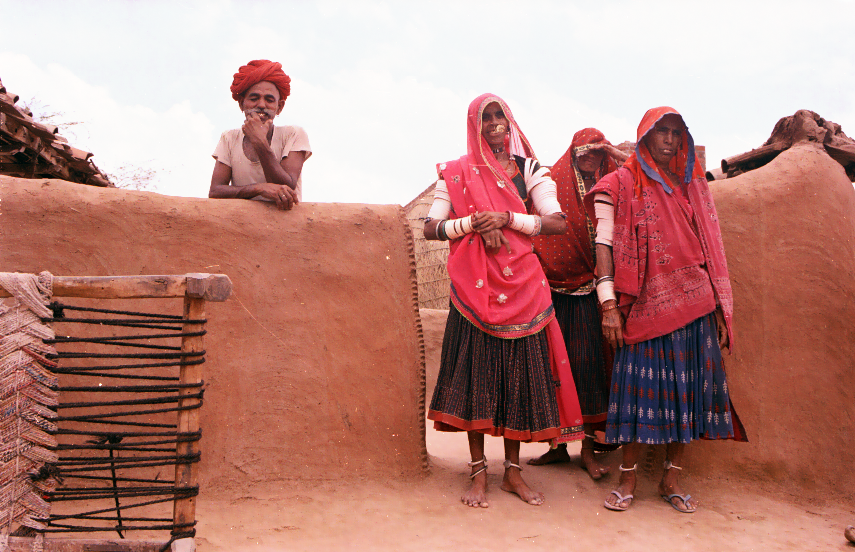
Even today, traces of this system survive. The Bishnoi community, spread across the land between Bikaner to Jodhpur, continues to preserve a strong visual identity through dress. A circular print, known locally as kachri sada, remains associated with the community. They also avoid indigo because it is prohibited according to the community’s 29 principles. Seeing the wide use of red in the prints shows the textile colour palette of Rajasthan is red, not indigo. Here, even the widows wear maroon-red instead of white. Although the original hand-block printed versions have largely disappeared — replaced by screen-printed cloth — the colour conventions and visual identity has survived this adaptation.
Panchayats among Bishnoi, Jat, Gurjar, Meena, and Meghwal communities have actively encouraged people to continue wearing these prints during weddings and social occasions. To adapt these textiles to contemporary tastes, many women embellish them with gota-patti work while retaining the original printed base.
Munipella: How did local ecology influence the motifs, materials, and knowledge systems that shaped Rajasthan’s textile traditions?
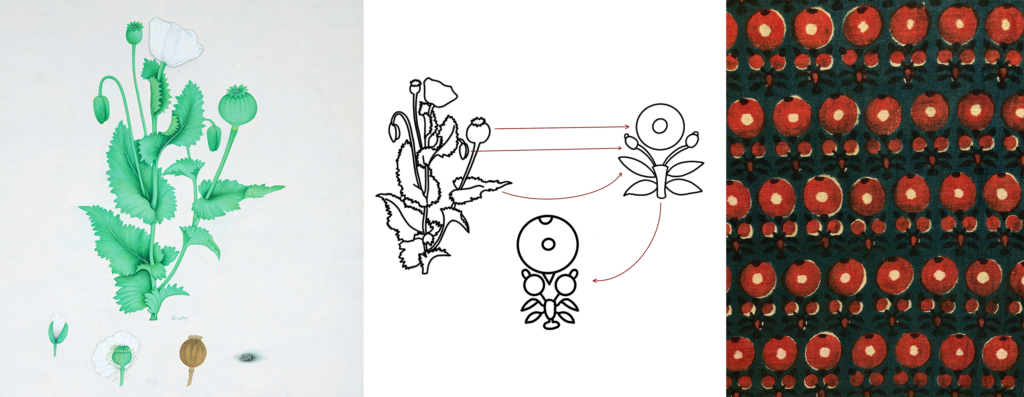
Meena: People often think of textile motifs as decorative inventions. In reality, most traditional motifs emerged from close observation of the natural world. In my research, I have found that nearly 70 to 80 per cent of traditional motifs are derived from plants. We encounter designs inspired by gunda, nimboli, methi, chameli, dhaniya, boria, and numerous other species familiar to desert communities. Not all motifs are botanical. Designs such as bhalka emerge from the spear, while qatar takes inspiration from the dagger. Yet, an overwhelming majority of motifs originate from the varied forms of plant, insect and animal life of Rajasthan. This challenges the common perception of Rajasthan as a barren landscape. The desert possesses a rich ecological vocabulary, and that vocabulary found expression through textiles.
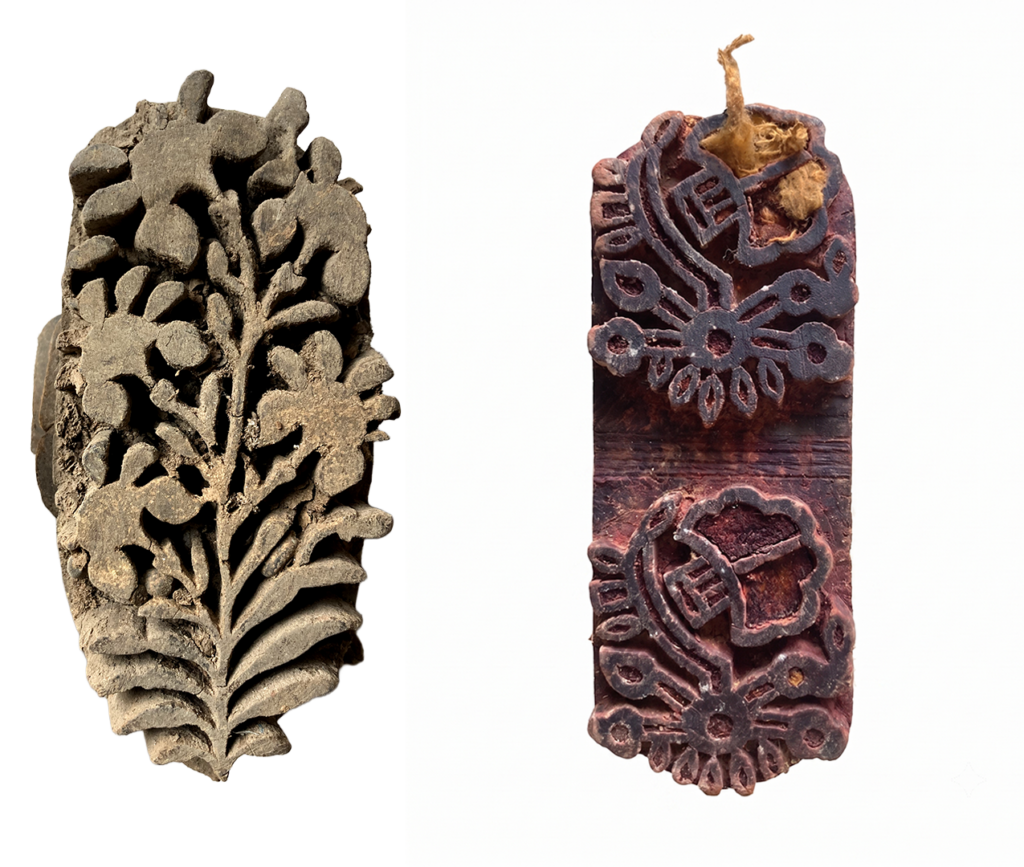
What interests me most is how artisans transformed living plants into repeatable motifs. A block carver does not reproduce a plant exactly as it appears in nature. He studies its form, identifies its essential characteristics, and gradually simplifies it into a design that can be carved and printed repeatedly.
The true designers of these textiles were therefore the block carvers themselves. They determined what to retain, what to simplify, how motifs would repeat, how spacing would function, and how colour and resist would be applied. They were simultaneously observers, designers, technicians, and storytellers. Their ecological knowledge extends far beyond design. Every printing centre developed its own methods in response to local conditions. Water, ground, clay, climate, minerals, and vegetation all shaped what the final textile looked like.
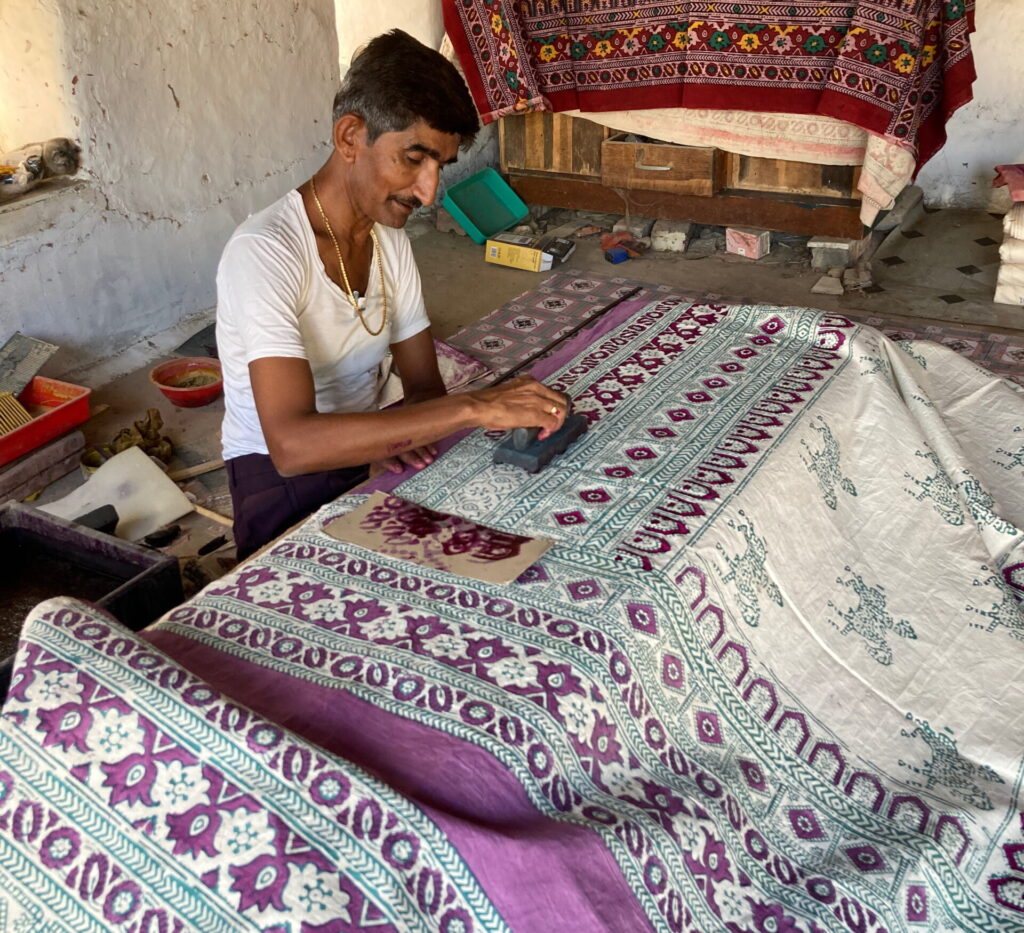
One of the greatest misconceptions about traditional printing is the assumption that it follows a fixed formula. In reality, every region developed specific knowledge systems. The composition of resist pastes varied. Printing dye and resist recipes varied. The printing sequences varied. Traditional printers collected clay from the beds of seasonal ponds when they dried up, not from mines. Different ponds produced different clays, each affecting the printing process differently. Water was equally important. Its mineral composition, iron content, and pH directly influenced colour outcomes. This is why centres such as Bagh in Madhya Pradesh became known for their distinctive bright red shade as they are lucky to receive the unpolluted water of Baghini river flowing from the forest.
At Pipar village, near Jodhpur, the Chiplai nadi (pond) water yields different shades of red, depending on the season. This is due to the changing concentration of minerals in the water as the pond gets charged during the monsoon and slowly dries up during summers. The textile brands who want standard shades do not understand this ecological phenomenon. But traditional printers understand these variations intuitively. Their knowledge is not separated into chemistry, ecology, botany, and design. It exists as a single integrated system accumulated through generations of practice.
Climate has also shaped production in the past. Many forms of printing were suspended during the monsoon. Mordant-printed cloth was left to mature in the monsoon moisture and later processed during Diwali as it produced richer colours. Printers frequently moved between agriculture and craft according to seasonal cycles. Design institutions should align with this kind of artisanal knowledge.
Munipella: How do textile traditions help us understand the movement of communities and cultural exchange across Rajasthan, Kutch, and Sindh?
Meena: Much of my research has focused on the printing communities of western Rajasthan and Kutch, particularly the Khatris and Chhipas. My fieldwork involved documenting surviving traces of their histories, often absent from written records, through old blocks, family collections, and private archives. Through textile dealers and artisan families, I have documented nearly 2,000 historical designs that reveal forgotten printing traditions.
As I traced their histories, it became increasingly clear that Rajasthan, Kutch, and Sindh once formed a connected cultural landscape. During times of famine, before Partition, distress migration has been both westward, from Sindh, and to Malwa (Madhya Pradesh) in the east. Many craft communities migrated from Sindh and permanently settled in Rajasthan, Kutch and Madhya Pradesh. I have spotted many old kikar (gum arabic) wood blocks of Sindh in Rajasthan, Kutch, and Madhya Pradesh.
Before modern political borders divided these regions, people, goods, techniques, and ideas moved freely. Kutch and Sindh shared deep cultural and economic connections. The similarities in printing traditions across these regions are evidence of those relationships.
Migration among artisan communities was often driven by ecology and trade. Water sources, grazing routes, markets, and trade corridors influenced where communities settled. Kutch, Barmer, and Sindh formed a continuous cultural landscape where music, language, and textile traditions flowed across boundaries.
Language provides the most fascinating evidence in this regard. The Manganiyars, for example, sing in Sindhi, Kutchi, Dhati, and Marwari. Textile traditions reveal similar continuities. Take ajrakh printing in Barmer and Kutch. The printing process, design techniques, and historical origins are essentially the same in both regions. Their craft traditions emerged from Sindh and were carried to these two geographically separated locations by the Khatri printing communities that dispersed and settled in different regions. Yet the terminology used to describe the stages of printing differs because the craft became embedded within different linguistic environments.
The same motif may carry different names in neighbouring regions. At the same time, a single name may refer to different visual forms. Among Banjara communities, for example, I documented a design known as Nadana in several locations across Rajasthan. The name remained the same, but the design itself varied from region to region.
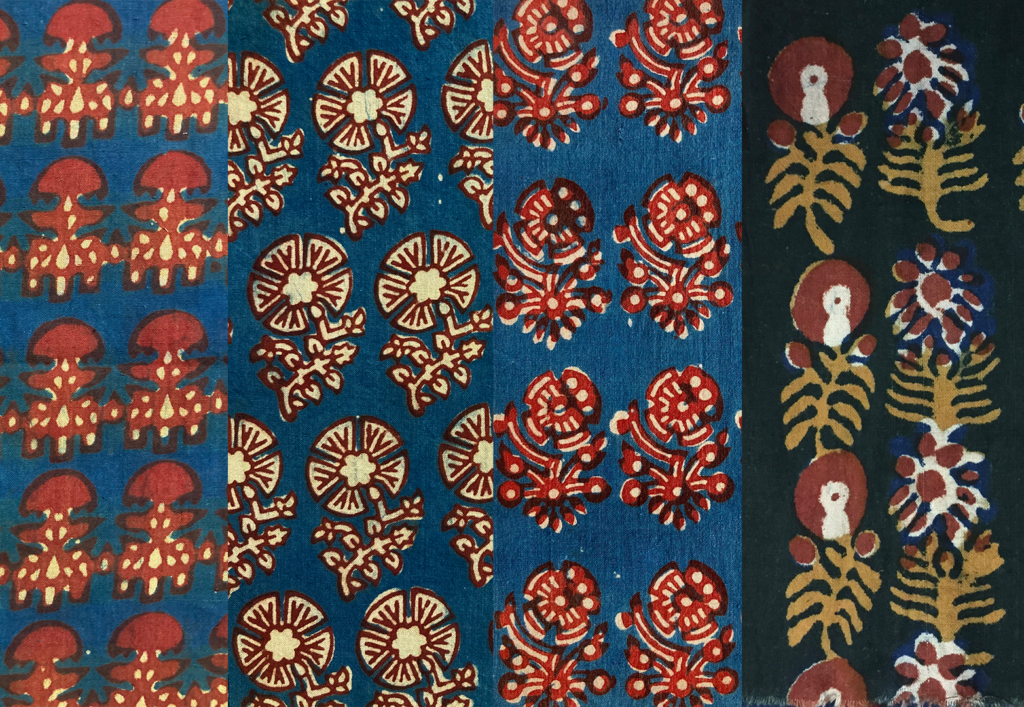
As one moves geographically across Rajasthan, these differences become visible in the designs themselves. The prints of western Rajasthan are generally bold and large-scale. As one moves eastward, through Pali and Ajmer towards Jaipur, the designs become increasingly intricate, reflecting the influence of centres such as Sanganer patronised by nobles and the aristocratic class.
Trade also played a crucial role in shaping these networks. Before Mumbai emerged as India’s dominant western trade hub, Surat and Karachi were the busiest ports. Jaisalmer maintained strong connections with Sindh, and caravans moved goods across these regions through extensive trade routes. My research also revealed how dramatically the landscape has changed. Historically, almost every village had printers, dyers, and artisan communities. Most have disappeared during the last century.
The first major disruption came through machine-made Manchester textiles during the colonial period. After Independence, screen printing and industrial textile production accelerated the decline. Today, places such as Sanagner, Pali, Balotra, and Jodhpur contain thousands of screen-printing units. Traditional printing centres have disappeared, and with them have vanished local motifs, specialised craft vocabulary, community histories, and inherited knowledge systems.
Munipella: What have you learnt about the way communities preserve and transmit cultural knowledge across generations?
Meena: One of the most important lessons I learned from scholars, such as Komal Kothari and Dr GN Devy, was that cultural traditions cannot be understood in isolation. My work on the languages of Rajasthan played an important role in shaping this understanding. Different communities classify the world differently. Their vocabularies preserve memories of landscapes, occupations, relationships, and histories that may no longer be visible elsewhere.
I had observed something similar while studying Meena wall paintings. Even within a relatively small geographical area, stylistic variations often corresponded with linguistic and cultural differences. When language shifts, artistic expressions change as well. But these changes are fluid; there are no abrupt transitions from one region to the next, no clear boundaries demarcating each region’s traditions.
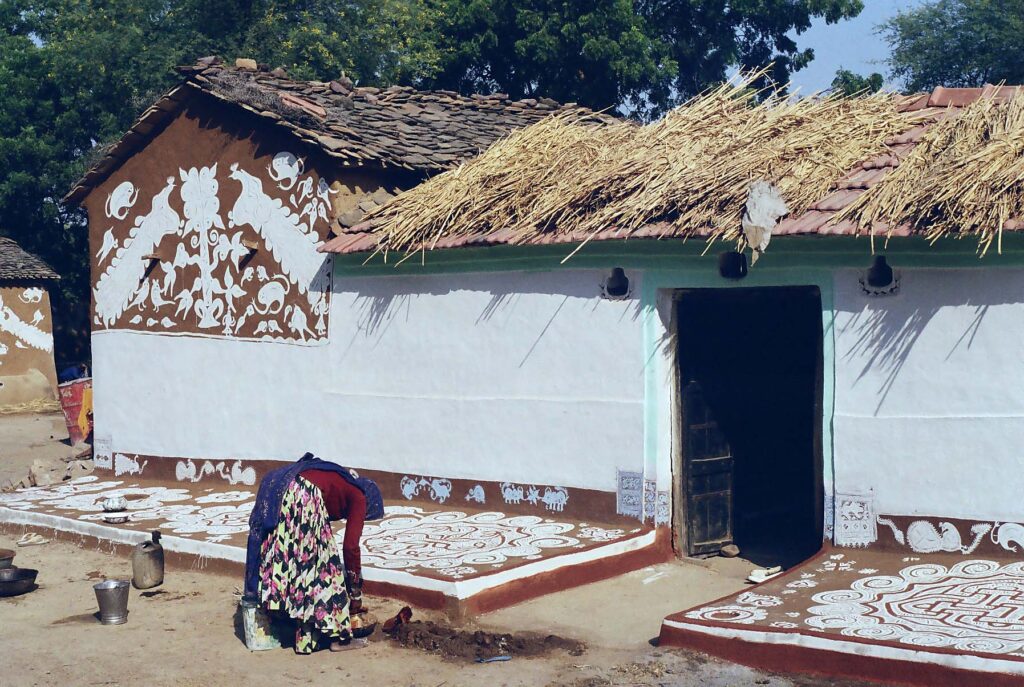
A textile cannot be understood only as an object. It is connected to the environment that produced its raw materials, the language that names its motifs, the community that wears it, the songs that celebrate it, and the historical and social experiences that shaped it. Similarly, a block print contains far more than a decorative pattern. It contains ecological observation, linguistic memory, artisanal creativity, community identity, and historical movement. Much of modern scholarship separates these subjects into different disciplines. Traditional knowledge systems rarely worked in that way. Knowledge emerged through relationships rather than categories. When a craft disappears, we lose not only an object or a technique, but an entire way of understanding the world.
First published: July 31, 2026