-
ChicagoSoni, Anchal. "The City as Gallery: Udaipur’s ‘Hathi-Ghoda’ Murals." Impart Perspectives, April 3, 2026. https://imp-art.org/perspectives/dispatches/the-city-as-gallery-udaipurs-hathi-ghoda-murals/
-
MLASoni, Anchal. "The City as Gallery: Udaipur’s ‘Hathi-Ghoda’ Murals." Impart Perspectives, Apr. 3, 2026, https://imp-art.org/perspectives/dispatches/the-city-as-gallery-udaipurs-hathi-ghoda-murals/. Accessed 20 Oct 2026.
-
HarvardSoni, A. (2026) The City as Gallery: Udaipur’s ‘Hathi-Ghoda’ Murals, Impart Perspectives. Available at: https://imp-art.org/perspectives/dispatches/the-city-as-gallery-udaipurs-hathi-ghoda-murals/ (Accessed: 20 October 2026).
The City as Gallery: Udaipur’s ‘Hathi-Ghoda’ Murals
In Udaipur, once the capital of Rajasthan's Mewar kingdom ruled by Sisodia Rajputs, 'hathi-ghoda' wall murals are an integral part of the cityscape — and the local cultural economy.
By Anchal Soni
Link copied!
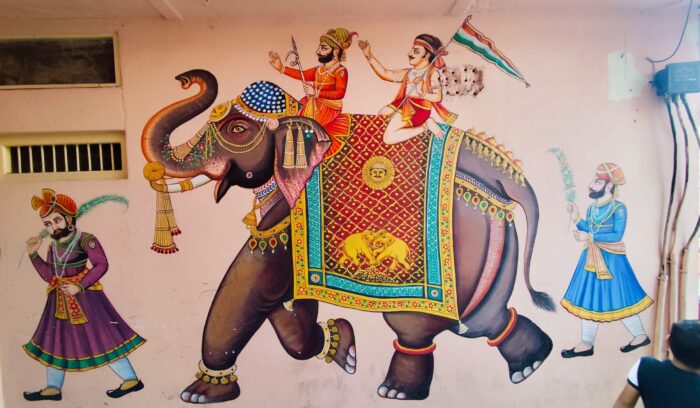
Udaipur's 'Sunaro ki Gali' in the Old City area has some of the best examples of hathi-ghoda murals. Courtesy the author
As one walks into the narrow lanes of the Old City in Udaipur, the walls become a continuous canvas. Colourful depictions of Hindu marriage processions, elephants and horses with their riders, cows and cowherds, and scenes from darbars (royal court gatherings) decorate the exterior walls of homes — some with new murals layered over older, faded ones. Very often, such large-scale wall paintings faithfully reproduce familiar themes and motifs from miniature art once produced only by royal court painters, and pichhwai art commissioned for Vaishnav haveli temples.
Rajasthan, like the rest of the Indian subcontinent, has a rich history of wall murals — stretching all the way back to prehistoric cave art. Indigenous practices, such as Bhil art and mandana, traditionally painted on mud walls of village homes, are part of unbroken living traditions that continue to this day. Udaipur’s murals, however, reflect the dominant influence of Rajput painting traditions on the city, once the capital of the Sisodia clan of Mewar. They are also an integral part of the local cultural economy and the city’s visual culture.
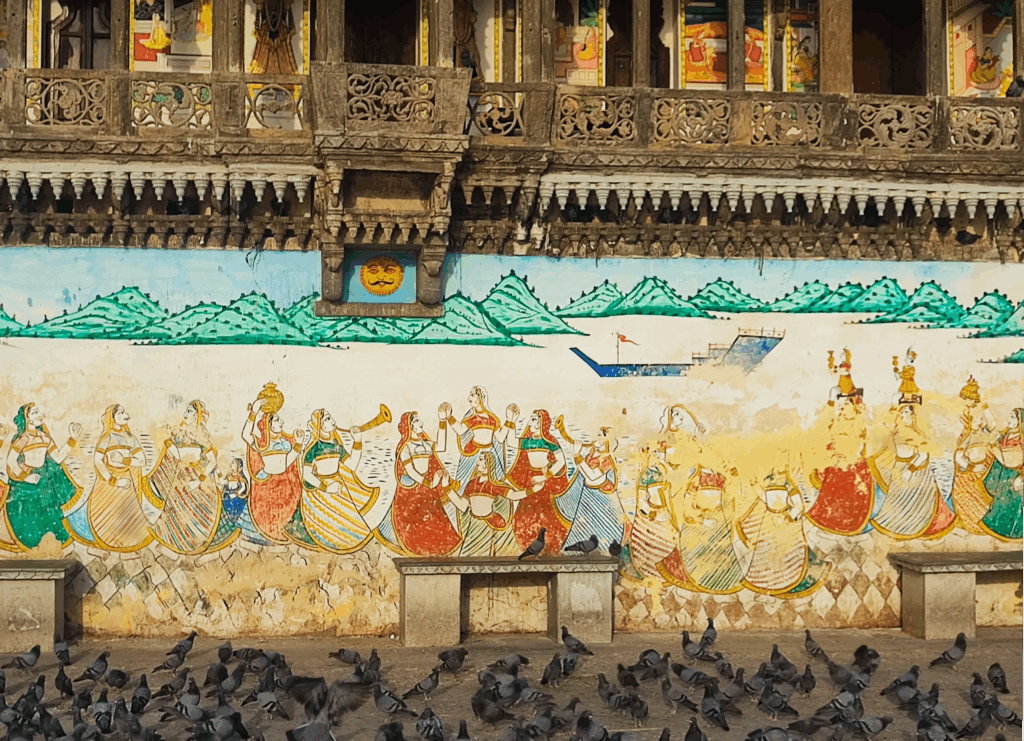
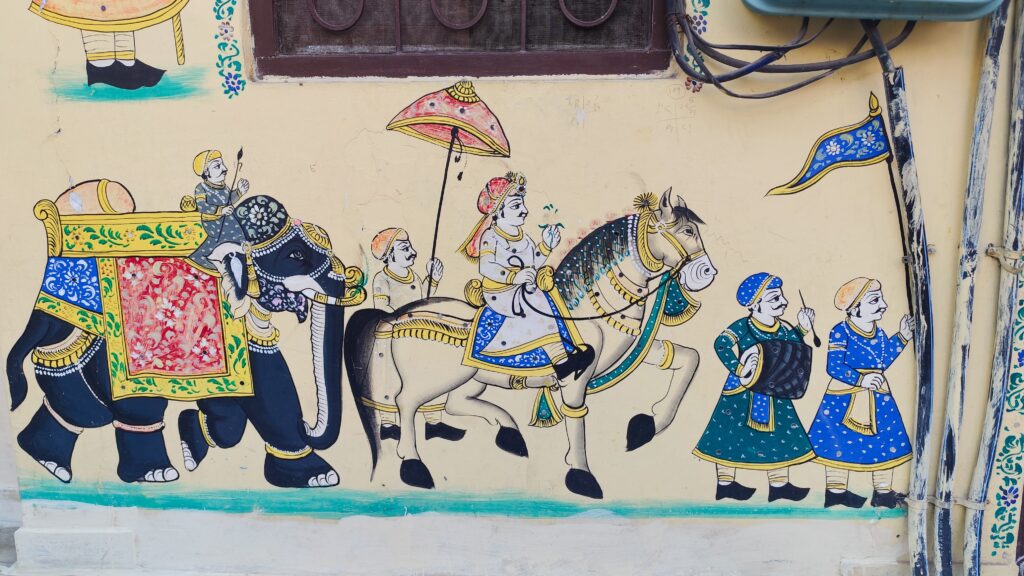
Heavily influenced by the Mewar school of painting, “hathi-ghoda” aka “elephant and horse” wall murals are commissioned just before weddings as homes get spruced up for guests before marriage festivities. The bride’s family usually commission a mural depicting the doli (the traditional palanquin for the bride), along with a chowkidaar (watchguard) or two near the main entrance. The bridegroom’s family, on the other hand, picks designs depicting a baarat (wedding procession). Sundar Paliwal, a self-taught veteran artist, says, “This [mural tradition] is going to stay. Otherwise, no one knows, after a day or two, if there even was a wedding, regardless of whether the families spend lakhs [of rupees] on it.”
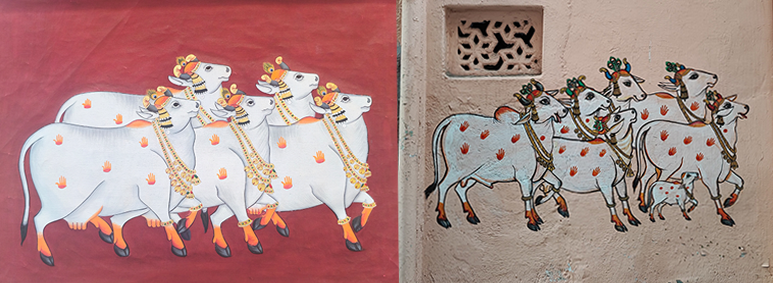
The motifs of the hathi (elephant) and ghoda (horse) are especially important as they represent ‘wealth’ and ‘power’, respectively. Families belonging to the Vaishnavite Pushtimarg sect also commission devotional murals during weddings. These incorporate motifs like cows and cowherds, symbolising the Hindu deity Krishna, inspired by Mewar’s sacred pichhwai art tradition from the Nathdwara school of painting. According to Paliwal, these murals represent an unbroken continuum of artistry, with painters adapting highly-regarded regional painting motifs from the Mewar school to create the distinctive wall paintings that now grace Udaipur’s alleys, especially in older neighbourhoods. “Udaipur’s mural art is [Mewar’s] miniature art that has transcended its medium,” says Jagdish Menaria, a first-generation artist in his 30s who learnt traditional art techniques as an apprentice under Paliwal at his workshop.
With a thriving cultural industry catering to tourists and the global market for traditional Rajasthani arts and crafts, the city has a high concentration of art galleries, workshops, and artisanal shops. Many art emporiums have attached workshops that employ trained artists for fixed wages for painting miniatures and pichhwais en masse. These sell for anything between a few thousands rupees to a few lakhs. Wall mural art is an offshoot ‘product’ of this local creative economy around traditional art.
Unlike miniatures or pichhwai artwork, which remain anonymous, hathi-ghoda murals are often signed with the painter’s or workshop’s name and phone number, locating them more firmly in the category of commercial art. Most wall mural painters are affiliated to workshops under an established master who negotiates commissions, provides labour opportunities, and teaches the traditional techniques for murals, miniatures, and pichhwai art. Artist Narendra Sharma, who runs one such workshop, says, “Right now, only the lowest level of artists paint these hathi-ghoda murals.”
However, one of the painters working under Sharma reveals that murals are still a significant source of income. Despite the large number of art galleries in Udaipur selling miniatures and pichhwai art, supply outstrips demand, giving galleries the upper hand in terms of setting the price, usually in the form of wages for a certain number of artworks per month. “There are many artists painting miniatures and pichawais, so people get the work done on a lower budget. Most of the money [made from selling the art] goes to the commercial galleries, not the artist,” says Sharma. As a result, some artists stop making miniatures and pichhwais — despite the respect they get as master artists — to take on the “easier” wall mural commissions because they take less time, and the pay is decent for the labour involved.
Dilip, a master artist, switched to painting wall murals as it caused him less eye strain. He was earlier attached to a workshop where he was paid a monthly wage for producing miniatures, but now works independently. Kantilal Chaudhary, another artist, depends on a workshop — where he has worked for the last 20 years — to find him mural commissions. Rather than being a permanent employee, he is taken on as a temporary gig worker for each project and paid on a per day basis for his labour. Living at the nearby village of Palodra, he travels to the city every morning for work to support his family’s small business back home during the off season. He also does wall murals in his own village as an independent contractor and, once in a while, ceiling art in temples and hotels. In Chaudhary’s own words, mural artists are constantly hustling to find work where they can, saying, “When we look for 10 gigs, we get one.”
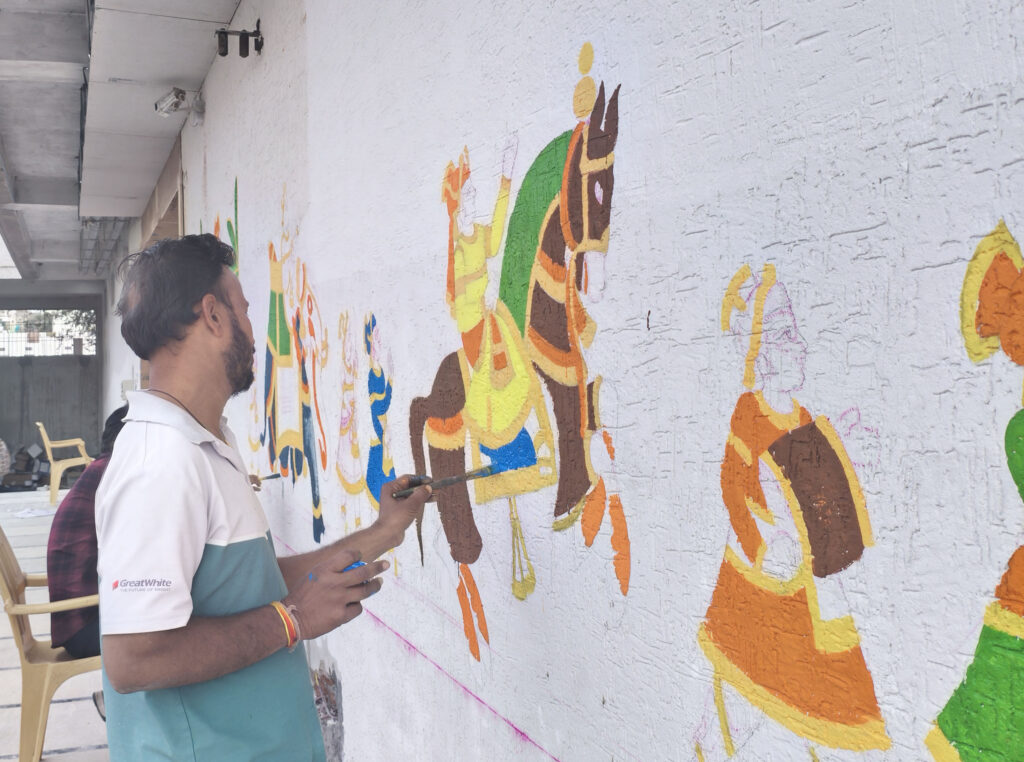
Commissions are negotiated directly with the patron-families, either by independent painters themselves or by workshops that employ artists. Business booms between October and March, which is peak wedding season in Udaipur. While speaking to artists, it becomes apparent that mural work is usually undertaken in times of economic hardships, health reasons, or towards the early part of a painter’s career. Bhajanlal, who often takes up wall mural gigs, says that he receives between four to five thousand rupees (USD 44-55) for “a floral design around the main door, two chowkidar figures, and the main mural.” The most common subjects he paints are hathi, ghoda, women with aarti kalash (ceremonial pot and lamp), and wedding processions with musicians, dancers, and riders.
Commissioned by Hindu households across castes and classes in Udaipur, Paliwal refers to these contemporary murals as ritualised paintings, guided by Vaastu (traditional Hindu principles of home design) or to ward off doshas (household imbalances). This is one reason why wall mural designs have stayed largely static over the years. Paliwal says that early examples of wall murals linked to weddings, even 40 to 50 years ago, could easily be classified into three simple “types” — hathi-ghoda (elephants and horses), doli (bride’s palanquin) or darbar (court scene). More elaborate murals have become popular in recent years, but still well within the traditional style. Paliwal remarks that murals now also depict elaborate wedding processions (baarat), chowkidaars at the entrance, and figures of women dressed in traditional poshak (attire) as part of wedding processions and rituals, which he says are “all additions.”
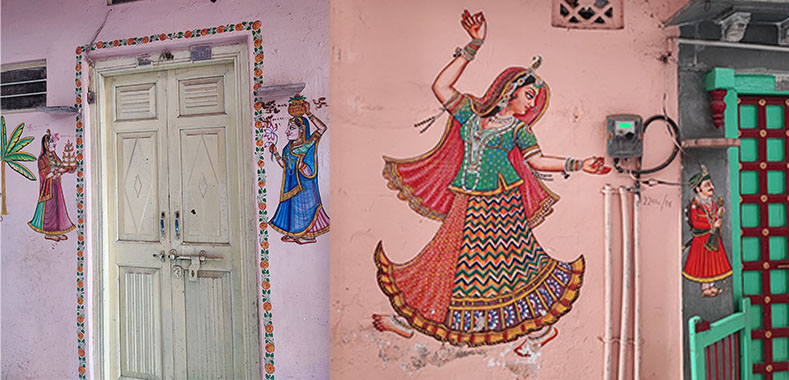
Earlier, women were not depicted on public facing walls because of conservative cultural values. “Before, we would paint women in darbaar scenes, and with aarti thali, but on the interior walls,” says Paliwal. Now in addition to these, women dancers also feature on exterior wall murals that point to the loosening of cultural norms around ‘acceptable’ designs. “Scope has expanded because of these,” Paliwal adds, saying it is master artists like him who “take responsibility” for the designs rather than the commissioning household. Another change — the exclusive use of opaque watercolours — has more to do with the supply and demand for wedding murals in the local economy. In the past, both watercolours and oil paints were used. “But oil paint stays for too long and challenges our rozi-roti [income]. Three, sometimes four, marriages can happen over the years in the same house, but murals done with oil paints don’t fade. We were at a loss,” says Paliwal. Therefore, mural painters have shifted to opaque watercolours that fade faster to ensure repeat commissions. Slightly bigger budgets prompt minor innovations, such as the use of mirror-work to decorate murals.
An interesting dynamic comes to light while studying the livelihoods connected to this ritualised and local cultural production. In their 2004 study of Miniature Painting, Cultural Economy and Territorial Dynamics in Rajasthan, India, Bautes and Valette posit that the intersections of surplus availability of the painters compared to the demand means cultural labour around traditional painting yields precarious livelihoods. They conclude that this type of ‘artistic production’ should be considered in limited economic terms, where a painter’s artistry — what he paints — is linked to what sells. In the case of hathi-ghoda mural artists too, the question of aesthetics is fundamentally the question of labour. “We just follow the fixed designs,” says Kantilal Chaudhary when asked whether he gets to show his creativity on the job. His murals are also signed — not with his name or number — but “Bauji’s name,” referring to the owner of the workshop he is employed by.
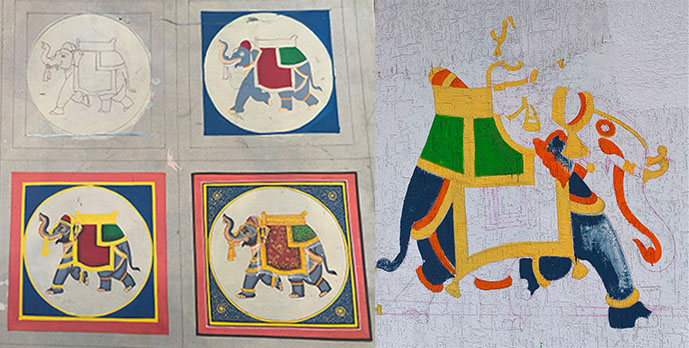
The representational economics established in the colonial times displayed a trend, where “the image of the city of Udaipur was determined by the historical domination of Rajput power,” according to Bautes and Valette. It is no surprise then that cultural labour is ranked based on feudal Rajput values that shape perceptions around what is deemed ‘valuable’ cultural production. Within Udaipur’s heterogeneous traditional artists’ community, wedding mural painting is regarded as manual labour, and less skilled work — the lowest in the hierarchy of traditional art practices. Narendra Sharma mentions that though he started in the profession as a hathi-ghoda artist, he shifted to the “more respectable” art form of pichhwai later in his career. Interviews revealed that artists producing miniatures and pichhwai art are regarded more highly because these are recognised art forms. Once patronised by Rajput royalty and savarna castes with courtly or sacred associations, they continue to receive international patronage and tourist attention. Wedding murals, on the other hand, are seen as a purely local phenomenon linked to marriage ceremonies with more ritual and decorative significance than artistry.
In his book Cultural Labour about folk performances in India, cultural theorist Brahma Prakash refers to cultural labour as “a creative economy placed in a hegemonic local context.” In the case of mural artists, the dominant Rajput culture and the savarna families who run artist workshops, and largely control the local economy around traditional paintings are the “hegemonic local context.” Under such conditions, workers have to play their assigned roles to get the production values of their works recognised, according to Prakash. In other words, the artistic merit of a mural painter’s work is not recognised outside their assigned role of replicating hathi-ghoda designs.
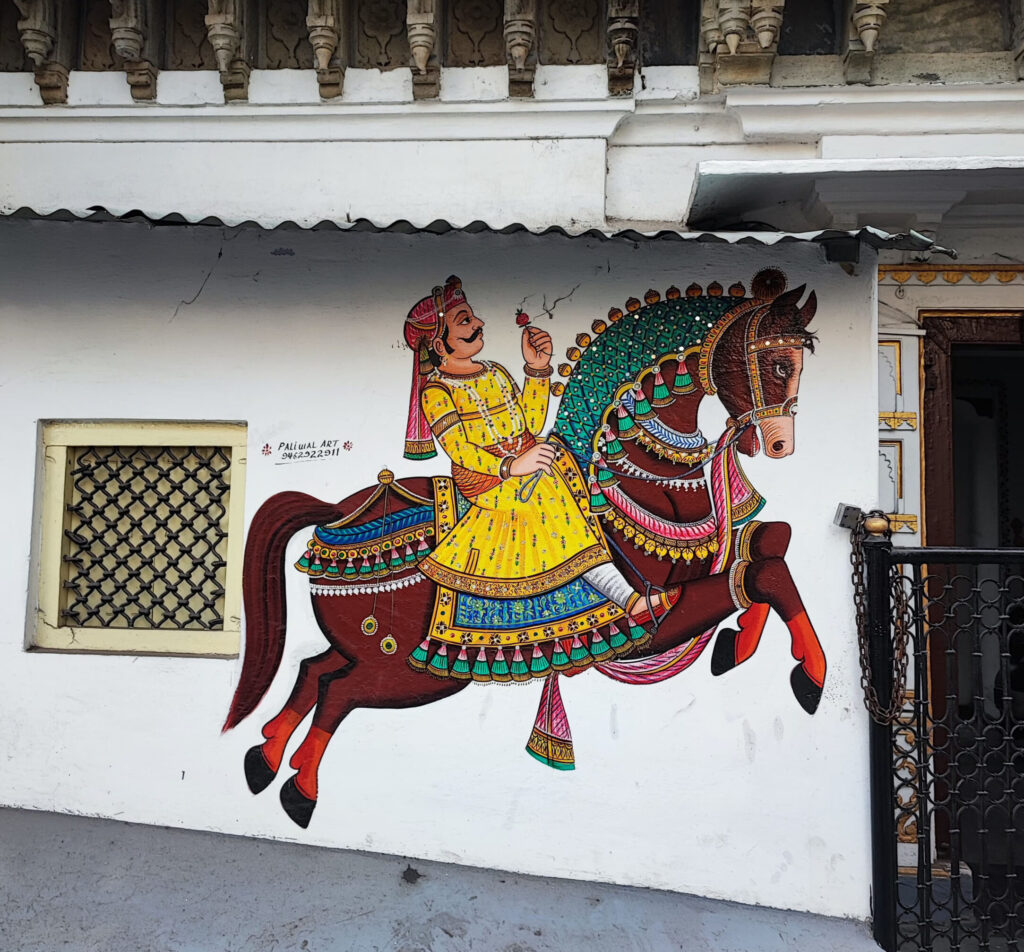
Among these designs, the horse motif holds a particularly masculine notion of power among Rajput warrior clans. An aged artist, who once worked in the city palace, tells me, “There is nothing as masculine as a horse in this universe. Horses don’t have breasts like other animals. This power makes the horse shubh or lucky.” In another instance of caste pride, an elderly Rajput woman revealed that in rural areas, till date, they take pride in not allowing Dalits to sit on a horse, let alone paint one on their doors. “Now, everyone who has money gets murals done,” she adds. For her and other interviewees from dominant castes, wedding murals are a part of savarna culture.
Murals commissioned by households from marginalised castes in Udaipur can therefore be seen as a form of a pushback on who can or cannot display these motifs that are associated with Rajput culture and dominant caste pride. In Regar Colony, a segregated Dalit locality, the murals are simple hathi-ghoda murals and accompanied by lettering over doors announcing caste identities: “Aadiwal family welcomes you” or “Rathod family welcomes you.” The declaration of caste identity in tandem with the murals disrupts their hegemonic association with savarna culture, and is a relatively recent phenomenon in the history of the city.
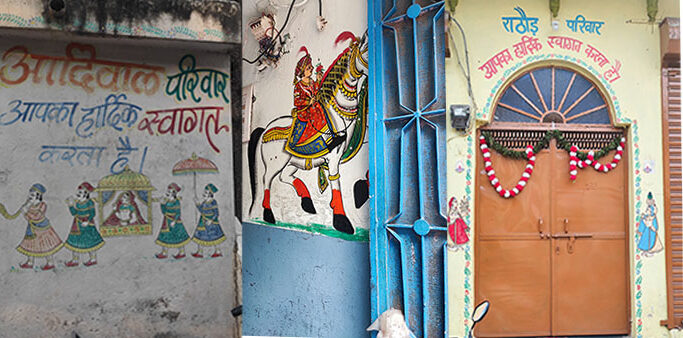
But, even here, commissioning such hathi-ghoda murals has acquired a certain mundanity through repetition. Rekha, one of the residents, says, “I do not remember when this [tradition of painting murals] began here,” pointing to the mural on her home’s entrance wall, painted a year back on the occasion of her brother’s marriage. Jawahar* (name changed) proudly depicting the horse and chowkidar painted on the narrow walls of his house, says, “We have lived here for generations, and we have followed this tradition.” Adding to the discussion, he adds “My children are educated. My son studies at IIT.” Walking through the colony, I notice a few women in Rajputi poshaks with the distinctive multilayered blouse, which — like higher education and hathi-ghoda motifs — were once historically denied to Dalits by the savarnas. The rhetoric of generational claims to visibility, space, and an Ambedkarite consciousness, although not loud, speaks through such everyday acts, small and big.
According to scholar Debashis Debnath’s essay, Hierarchies within Hierarchies: Some Observations on Caste System in Rajasthan, various “fissions and fusions” in the region led to the inception of many new castes that were endogamous communities within a hierarchical order with the classical domination of the Rajputs (the sons of the kings). In feudal princely states, societal hierarchies were largely determined by proximity to the ruling Rajput clans with professions and occupations that propped up the administrative structure regarded more highly. In the course of time, this shaped the regional caste system tinged with pan-Indian features of the varna system linked to ritual purity and economic status. Thus, ‘Rajputisation’ is the model of emulation in the state, with practices geared towards the process of mobilisation toward the upper order. This caste dynamic underpins the culture of the contemporary city, including the popularity of hathi-ghoda among locals in Udaipur, a city founded in 1559 by Udai Singh II of the Sisodia Rajput clan.
However, the local demand that has sustained the hathi-ghoda mural tradition for so long took a hit after the coronavirus pandemic. “The art form has become stagnant after Covid. Earlier, you could find a painting at every other house,” says Menaria, remarking that less people are commissioning murals now. In all the interviews, the artists expressed a concern with how there is “none to highlight this art,” with big commissions from commercial establishments, such as malls and hotels, veering towards generic art or graffiti-style paintings. But, despite the shifting demand, the hathi-ghoda mural tradition continues to shape the region’s visual culture. Rather than a blank canvas, the walls of the city are a site of negotiation; a contested terrain where caste hierarchies and the hegemony of Rajput culture mould informal labour practices, cultural production, and consumption within Udaipur’s creative economy.
First published: April 3, 2026