-
ChicagoUpadhyay, Shweta. "‘Homing’ in on Zarina’s Process: An Interview with Curator Sarah Burney." Impart Perspectives, July 7, 2026. https://imp-art.org/perspectives/interviews/curator-sarah-burney-on-what-home-meant-in-zarinas-practice/
-
MLAUpadhyay, Shweta. "‘Homing’ in on Zarina’s Process: An Interview with Curator Sarah Burney." Impart Perspectives, Jul. 7, 2026, https://imp-art.org/perspectives/interviews/curator-sarah-burney-on-what-home-meant-in-zarinas-practice/. Accessed 15 Oct 2026.
-
HarvardUpadhyay, S. (2026) ‘Homing’ in on Zarina’s Process: An Interview with Curator Sarah Burney, Impart Perspectives. Available at: https://imp-art.org/perspectives/interviews/curator-sarah-burney-on-what-home-meant-in-zarinas-practice/ (Accessed: 15 October 2026).
‘Homing’ in on Zarina’s Process: An Interview with Curator Sarah Burney
The artist's former studio manager discusses the new exhibition 'Zarina: Directions to my House' (2026) at STPI, Singapore, and the insights she gleaned about the artist's practice during the time she spent with her.
By Shweta Upadhyay
Link copied!
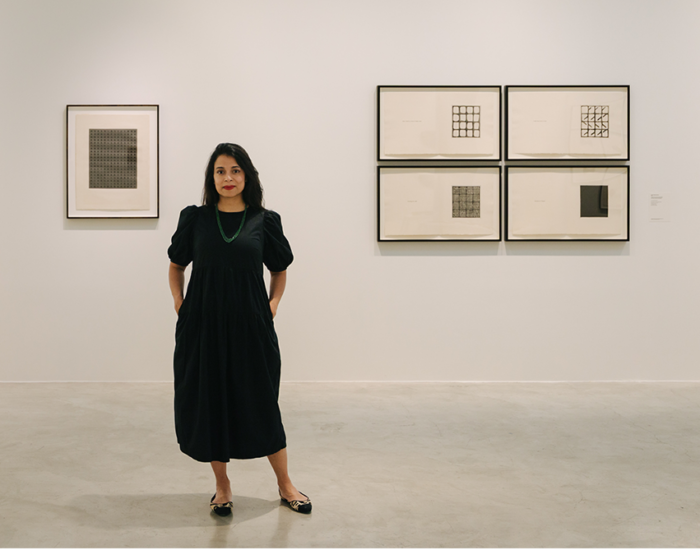
Curator Sarah Burney at the STPI exhibition Zarina: Directions to My House. Courtesy STPI, Singapore
From 2009 to 2013, Sarah Burney would take the train everyday to a small, light-filled loft on West 29th Street in Manhattan — then the studio and home of the late Zarina (1937–2020). The artist, who was 50 years her senior, reminded Burney of the women she grew up around in Kuwait and Pakistan. A matriarch figure who made her soup after her dental surgery but also reprimanded her when she made mistakes. Recalling her time as Zarina’s studio manager, Burney says, “One of the reasons our relationship was so personal is because we spoke in Urdu. Apart from my parents, she’s the only person who I spoke the language with on a regular basis. When other people would come to the studio, we would switch to English but when we were alone, she insisted we speak exclusively in Urdu.”
During this period, Burney would be instrumental in putting together Zarina: Paper Like Skin (2012-13), the artist’s first retrospective exhibition organised by the Hammer Museum, which would later travel to the Solomon R. Guggenheim Museum and the Art Institute of Chicago. She would also be involved in the presentation of the series Home is a Foreign Place (1999) as part of Everybody Agrees: It’s About to Explode (2011), the Indian Pavilion exhibition, at the 54th Venice Biennale.
Later, in 2018, she would partner with Zarina to co-author her memoir Directions to My House, published by A/P/A Institute at New York University (NYU). When listing the influences on her work as an independent curator and writer, Burney says that her time with Zarina shaped and continues to shape “her approach to artists’ materials, archives, language, and the intimate forms of knowledge that emerge through studio practice.”
Burney’s most recent endeavour has been the curation of the landmark show Zarina: Directions to my House (2026) at STPI, Singapore. It features over 50 of Zarina’s works, showcasing the scale of her practice over a seven-decade career as one of the most significant printmakers of the late 20th and early 21st centuries.
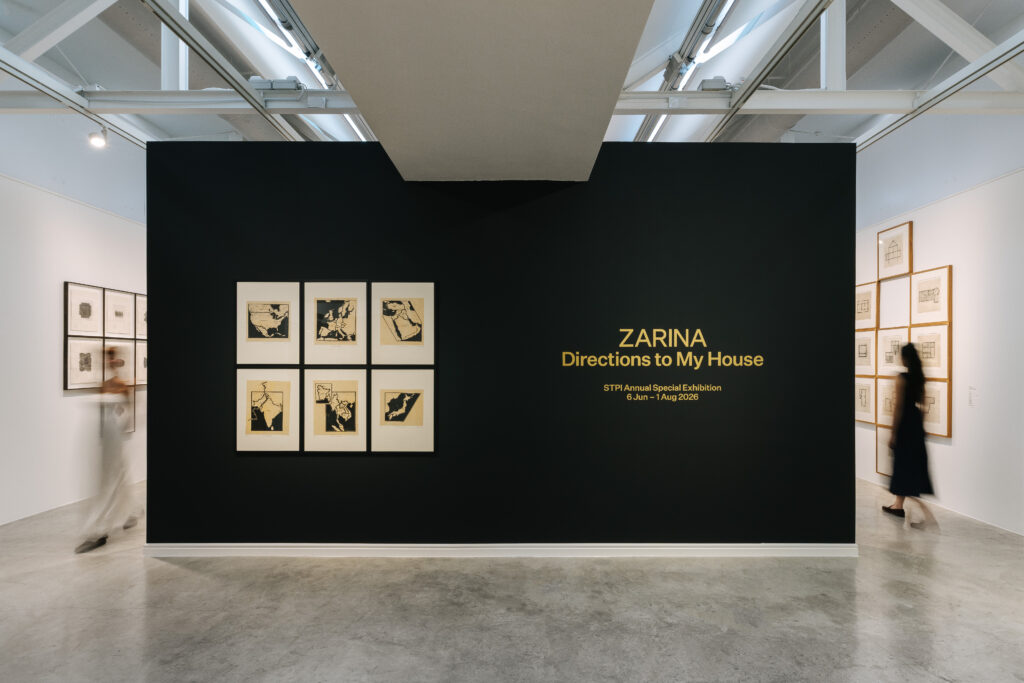
In a chat, Burney discusses why ‘home’ was the central, organising principle of Zarina’s work, and the insights she gleaned about the artist’s process in that loft in Manhattan.
Shweta Upadhyay: Tell me about the curatorial vision of Zarina: Directions to my House. How did your personal relationship with Zarina inform the curation?
Sarah Burney: In many ways, this show is a continuation of a conversation between Zarina and me. The title of the show is also the title of Zarina’s memoir, which we co-wrote. At the time, we were referencing the title of a 2001 poem, the only one she wrote in her lifetime that did not accompany an art work.
The memoir was sort of a narrative biography that included pictures of her work and her personal photographs. But this time, I felt like it was my chance to explore the ideas of home through her work. It’s tied to my time in that studio that was also her home, and the time I spent with her there. Home was such a central, organising principle for Zarina, not just artistically, but intellectually, philosophically, poetically.
There are so many entry points to Zarina’s work: you can do a show about minimalism, you can do a show about printmaking, you can do a show about just her materials. But I think in bringing her work to Singapore as an institutional presentation for the first time, I wanted a theme that would allow me to show as much of her work as possible. I had to bring it back to the central idea of home.
Upadhyay: In the curatorial note, you quote her: “My home is my hiding place, a house with four walls, sometimes with four wheels.” Could you elaborate on the different ideas of ‘home’ in her work?
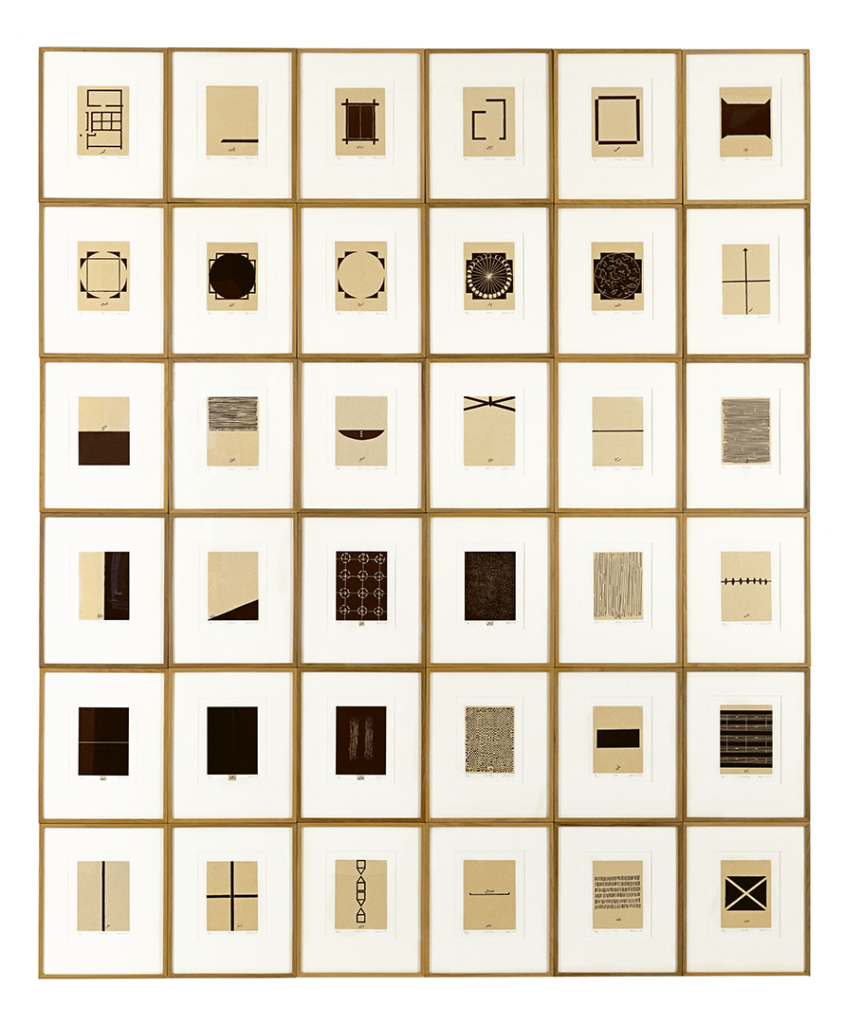
Burney: I’ve organised the exhibition thematically into several sections and in each section, I try to illustrate one idea of home that Zarina explored through her works. We begin with her first house, depicted in the work Father’s House (1994), which is a floor plan. The floor plan is something we see come up multiple times in Zarina’s practice. Architecture was such an important influence. She considered the physical space of a home in works like Father’s House, the etchings in Homes I made/ A Life in Nine Lines (1997), and even in the House of Many Rooms (1993) series.
She considered the people that make a home. In portfolios like The House at Aligarh (1990), she fragments the physical structure of home. She has these architectural fragments like that of a corner or a floor pattern, but she is also considering interpersonal relationships in those spaces. The work has accompanying text like ‘Aslam tells a story’; ‘Ami waits for the motia (Arabian jasmine) blossoms’; ‘Saeeda brings her children’; ‘Rani asks me to sing a song’; ‘Abba comes in to look at us’. We see that more clearly in Homes I Made/ A Life in Nine Lines, House of Many Rooms. The idea of home as a sanctuary is shown through Spaces to Hide (1980-81) and the 1983 cast paper sculpture Shelter. In the series Home is a Foreign Place (1999), she’s moved on to abstract notions of home, but also Urdu as home. Language defined what home meant to Zarina as well.
Upadhyay: Can you elaborate on her relationship to Urdu?
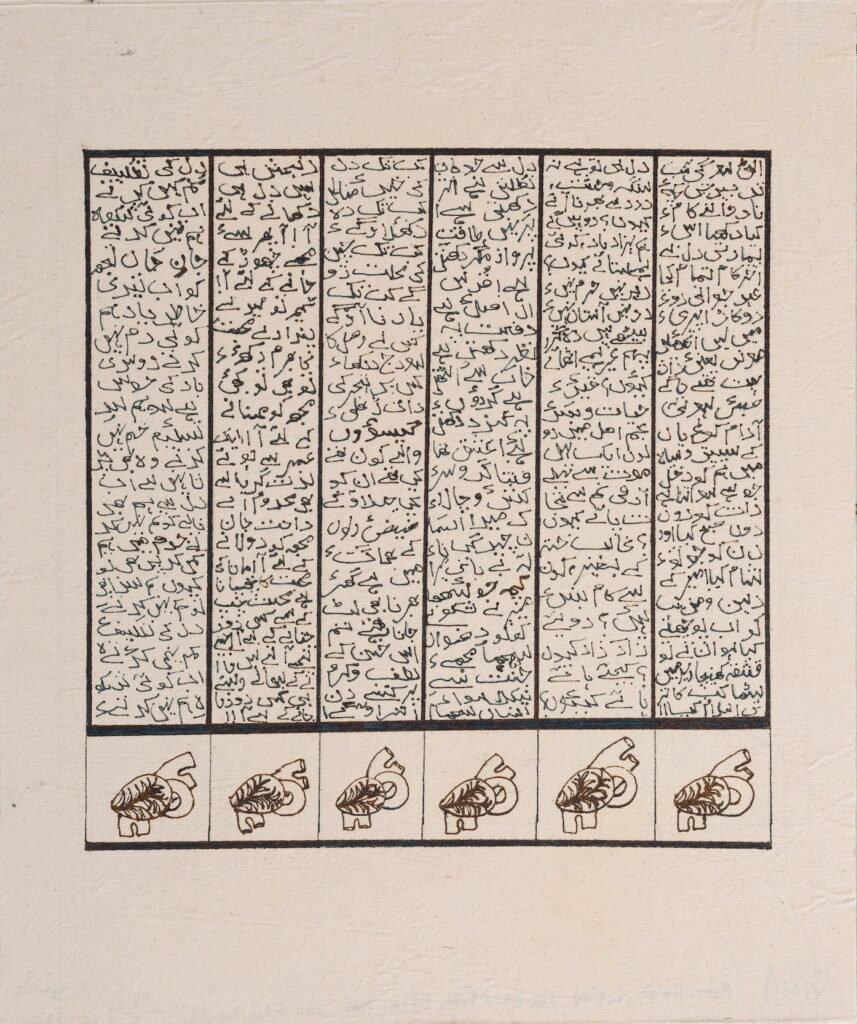
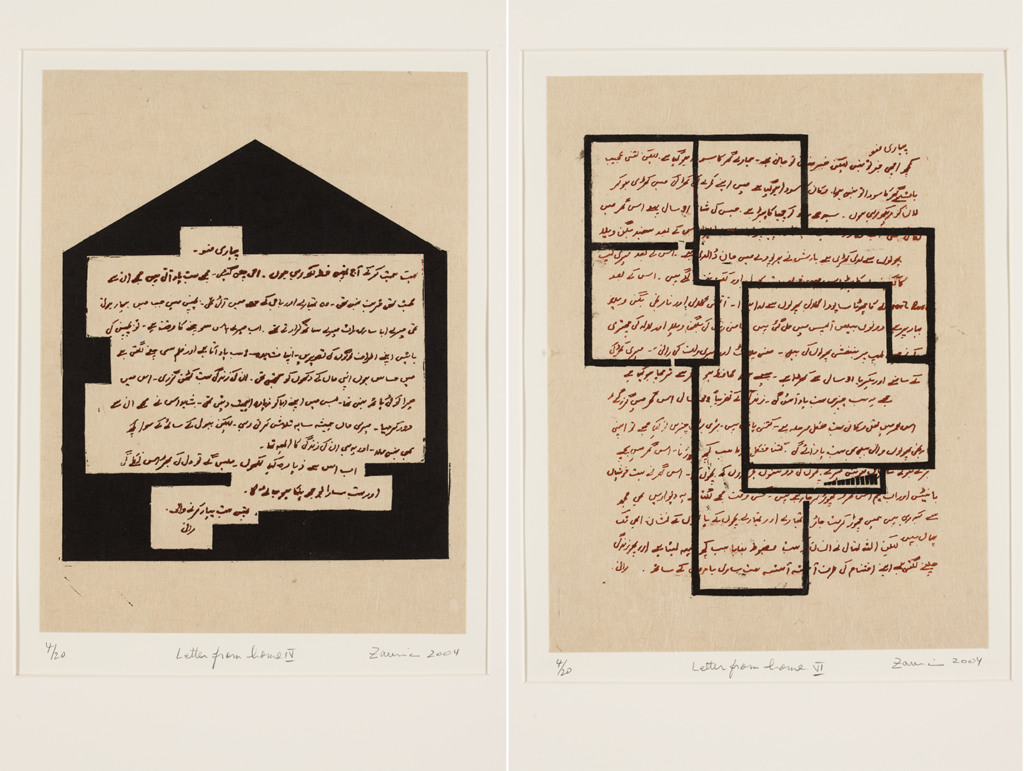
Burney: In the show, I have a section called Rani in Urdu. Rani was her sister — the person Zarina was closest to in the entire world. She was her sister and a confidant, but she was also an artistic muse, and a collaborator. All of the works in this section, except for the sculptural installation, all involve Urdu, and are all inspired by Rani. And I think that the relationship was even more precious to Zarina because it existed only in Urdu. We have the series Letters from Home (2004), where Zarina has used letters her sister Rani wrote to her, but never mailed, as part of her artwork. We have Urdu Proverbs (1991), a collaborative project between the sisters. Rani actually compiled a book of 101 Urdu proverbs, and Zarina made the illustrations. Urdu Proverbs is the only portfolio where Zarina actually did a re-strike in 2011. She had originally made the work at the Women’s Studio Workshop, when she was a resident in 1991. Each of the ten prints contains a simple, minimalist image. The last page of the portfolio lists the 10 Urdu proverbs that inspired the images but without translations. These phrases are witty, like “Halwai ki dukan pe dadaji ka fatya” ( Commemorating grandfather’s wake at the halva shop) and “Saanp nikal gaya lakeer peet te reh gaye” (Beating the trail after the snake has gone).
And then, in 2011, right when she is dealing with critical press in America, when she has her retrospective travelling to the Guggenheim and the Art Institute of Chicago, and she’s about to represent India at the Venice Biennale, she re-strikes Urdu Proverbs. She puts each Urdu phrase directly under each corresponding image, making the script a part of the prints’ artwork. But she still doesn’t include translations. It was so bold of her to choose to do that — make this work that is so Urdu, when the world’s attention, when America’s attention, is coming straight at her.
Upadhyay: Why didn’t she translate the words?
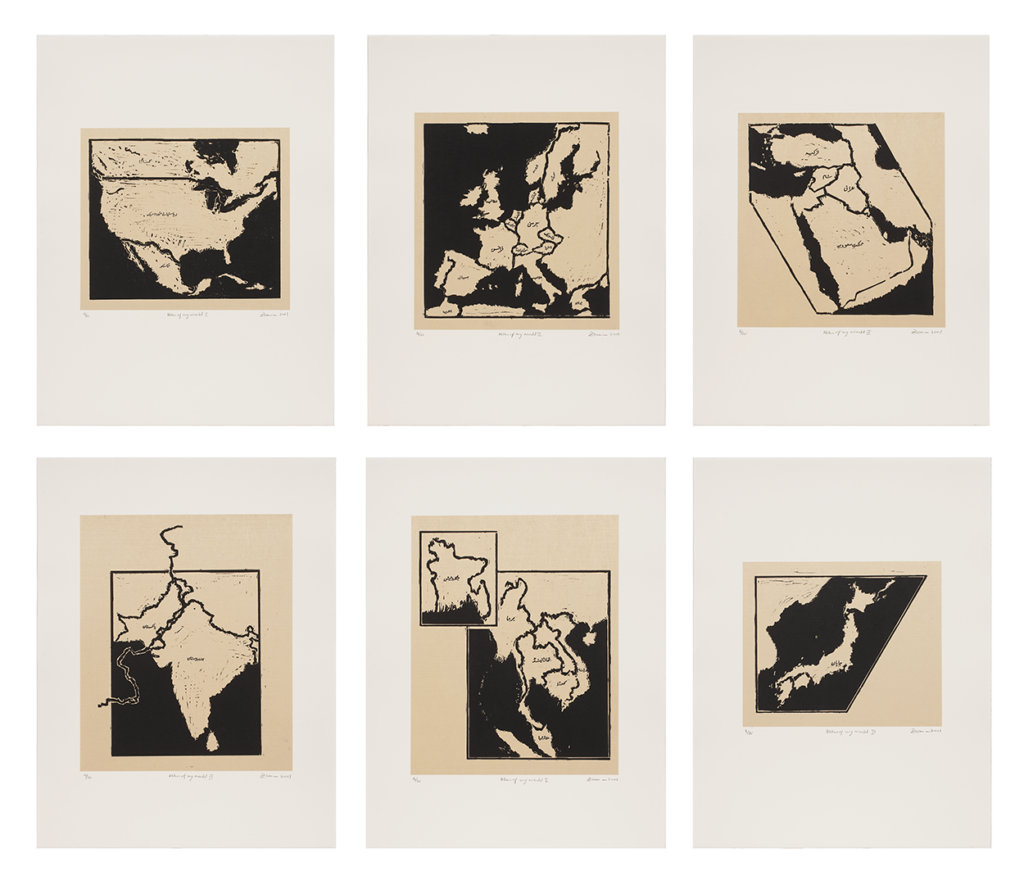
Burney: She always straddled different worlds. Sometimes she translated, sometimes she didn’t. Her use of Urdu evolved with time. In the beginning, she used it sparingly — a few Urdu words in titles. Then, with the re-strike of Urdu Proverbs, she used the Urdu phrases as citations. She also used Urdu words as cartographical labels but her linguistic boldness reached its peak when she began using Urdu poetry without any translations. Some works don’t need a translation because they are very representative images, like a map or a floor plan; those she labelled in Urdu. Some other works she created are meant as a dialogue between her and native Urdu speakers. But then there are others, such as the Home is a Foreign Place series, where she literally inserted the English word under the Urdu one. In such artworks, we see her point to other languages of knowing, naming, feeling, and expressing. (In the 2011 essay, Conversation with my Self, Zarina writes: “I chose Urdu not for the beauty of the calligraphy or the exoticism of its aesthetics. I was placing my work in a historical moment, capturing a time when one wrote and read in Urdu. Urdu was born in Delhi; Amir Khusrau called it ‘Hindawi’, the language of Hindustan. Now we are witnessing the slow death of this language in the same city.)
Upadhyay: So when she didn’t translate, that’s also a form of abstraction, right? Where the loops, waves, dots, and curved strokes of Urdu intertwine and enmesh with geometrical, cartographic lines. Like in Untitled [Map of Delhi with poem by Mir] (2010), the verses by Mir are overlaid on a map. It is like a map within a map.
Burney: I think she was thinking about abstraction as a concept, but she was also kind of revelling in the beauty of the Urdu script itself. Zarina was a poet before she was an artist. She often says, words come before images. And she really did work like that. Urdu poetry was her emotional anchor. She is of the generation where they slip poetry into every conversation. She would quote poetry all the time, mostly Ghalib and Faiz. Mahmoud Darwish’s poetry was a huge influence on her, and so was Adrienne Rich’s work. Urdu poetry was in her blood. Zarina’s adult life was defined by movement, and Urdu poetry really grounded her in some ways.
There is never one clear reading of any artwork. So if someone couldn’t read Urdu, she knew that it wouldn’t prevent them from having a relationship with that artwork. She didn’t feel like she had to explain everything at first glance. I have a personal relationship with the work because I knew Zarina, because I knew Urdu. But I’ve seen people who don’t speak Urdu at all, who are not South Asian, who don’t have those frames of reference, but still have a deep, emotional reaction to her work. Not knowing Urdu is not a barrier to having that feeling of intimacy with Zarina’s art.
Upadhyay: Can you tell us why Zarina favoured printmaking as a medium? You mention in your curatorial note that the act of mark-making — cutting, engraving, incising — was central to her exploration of memory and inscription.
Burney: Printmaking was both an intuitive, embodied choice and a deeply personal one for Zarina. She often said, “I don’t draw, but carving comes naturally to me.” That simple statement captures her instinctive relationship to the medium, particularly woodcut, which was the first printmaking process she studied. Eventually, it became the most iconic expression of her practice. The medium mirrored her temperament. The acts of carving, incising, and engraving were ways of thinking through the hand. The physical resistance of the block, the slow construction of an image, and the precision of each cut reflected the quiet rigour and deliberation that defined her approach. Printmaking is also an inherently sequential process — you must first conceive an image in reverse, then carve the block, ink it, and finally pull the print. That careful choreography of planning and execution matched her personality; Zarina was methodical, patient, exacting, and brilliant.
Her attraction to printmaking was also shaped by her childhood. Although she had taken basic painting classes while living in Aligarh, she did not grow up surrounded by paintings. Instead, as the daughter of a history professor, she grew up in a home filled with books. Paper and ink were familiar materials long before they became artistic ones. She often remarked that she felt at home with them. Zarina did not study art formally, so she was never steeped in the traditional hierarchy of artistic media that privileged oil painting or marble sculpture. That outsider’s perspective perhaps helps explain her unabashed embrace of printmaking; it was her definitive medium. She had an enduring fascination with diagrams, floor plans, maps, and other systems of spatial notation. She had trained in mathematics and statistics, and her images also hold the clarity and precision of mathematical or scientific thought, while remaining deeply emotional.
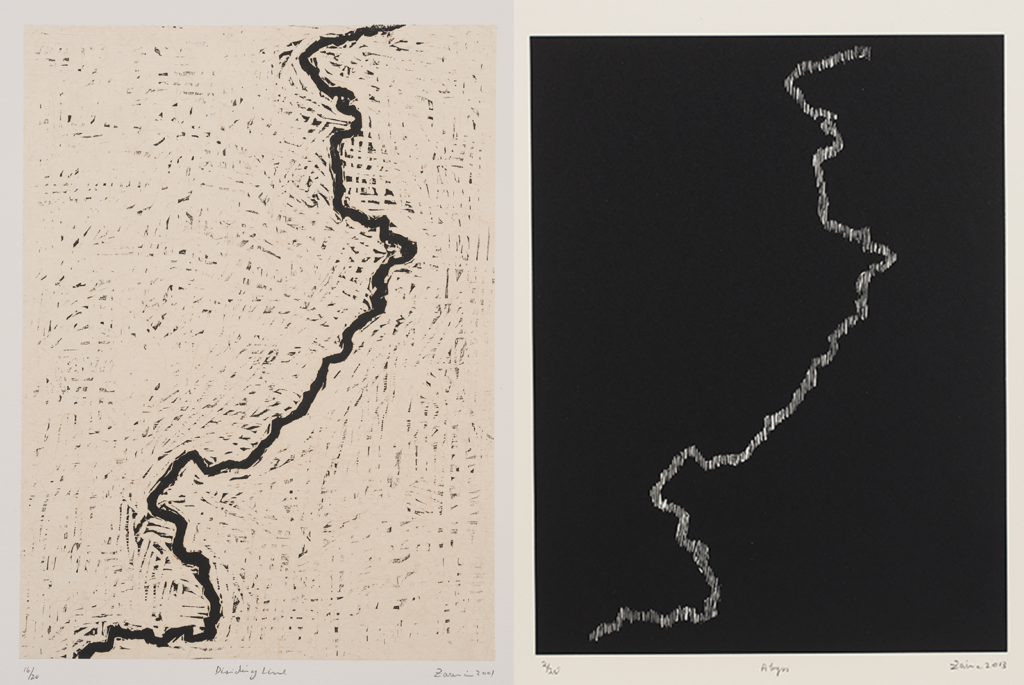
Printmaking also suited the life she lived. Zarina spent much of her career moving between cities and countries, and the medium is inherently portable: plates can be packed, paper can be rolled, and wherever there is a printmaking workshop there is a community of artists. For someone whose work continually explored home, migration, memory, and displacement, printmaking was not simply a method to make images; it was a medium that reflected the rhythms of a cosmopolitan, itinerant life.
Upadhyay: Her minimalism is able to translate the wounds of Partition, of losing a home, of exile into a universal language of personal grief. What were her ideas of art and space that made her believe that the abstraction of fragmented spaces could communicate the affect of being displaced?
Burney: I would tie that back to her aesthetic, her preference for open forms, negative space, geometry, balance. She cited Islamic architecture for that. She spoke very forcefully about the rejection of Western-centric reading of her work that stated that minimalism was something she discovered when she came to Europe. Or it was something she picked up while looking at the work of American artists. Yes, she loved the Western minimalist artists (she loved Kazimir Malevich, for instance), but her eye was formed when she was at Fatehpur Sikri with her father. The balance, the geometry, the wide open spaces of Mughal architecture trained her eye long before she had visited any gallery or museum in Europe. That sort of evoked this connection between space and memory in her prints. You actually feel that you are in that room or you remember a room that you once inhabited that was similar. That creates a kind of a connection between the viewer and her work.
Upadhyay: Can you tell me something about the work Beyond the Stars (2014)? There’s this contrast between darkness and light owing to the use of gold, which is very transcendental.
Burney: It’s one of my favourite works because it combines some of the strong elements of Zarina’s practice. It’s a print, but she uses the gold circles that are hand additions. She hole-punched the paper and gilded it with gold leaf and pasted it on top. Visually, the circles transgress the boundary of print, which is also playful. It’s so Zarina. It sort of harkens back to her early silkscreens where she’s really just playing with form and balance. And then the poetry, you know, that is such a moving line of poetry by Allama Iqbal, “sitarron se aage jahan aur bhi hai” (Beyond the stars, there are many worlds).
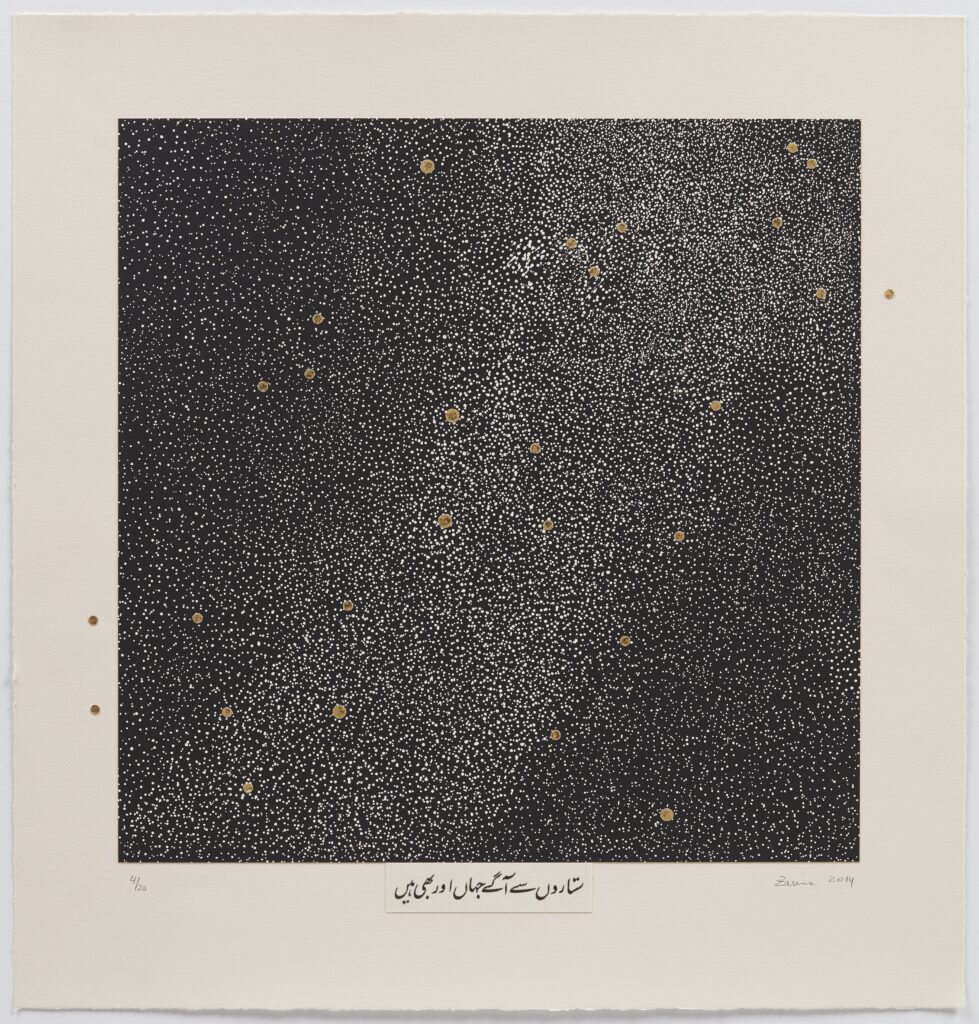
In making this work, she was really signalling her contemplation of the final moment. Mortality was on her mind. Losing her sister was a hard moment. Zarina’s health was also not the best in 2014. So the idea of the afterlife, of life beyond the stars, was at the forefront of her mind. And I think in creating this stunning work, she was telling us that she was approaching this with curiosity and readiness. That she was not afraid.
The heavens or the stars was a recurring element in her work. The earliest example of this is Nightfall (1984), which is a cast paper sculpture in black with gold specks. And then in Home is a Foreign Place, there is the “sitare” (stars). She had always been fascinated by the night sky, and its symbolism in Islam. The Quran says that God has placed you under a sheltering sky. There is sort of a Muslim affinity to the night sky because it is regarded as a manifestation of God’s protection.
Upadhyay: What about other references to Islam in her work? There are series with titles, such as Tasbih (2008-11) and Noor (2011).
Burney: Noor means blinding light. God is considered noor in Islam. When you enter the blinding light, you are meeting the maker. Even her work A Few Steps in the Land of Confucius (2008) — which is not in this show — is her response to a hadith that says, “Seek knowledge even if you have to go as far as China.” She conceptualised this work when she was in Shanghai for an art fair, and she went to a temple. She climbed hundreds of steps to go up, and when she reached the top, there was Confucius’ name. She made a rubbing imprint of the steps of the temple. There’s also Tasbih, sculptural replicas of Islamic prayer beads, and a small work that we have in this show called Silent Night (2017), which was made by rubbing a seal that Zarina had in her studio, pinned onto her bookshelf, and which says, “Allah u Akbar” on it.
Upadhyay: What, according to you, is the relevance of Zarina’s works in the contemporary moment?
Burney: I think she is timeless. Her works are prescient and of the moment. It is a little bit sad that so many of her political works are still so relevant. She has memorialised cities where Muslim minority communities have been persecuted. 9/11 and the Islamophobia that followed saw a big, noted shift in her work. She became more political, more bold in foregrounding her Muslim identity. At the same time, she was also spiritual and playful in her work. She was able to hold these multitudes beautifully.
But it wasn’t that she only cared about Muslims. Every migrant crisis that was happening around the world took her back to being a child during the Partition event. She was ten when Partition happened, and she remembered being in a covered truck and seeing bodies on the road. I referenced this in the wall text for this exhibition — for Zarina, having lived through the Partition, she was not only sensitised to the plight of those who are displaced by war or politics, but she felt it was her duty to memorialise these communities in her work.
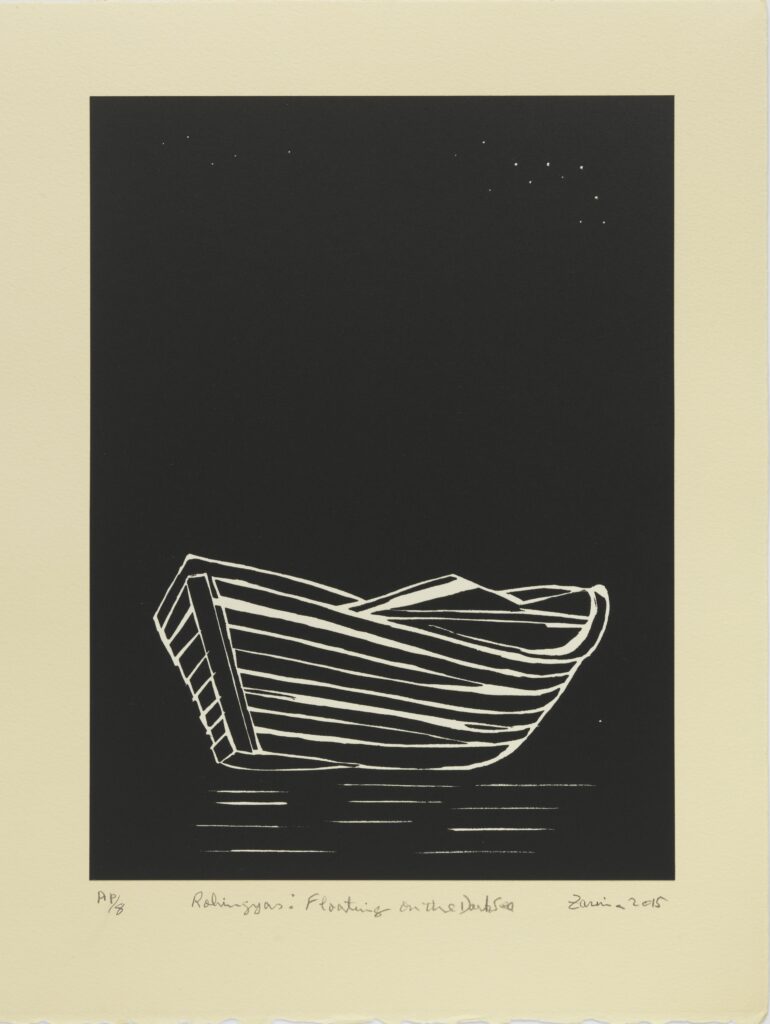
In works like Rohingyas: Floating on the Dark Sea (2015), 50 Nights of Gaza (2016), These Cities Blotted into the Wilderness [Adrienne Rich after Ghalib] (2003), she was reflecting on contested terrains and the pain of migration. She made Sinking Boat with a Heartbeat (2015) while witnessing the Syrian refugee crisis. There is minimal figuration — an electrocardiogram inside a sinking boat. For me, this is a poet working. She was able to strip a complex event down to one simple image. Yet, that doesn’t lessen its impact; it becomes even more emotionally charged. The heartbeat inside the boat is a print she made of her cardiogram. That’s actually Zarina’s heartbeat!
One of the most exciting things about bringing this exhibition to Singapore is that it has an international population. Every third person had a story, if not about the Partition, then about another country that they and their family had to flee. They found their home on a map that Zarina had made.
Watch Impart’s explainer video on the profound symbolism of Zarina’s work, and take our free online course, Modern & Contemporary Indian Art.
First published: July 7, 2026