-
ChicagoPadil, Aranya. "Comradeships of Art-Making in Ranjit Hoskote’s Poetic Practice." Impart Perspectives, March 27, 2026. https://imp-art.org/perspectives/features/comradeships-of-art-making-in-ranjit-hoskotes-poetic-practice/
-
MLAPadil, Aranya. "Comradeships of Art-Making in Ranjit Hoskote’s Poetic Practice." Impart Perspectives, Mar. 27, 2026, https://imp-art.org/perspectives/features/comradeships-of-art-making-in-ranjit-hoskotes-poetic-practice/. Accessed 16 Oct 2026.
-
HarvardPadil, A. (2026) Comradeships of Art-Making in Ranjit Hoskote’s Poetic Practice, Impart Perspectives. Available at: https://imp-art.org/perspectives/features/comradeships-of-art-making-in-ranjit-hoskotes-poetic-practice/ (Accessed: 16 October 2026).
Comradeships of Art-Making in Ranjit Hoskote’s Poetic Practice
Hoskote’s 'art' poems function as snapshots of pivotal moments in the Indian artistic landscape, born out of shared passions and intense friendships with artists.
By Aranya Padil
Link copied!
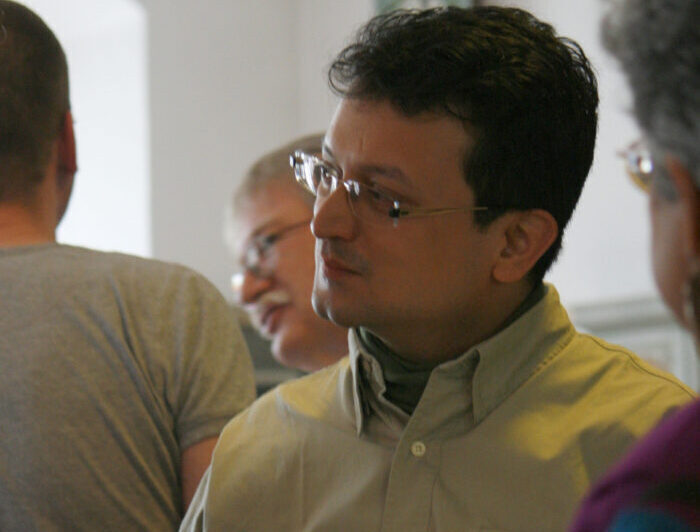
Art critic and poet Ranjit Hoskote. Photograph: Harald Krichel (2012), Wikimedia Commons
“Morning wells like blood
in the stag’s hollow eye”
This compelling image, filled with movement and sensual vigour, opens the first poem from Ranjit Hoskote’s 2001 collection The Sleepwalker’s Archive (2001). The cover of this book is an artwork in itself — designed by the late bilingual poet Arun Kolatkar. Hoskote remembers the design process fondly as he speaks of their shared love for things beautiful and abstract. “It seems like yesterday that we were sitting around a table at the Wayside Inn comparing river pebbles, beach stones, shells; or looking at second-hand books at the OCS Tower pavement — we discussed [Immanuel] Velikovsky’s eccentric theories there once while spotting cannonball trees along the Esplanade,” Hoskote recalls.
Kolatkar is better known as a poet, but he was also an artist. His book covers and visual art have been posthumously exhibited across the world in the last two decades. Meanwhile, his poetry has acquired iconic status and is regarded as an ethnography of Mumbai’s journey into modernity. The poet Rekha Shahane — whose husband Ashok Shahane collaborated closely with Kolatkar and published all his poetry under the imprint of Pras Prakashan — once described Kolatkar’s poetry to me in vivid terms: “Arre, he was an artist only! He hid paintings in his poems!” Hoskote laughs when I tell him about this exchange; we both know that this “portraiture” of artistic practice is startlingly appropriate to his own poems.
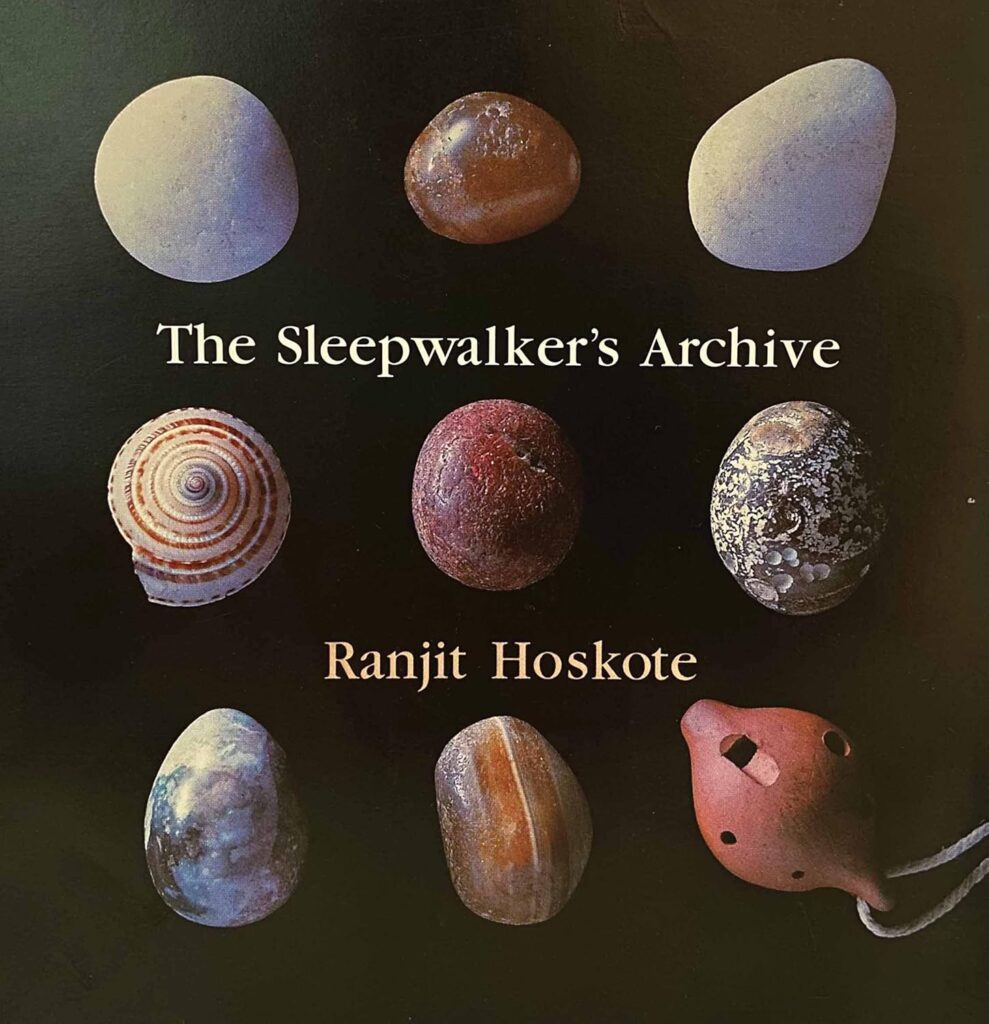
Spanning close to four decades of hybrid artistic practice, Hoskote’s poems can be viewed as a window into his creative and curatorial philosophy on art-making itself. The ‘text-image’ cited at the start of this essay is from his poem “Altamira,” referencing cave paintings in Spain drawn 36,000 years ago. Even this precise image betrays the gaze of a curator — a gaze that re-interprets movement as both idea and lived experience through an empathy borne out of careful study. Hoskote is a foundational presence in the Indian contemporary art landscape. In an expansive survey, curator Vidya Shivadas selects him as one of five writers whose critical and curatorial practices has shaped the field of Indian art criticism, post-Independence. Shivadas insightfully notes that “with Ranjit Hoskote, there is a return to the more immediate role of criticism in a one-to-one relation with art practices and artists.” While she doesn’t specifically reference Hoskote’s poetry, she notes his “poetic eye” as a critic.
Writing into Art: A Poet’s Practice
Hoskote’s “poetic eye” curates language as much as the image hiding within. His craft is best explored through poems from his oeuvre which write into and around various forms of artistic practice. The ‘eye’ — as an embodiment of sense-experience — narrates the poet-persona’s encounter with the lived universe, the way a brush infuses colour and movement into a scene. This movement from one sense to another, and one that defines different forms of artistic expression, is exemplified in the Japanese literary tradition of zuihitsu. The genre’s name, most often translated as ‘following the brush’ or ‘running brush’, refers to the free-associative, non-linear writing style that resembles the swipes of a painter’s brush gliding across the canvas. Commentators often trace this form back to The Pillow Book, completed in 1002 AD, compiling disconnected fragmentary lists, anecdotes, poems, and thoughts penned by the poet and court lady Sei Shōnagon after the death of her patroness Empress Teishi (r. 990-1001).
During a conversation about this form, Hoskote’s eyes light up at the possibilities of such a poetic curation of text with image while retaining the mysterious design of non-linear narratives. As I wade through the imaginative currents unfurled by Hoskote’s verse, I invoke the speculative intensity and unfettered intuition inherent in zuihitsu compositions. Such a methodology of reading is alert to the unexpected, akin to the searching ‘eye’ that discovers a surprising detail in a centuries-old courtly landscape painting.
In the title poem of Hoskote’s collection Hunchprose (2021), the figure of the poet, “who must constantly contend with opposition and misunderstanding,” lashes out and reveals the flaring of meaning derived through quiet attention. The portmanteau reminds us of the hunchback of Notre-Dame, Quasimodo, but also the crouched position of the bird of prey (picturised on the cover) — visually transformed in the final volta of the poem — “I bend over my inkdrift words, And when I spring back up I sting.” In the dramatic ‘sting’, the heightened attention of a predator transforms into the artist’s moment of revelation. The poet labours in the enigmatic realms of “fraying knots coiled riddles scrolled bones.” The easy certainty of prosaic narratives, and “tall tales” with fairytale endings is not for him.
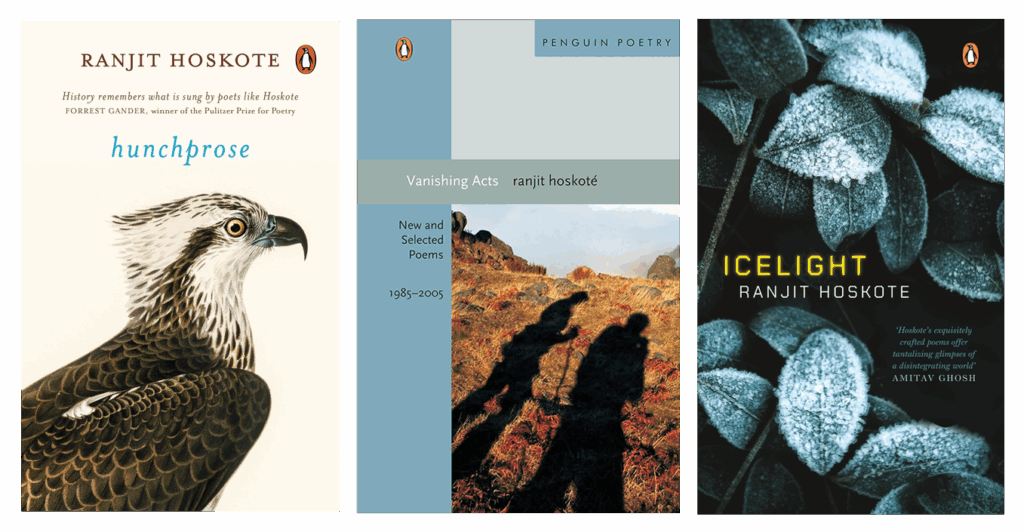
Hoskote has described the ars poeticas of Hunchprose as “a meditation on the role and place of poetry even as it engages with the cataclysmic urgencies of our historical present…” In part triggered by the trifurcation of Kashmir in 2019 to which he has ancestral ties, Hoskote described the collection of poems as the quest of the survivor, who is “simultaneously hostage and explorer, lost pilgrim, healer in search of forms of remedy against multiple traumas, storyteller walking at the edge of a new alphabet.” We repeatedly see this in Hoskote’s oeuvre — the creative act follows the trajectory of the artist’s concentrated hunt for meaning rather than a linearity of plot and purpose.
This awareness of the non-linearity of art seeps into “Miniature” from the collection Vanishing Acts (in the section “New Poems 2001-2005”). Hoskote deftly illustrates why any sequential logic of a fictional narrative applied to the artwork feels inadequate. In the process, he reveals just how this art genre can re-wire temporality. Simultaneous happenings occur around the painter in the palace — “a courtier sprints in slow motion,” “in the courtyard, wolves devour her discarded lover,” “under the roof, a page trembles.” But the painter is engrossed, recording the drama of light on a young bride’s cheek. In this play of simultaneity and animated imaginations colliding with events, the poem itself operates like the miniature in which the painter, painted, is “holding his breath” before he knows “where” he will finally paint “the curtain.” The poetic volta rearticulates space as time, paralleling how a miniature painting holds several non-linear narratives on a single surface. One can imagine the painter’s suspended breath released as the poet’s “breath” in the titular poem of Hunchprose, which opens “lost doors” that were “carted away by raiders.”
In Hoskote’s poems, questions are devices to plough the inarticulable revelatory depths intrinsic to art where narratives are released to the viewer through simultaneity, juxtaposition, and multi-linear progression. A poem dedicated to the artist Ravi Agarwal, “Departures” from Hoskote’s eighth collection of poetry Icelight (2023), is composed entirely of questions. A series of realistic and imagined visions collide in processes of naming, framing, and representing: “What if the bat practising a dive behind the shuttered windows of the Natural history section…?”, “What if you tried to prise a password out of the stuffed orangutan / the taxidermists have enthroned as a totem at the zoo?” The artist and the querent are picturised at the centre of these ecological, religious, and social processes enervated in the “contemplation” of the non-human, which defy attempts at codification and segregation that plague the colonial enterprise of curating collections — even taxonomical categorisations in museums of ‘Natural History’.
The Involved ‘Eye’ of Friendship
Hoskote’s curatorial practice is informed by the artist’s persistent improvisation and the scholar’s passionate eye for detail, but his poems are often “gifts,” born out of intense friendships and shared passions. In Pale Ancestors (2008), a body of work featuring 48 large watercolours by Atul Dodiya, Hoskote curates a hybrid text-image form that is neither artbook nor catalogue. Each artwork appears with a poem in response, evoking the titular “ancestors” — spirits, ghosts, and “spectral presences” of ritual, both magical and mystical. Mythic and historical personas from different cultures inspire Dodiya’s sparse surrealistic washes and Hoskote’s impassioned poems. Illustrating the “plural ancestries” that inspired both the artist and the poet, Hoskote reaffirms the role of “two decades of friendship” that shaped this formidable archive of “shared attentiveness.”
The poem “on the trail” voices the many strands of this attentiveness, exploring what it means to collaborate and to look at the same thing with different sets of eyes. How does a poet follow the “spoor” of the artist? What happens when two strings, tuned to the same musical note, resonate? What infinite harmony of microtones splinters into music in that union?
In response to a painting that appears to depict a slim silhouette of a person urinating on a skull, Hoskote annotates the creative act, of a splitting of ‘Self’ and ‘Other’ and of empathetic dissociation, with this question: “How to… growl in the other’s belly and roar through the other’s mouth?” He translates image into dissonant text, but also negates the self in service of an image that speaks with the voice of the other. The ‘Other’ in this case represents Dodiya — the artist — but also subjects that are recruited from different cultures and different “personas,” such as the scribe, the poet, and the hunter. The ‘Other’ also punctuates aesthetic and divine genealogies that include Auguste Rodin, Joseph Beuys, Gustav Klimt, and the mythical ‘Tower of Babel’.
Dodiya’s paintings voice traces left by history, tradition, and myth, seen through the anthropologist’s cultural gaze and the quiet wonder of the storyteller. The poetry ricochets of this propensity for uncanny juxtapositions, revitalising canonical texts and figures with metaphor and zeugma. In the corresponding prose-poem, Hoskote approximates the Persian atelier’s distillation of “leaf and stone, cloud and shell” to an eternal tussle with colour. “He fought them all his life,” the poet exhorts, tracing a pilgrimage of hues from material — “broken coral, ground lapis, turquoise, and dragon’s blood,” to composition — “fixing them on a sleeve here, a turban there, a patch of sky beyond.” Meanwhile, Dodiya’s watercolour seats a turbaned figure of the “Dervish from Baghdad (after Bihzad),” draped in layers of fabric, with oblong rectangles, reminiscent of the master miniaturist’s use of geometric forms. The poem enhances the mystic underpinnings of the act of creation by ascribing a meditative surrender to the figure — “bihzad closes his eyes”.
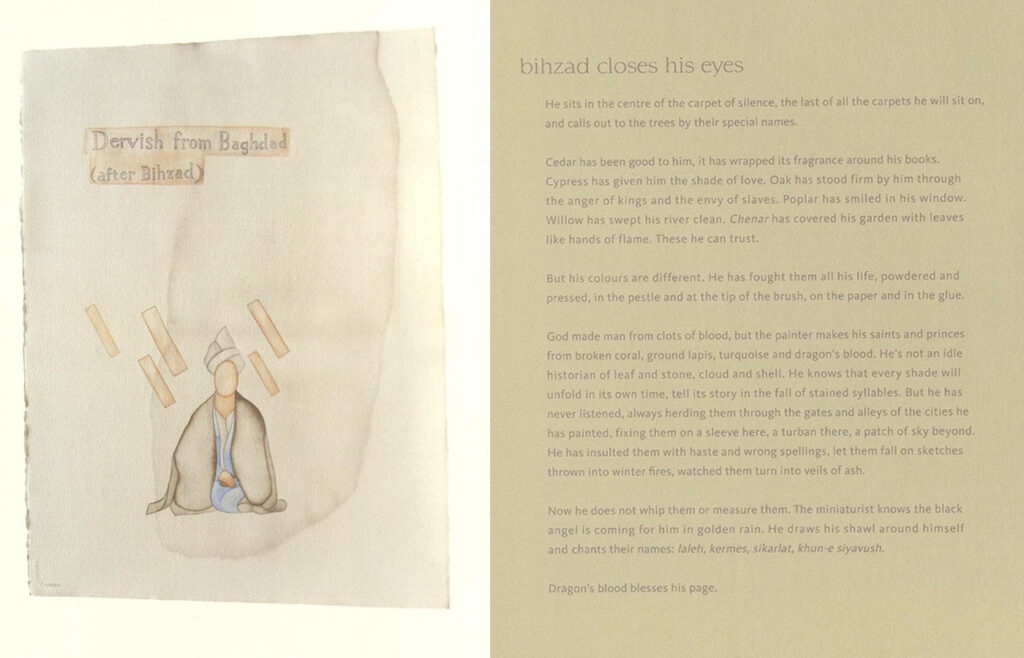
We return to this image (of eyes closing) in another poem, “The Guide Recalls the Mountain,” dedicated to Atul Dodiya from the book Central Time (2014) that brings together Hoskote’s poems written between 2006 and 2014. In the first stanza, the poet refers to a notional “they” — artists who return again and again with their “frayed knapsacks” and “propped up easels” to paint a mountain. But they haven’t “got it”; they make a mess. Instead — “You have to wait until the clouds wipe out the light… Stand your ground.” In the volta of the last two lines, the epiphany of image-making is revealed:
“the peak stands cold and crystal-sharp.
It speaks to you when you squeeze your eyes shut.”
Hoskote speaks of Dodiya’s fascination with Paul Cézanne’s obsessive oil-painting iterations of Mont Sainte-Victoire as the starting point, but he is quick to point out that the poem is about “image-making” and the ways in which an image or an artwork releases itself to you. Image-making for the poet and the artist, the reader and the viewer of artworks, is tied to a moment of reflection; the space of reverie and imagination, away from the business of worldly activity and practice.
The closing of the eyes is both instrumental and metaphorical, alluding to how the intricacies of form and colour reveal themselves as an alchemy born in the fingers — felt rather than ‘designed’ into being. The poem asks formal questions about the act of creating art, a subject that the poet revisits in other poems. What is the subject of a painting? How does a painting decompose and re-compose into an image? — such questions are at the heart of the practice of both the poet and the artist. But the poems do not presume to give answers. They transform the quiet energy that accompanies the careful description of a scene (whether through a painting or wordsmithery) into the abstract moment of revelation; the magical convergence of two friends making art in continuum.
Entangled Biographies and Shared Landscapes
What emerges in many of these works is the notion of art as dialogue. The space of imagination, essential for the creative act, is constructed through conversation between artist and poet, but also artist and curator. It reveals the importance of discursive back-and-forth in deepening the space of testimony, of witnessing.
During our conversations, I realise that the only way to enter the world of Hoskote’s poems, steeped in decades of evolving aesthetic insight, is through the empathy of shared epiphany. His keen eye snatches pivotal moments in the Indian artistic landscape, simply because it is guided by the emotional charge of his relationships with artists. But this poetry goes beyond the human — also latching on to the inner lives of objects and images. It is not as if Hoskote sits down to construct poems on artworks or artists. But “images wander,” he reminds me, and they morph into language, unleashed as poetry.
“Palace,” a poem for Sudarshan Shetty written in the early ‘90s (from The Sleepwalker’s Archive), was triggered by Shetty’s 1995 exhibition, Paper Moon. This was Shetty’s first break-away solo show that marked a decisive shift in his practice, moving away from two-dimensional images to sculptural forms and installation. The uncanny juxtapositions, that sutured the mythic with the mundane, echoed the fragmented realities of a postmodern aesthetic that was sweeping through the artworld in the ‘90s.
Shetty has frequently cited the enormous influence of that first solo show, even showing a work from it at the 2025 India Art Fair. GallerySke has also noted that the works “seemingly on the verge of collapse” mark a “pivotal moment” in his career, moving from materiality to “a preoccupation with ‘eternal residue.’” Orijit Sen, recalling the remnants from that iconic show, listed: “a pair of tailor’s scissors made of teak wood,” “a pink male torso neatly severed at the chest and thighs, and a pair of carved angels wings.” The “residue” of those wings takes flight in Hoskote’s surreal narrative poem. Several journalistic accounts cite a fragment from Hoskote’s critical assessment of the works from Paper Moon: “highly stylised, phantasmagoric fairground images.”
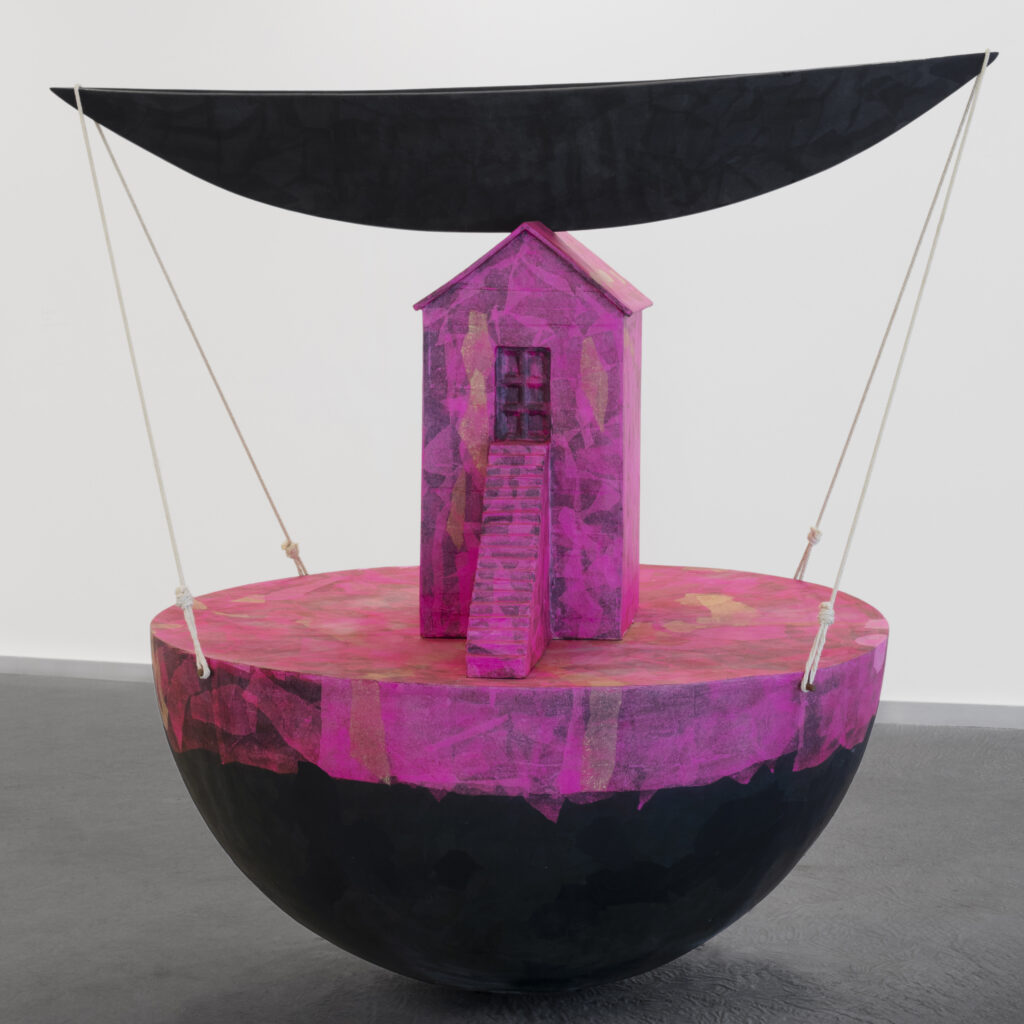
This description applies to the “Palace” that the sutradhar reaches in his poem, “through spiked gates and sunken courtyards.” “Mute gondoliers” with “night-long oars” roam the palace where “the gardeners never talk about the fallen waves that they/ shear away every morning.” One can’t help but wonder about those waves — were they born in the boat from that exhibition? The boat beside the wooden house on stilts, which contained “the notion of water”? The riverine imagery of temporary abodes — common both to the “queen’s favourite palace” and to the “unmoored” boat — resonates across the work of both artists, as does the question of home. But images from Shetty’s practice also combine and shape experiences of ‘place’ through Hoskote’s own travels. Shadows of architecture and the favoured terrains of Sikandra, Agra, and Jaipur, are triggered by the artworks, constructing composite montages of feeling, rather than description.
It must be noted that these are not simply “art-poems” or ekphrastic poems. Rather, as the poet emphasises, “art becomes the occasion” to explore “common ground.” For instance, both Vivan Sundaram and Hoskote shared a fascination for the sea. In an exchange towards the end of his life, Sundaram expressed a desire to have the poet take a critical look at his later works that referenced this theme. The poem “Bloodlines, Songlines” (from The Sleepwalker’s Archive) alludes to his early series of works in soft pastels called Journeys (1986-87). The poem also transmutes Sundaram’s use of engine oil in other works from this period and his responses to the Iraq war with a speculative “in your dreams, I have seen.” The sensory immediacy of that intimate vision is buffeted by details of “an oil spill,” “canvas sails burning,” “factory stovepipes,” and “towns unfur[ling] in napalm sails.” The tumultuous shared landscape of the sea converges on the poignant question of belonging that ends the poem: “Is home where we start from, or is home/ where our journeys take us?”
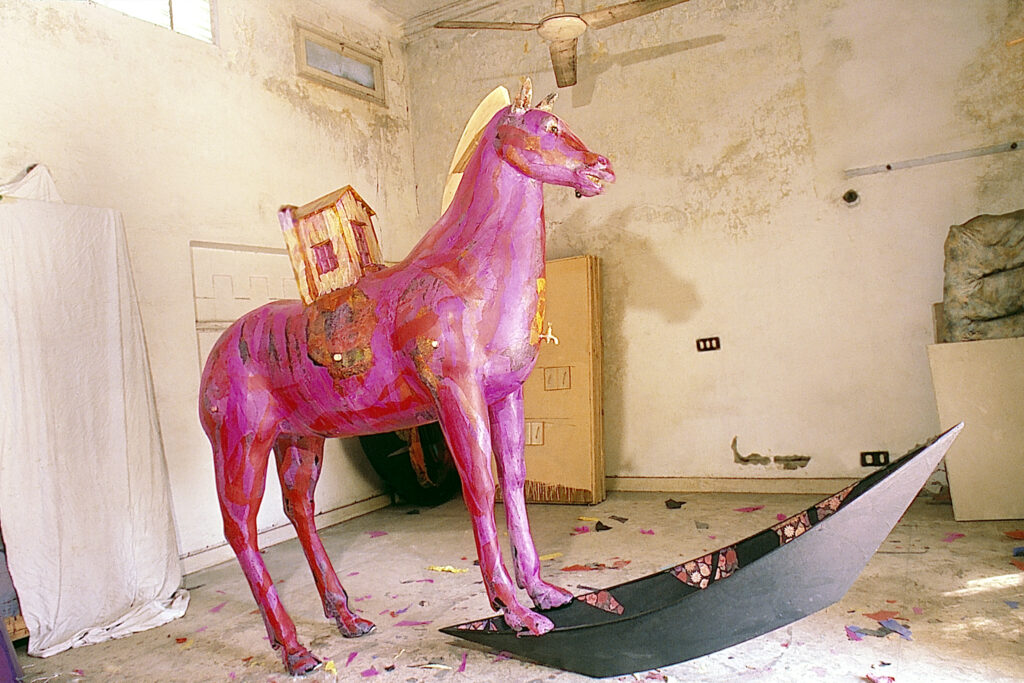
Hoskote returns to the question of ‘home’ again and again, through different images of transition and stillness, that amplify and deepen personal experiences of ‘place’. When we met in January 2026, Hoskote and I read “The Studio” (from The Sleepwalker’s Archive) for the artist Mehlli Gobhai, together. He smiled, recalling a real-life incident that inspires one of the scenes. Gobhai mistakenly enters a one-way lane in his own neighbourhood from the wrong direction, prompting the poet to describe him as an “anonymous tourist” in his own “warren of lanes.” But for the reader, this line is ironic, illuminating the artist’s re-crafting of the self and its engagement with the world through distance and a gaze that transforms everyday objects. In his workshop that is an “assemblage of memoranda,” “a bronze mango” morphs into a “grenade” that proclaims “a thunderstorm of parakeets.” This line is telling, particularly because Hoskote places Gobhai among the greats of Abstract Expressionism, such as Mark Rothko and Barnett Newman.
Hoskote materialises the depth of the abstractionist whose artworks render a delicate balance of line and hue that suggest moods rather than realist agendas. The nomadic workplace of the mind observed in tight cinematic shots, rather than explained through aphorism, also speak to a theme that recurs through the ‘90s in Hoskote’s writings — of the shifting scales of the place of artistic production that could be “as large as a city and as small as a laptop.”
Hoskote curated Gobhai (along with Prabhakar Kolte and Yogesh Rawal) in his first exhibition Hinged by Light (Pundole, January 1994). The curation emerged out of a “conversation between friends,” where he expressed a desire to “show, rather than tell,” while discussing an aesthetic point with Gobhai. The exhibition, again, marked a transition in India’s artistic landscape: this time, in the work of abstractionists who were moving “into sculpture, architecture, and social space.”
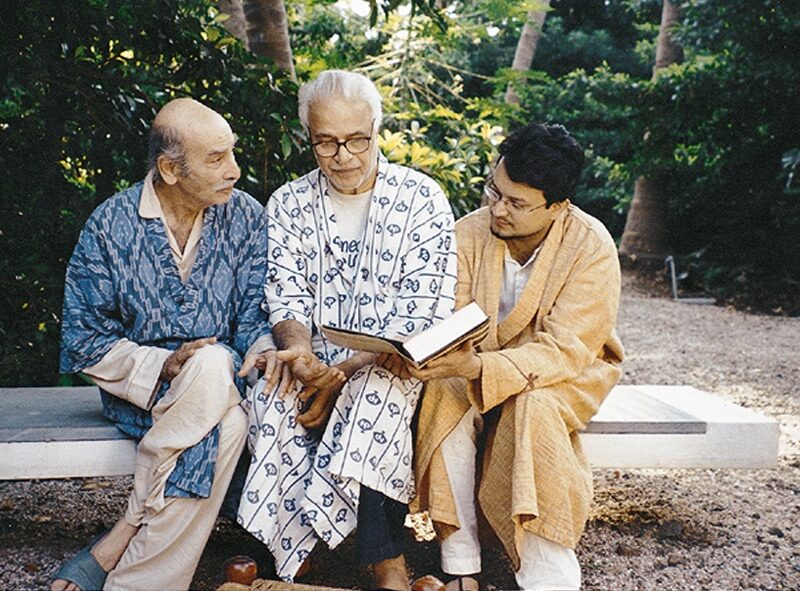
Biographical references in Hoskote’s poems show how personal experiences can shape artistic practices. The poem “Freehold” (from Central Time) speaks directly to Gobhai moving out of his childhood home, after the death of his mother, and ends with an image that anthropomorphises lived space, gesturing towards the ways in which inanimate objects hold deep associations of memory and consciousness. “The house finds its breath again. Its past/ is an abandoned line of defence.”
The question recurs subliminally in the poem dedicated to Baiju Parthan called “Travelling Light” (from Central Time). Hoskote spent his early years of childhood in Goa, like Parthan, who spent his student years there. The poem, in the form of an address, invokes the physical environment that was familiar to both in their formative years. “Take nothing with you/ except the sky stencilled in the window/ to picture the next stage in this journey/ that will carry you past the poplars of home.” The suggestion is tender, but also drenched in the authority of an intimate friendship. While speaking of their “lasting friendship and collaboration” in an interview, Hoskote fondly remembers his first interaction with Parthan, during an MF Husain show: “I was sitting on the floor… making notes for my review for The Times of India, and had shaped some of Husain’s newspaper sheets into a mock-crown. That’s when this polite, dignified, very well turned-out person [Parthan] came up to me and said, ‘Are you Ranjit Hoskote?’ To this day, I maintain that I answered pleasantly in the affirmative, while Baiju holds that I looked up at him with youthful arrogance (I was 22).” The quiet humour of that recollection is poignant and the poem to Parthan — a gentle gift — is almost an epistle, one that could only be written by a dear friend.
The same tenderness born of friendship suffuses his poem “Painter Talking to Flowers,” a poem written in memoriam, for Bhupen Khakhar. “Good ol’ Bhupen,” Hoskote exclaims, his face redolent with uninhibited joy, remembering him as an “intriguing character,” when I show him the poem. This description of the artist is echoed in the title of a comprehensive essay — “A Crazy Pair of Eyes” — that skirts the line between memoir and critical assessment. It was written for an exhibition-catalogue (Touched by Bhupen, 2013-2014) that celebrates the life and work of his artist-friend. The poem embodies Khakhar’s subversive view of the world:
“Only this man praying at the highway’s edge
could hear the planes take off and land.
To the flowers, his love was clear as day:
he floated above the iron-bound hedge,
dodged watchtowers, gagged on the spiky taste
of a metal creeper growing wild. It overran
the city’s roofs. We drove on, he framed his scene…”
A precarious, militaristic haze shrouds the poem. Hoskote points out that this alludes to their trip to Sri Lanka, in 2002, a year before his death. They were there during a fragile ceasefire. The constant undercurrent of the military presence embedded in the rhythms of ordinary civilian life is recontextualised in the poet’s subconscious. A new imagination of the place emerges, enmeshing his memories of the trip and older, past associations. Hoskote had an uncle in the airforce and also a cousin in the IPKF, who received a Veer Chakra for the first overseas peacekeeping mission in Sri Lanka. Read in this light, the poem acquires a more poignant air as we unravel the interwoven affective connections to the place from which the poet carves out the imagery, which ‘frames’ Khakhar as the observing artist.
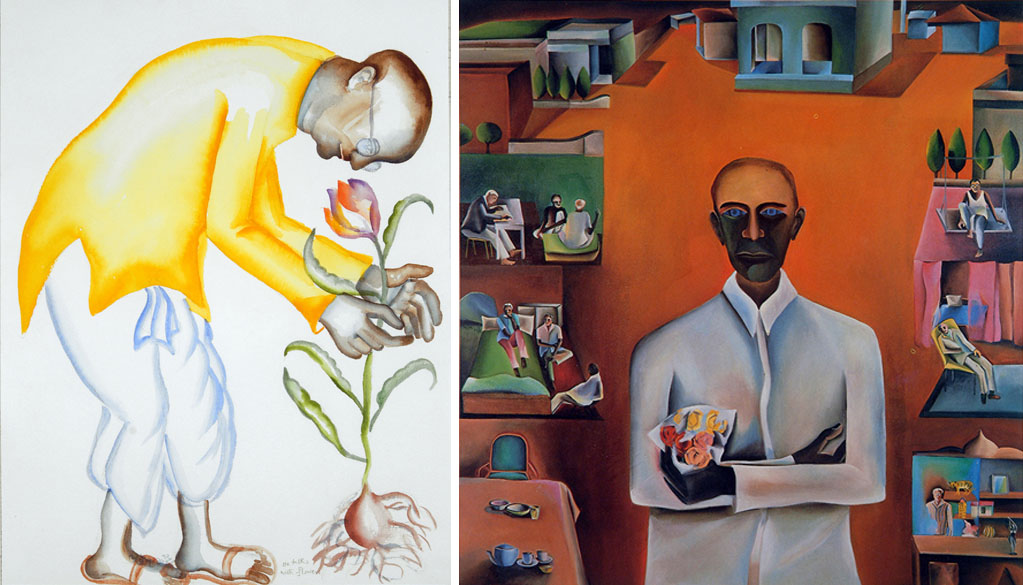
Hoskote notes Khakhar’s turn to the sacred and the mystic, even proposing “his profound engagement with religious culture, symbolism and expressivity” as the “third revolution” in “postcolonial Indian art” of which he was a part. He observes in his essay that Khakhar was frail by then, unable to climb mountains and exert himself. Nevertheless, his work during this period was affected by a profound, quieter energy and he was, in these years, quite unlike “the outrageous clown, the trickster, voyeur, and restlessly transgressive provocateur” that Hoskote had come to know.
The poem, in its quiet observation, aligns with the essay’s description of Khakhar as the “beatific celebrant of a hymnal illumination, melancholy witness, recipient of grace, and clairvoyant.” Perhaps the poem’s title was inspired by Khakhar’s watercolour painting, A man talks with flowers, which is part of collector Brian Weinstein’s collection. The artist (and the poet) make the transition, from a prayer to the framing of a scene, as he paints the “golden rain of the end” in “fading light.” (Golden Rain is also the name of a painting by Khakhar from this period.)
Negotiating the Question of “Belonging”
The concern around “belonging”/“not belonging” was central to the practice of Indian English poets writing in the decades after the Partition. Similar to how childhood experiences can shape an artist’s work, the choice of idiom (English/“Indian English”/Hinglish) recasts their practice within the larger trajectory of political, post-colonial discourse. Hoskote’s anthology of fourteen contemporary Indian English poets, published in 2002, is titled, tellingly, Reasons for Belonging. In that poetic curation, he deals with the question of a “national” framing: “These poets are not apologetic about the fact that they write in English; their poetry is refreshingly free of the excess ideological baggage of Indianness that encumbered the earlier generation of post-colonial Indian poets in English.” His invocation of the language debate is symptomatic of the concern with self-definition that has plagued several Indian artists.
Hoskote has dealt with this question of home, of nationality, and belonging in other contexts as well. For instance, when he took on the mammoth task of tracing the trajectory of art in the subcontinent through 12 important works. Gulammohammed Sheikh’s Speechless City (1975) provides one of the “dozen” lenses through which he views India. (Art India Vol. V Issue 1: Home/Nation). Hoskote notes “the allegorical muting of dissent” during the Emergency and the artistic choices of a “ghost city” without its people. The painting also makes an anonymised appearance in the coda poem from Central Time, called “The First and Last Portrait,” through this striking image:
“You can be all madness and insomnia,
you can hover above this town of barking dogs
like an eclipse. You can become a god.”
The “you” in this poem could be the poet, the artist, or the notional reader whose urge for curiosity is never satiated. Another line from the poem tangentially channels the myth of Icarus — “Put on these wings. You never knew where to stop/ and lapsed into lucid self-awareness only rarely.” These lines speak to the deep-seated anxieties of creative production, even as one braids the intense vulnerability that accompanies the creative act. This choice is political too, if we think of the poet as a curator of images and sensations.
The immediacy of the ‘imagined community’ as a nationalist paradigm re-enters Hoskote’s practice through his curatorial choice of including Zarina Hashmi as one of the four practitioners in the India Pavilion for the 54th International Art Exhibition, Venice Biennale (2011). Hoskote tells me that the choice was controversial at the time. It became an “emotional” milestone for Zarina, who went on record to congratulate the curator. In a poignant response to a question, which tellingly invokes her American citizenship, her life abroad, and a family history of surviving the Partition in the same breath, she reveals what Hoskote’s curatorial choice meant for her: “…to represent India is finally an acknowledgment of being a member of the nation.” Hoskote exhibited the works Home is a Foreign Place (1997), Noor (2008), and Blinding Light (2010).
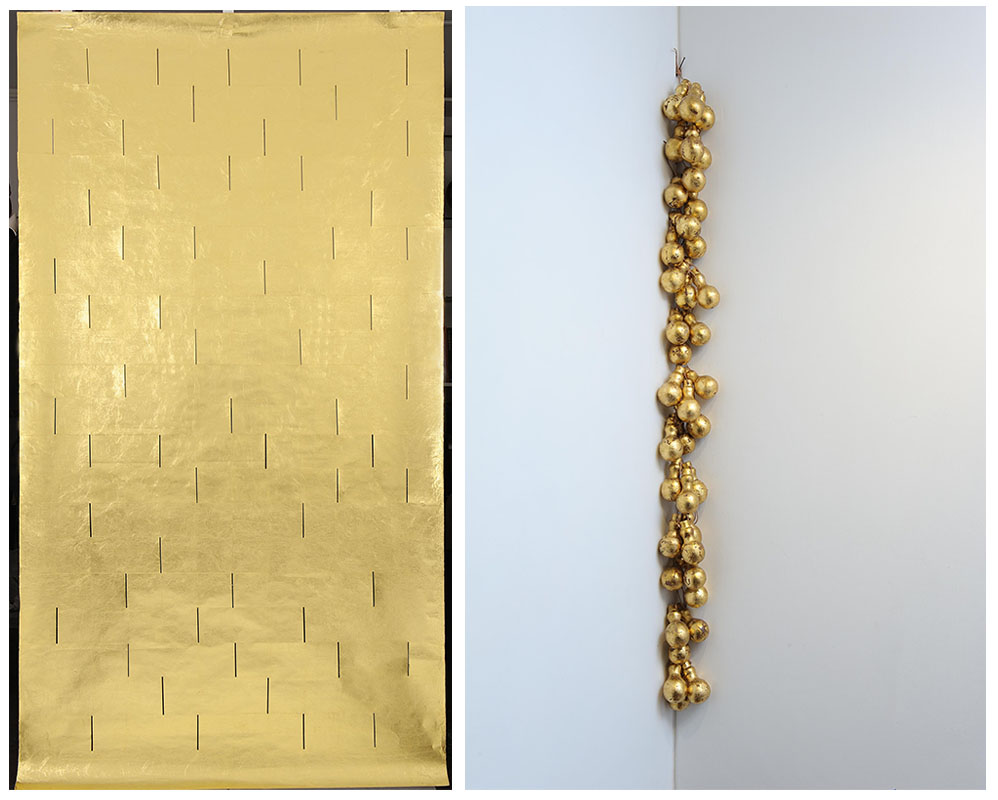
Across the multitude of Zarina’s artworks, one encounters a preoccupation with noor (divine light), that enters a poem with the same title in Hoskote’s latest collection of poetry, Icelight. “Pinpricks of light/ in the sky’s black yurt,” locate the stars as her companions in a lifelong attempt to “translate/ its pulse.” The light is both “marrow and bone” and while it “defeats the gaze,” the poet’s eye discerns its embodied, visceral connection to an ephemeral design rooted in mysticism. A poetic arc is formed in the way in which the artist wilfully embraces the ordinary devices of art-making, doubling down, with eyes closed, only to soar again, in the freedom of creation, which is evident in the finished artwork.
Friendship as Generative Methodology
Once the backstories of Hoskote’s poetic offerings became clearer to me, I realised that rather than limiting my interpretations, they broaden my ways of thinking about collaboration, friendship, and the ethics of aesthetic creation. In a poem that blends texts from original archaeological findings with “translations from the imagination,” Priya Sarukkai Chabria cites a primordial question – ‘O How did I make it?’; the citation is attributed to a “Mid 8th century copperplate inscription.” Hoskote’s poems often gather around this foundational impulse, fingering the twin-threads of how and why we create. He uses the form of the poem in the way that abstract artists visibilise their process, using material and formal gesture to activate discernible strands of their intricate artwork, but without ever really providing conclusive answers. The finished poem makes the incomprehensible journey from “the muddiness of life” to “the possibility of illumination” twice — in the artist’s workshop and in the reader’s imagination.
For Hoskote, the “messiness” of how you make things in art is a constant preoccupation. During the course of our conversations, he tells me that his friend Parthan recently nudged him to take up painting again. I am pleasantly intrigued, rather than surprised, to learn of this twin facility, in part because it feels like a natural extension of his poetry practice.
The immediacy of sensory perception in Hoskote’s poetry is shaped through dialogue. In this field of exchange, the creative act is neither solitary nor linear; it unfolds through affinities, correspondences, and the subtle labour of shared attentiveness. This deliberate approach privileges an affective sensitivity, born of the ecologies of friendship and articulated creatively. In fact, friendship is not the incidental context but a generative methodology that structures Hoskote’s aesthetic world. The poems trace a movement from intimate collaborations to broader meditations on home, nation, and belonging, suggesting that the artistic form can itself become a way of negotiating identity and memory. The moment of encounter becomes the site of imaginations and companionship, shaped by the poet’s attention.
Poetry and the imaginative construct of his artistic creations allow Hoskote to narrativise movements in space, placing the past, the present, the future, and even the speculative, in varied, composite chronotopes. Space is abstracted from temporal movements that break conventional sequential chronologies, framing landscapes in the light of shifting subjectivities and relationships. In a single image, or even a question, the expansive epic time of myth could collide with the slow everyday time of the atelier’s studio or the suspended motion of a painted bird of prey. These anachronisms show, by suggestion rather than figuration, the many-pronged passing of times. Like the flourish of the zuihitsu, his final triumph, as an artist, lies in recrafting space as time — unpredictable, revelatory, and sublime.
First published: March 27, 2026