-
ChicagoThomas, Angel Roy. "Pigment as Metaphor: Material Explorations in Varunika Saraf’s Art." Impart Perspectives, July 3, 2026. https://imp-art.org/perspectives/dispatches/pigment-as-metaphor-in-varunika-sarafs-artworks/
-
MLAThomas, Angel Roy. "Pigment as Metaphor: Material Explorations in Varunika Saraf’s Art." Impart Perspectives, Jul. 3, 2026, https://imp-art.org/perspectives/dispatches/pigment-as-metaphor-in-varunika-sarafs-artworks/. Accessed 15 Oct 2026.
-
HarvardThomas, A.R. (2026) Pigment as Metaphor: Material Explorations in Varunika Saraf’s Art, Impart Perspectives. Available at: https://imp-art.org/perspectives/dispatches/pigment-as-metaphor-in-varunika-sarafs-artworks/ (Accessed: 15 October 2026).
Pigment as Metaphor: Material Explorations in Varunika Saraf’s Art
In Saraf's layered compositions, colors, textures, and citations probe historical wounds that contextualise deeper political themes.
By Angel Roy Thomas
Link copied!
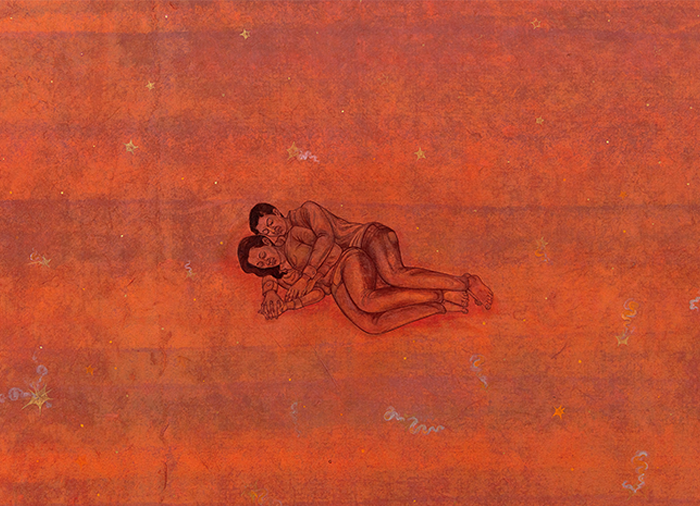
Detail of Love is Contraband in Hell [Assata Shakur]; Varunika Saraf; 2020; Watercolour on wasli backed with cotton textile. Courtesy the artist and Chemould Prescott Road
Varunika Saraf’s work is defined by layers — of colour, of materials, of textures; of layered meanings and complicated histories — all building up into narratives that show how our present is shaped by what came before. Working within an expansive art historical lexicon, Saraf uses specific references (or what she calls ‘citations’), drawing on images from newspapers, social media, popular culture, and other forms of documented pasts. Through such acts of creative archiving, her work makes sense of the present in the context of historical records. Her practice, attentive to moments of rupture, uses a carefully considered toolkit of strokes, washes, dyeing, pasting, and embroidery to tease out and make visible that which seems random, especially forms of violence, unlocking how historical trajectories shape our lives.
Central to her work has been handmade pigments and wasli paper, drawing on the traditions and techniques of Mughal miniature painting. Perfected by court artists working at royal ateliers and workshops, wasli preparation requires the painstaking layering of thin sheets of paper over each other with a glue preparation to create a surface that is absorbent enough to hold multiple washes of paint. Saraf also makes her own colours, like the miniature artists of old, grinding pigments before mixing them with binding agents to create watercolours. Her use of pigments as metaphor relies on both the intuitive use of colour as well as deliberate strategies that rely on her art history background and knowledge of crafting watercolours.
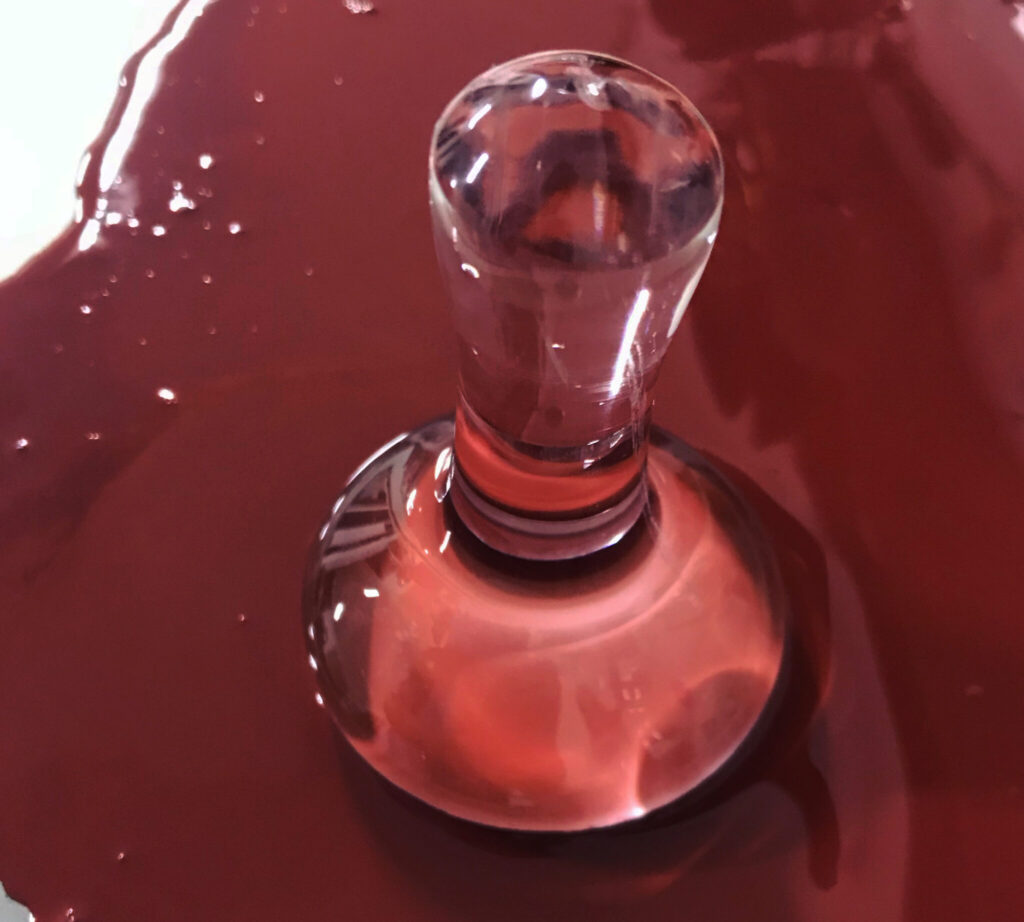
These techniques found their fullest expression in her third solo show Caput Mortuum (2021) held at Chemould Prescott Road. Caput mortuum is a pigment that resembles dried blood, and draws its name from the Latin phrase ‘dead head.’ Described as ‘worthless remains‘ in alchemy, it is derived from the iron oxide ‘residue’ left behind once the nobler elements have been extracted. Saraf delinks it from its alchemical context in her paintings, where the caput mortuum pigment becomes the ‘residue’ of the past instead. Once applied as a base coat, it seeps through many layers of colour washes, indicative of the role of memory and history in shaping contemporary politics. The artist invokes the idea of ‘haemorrhaging’ to describe how the pigment bruises a painting’s surface. The metaphor is clear. Historical injustices in the nation’s past always surface, like mottled blood — evidence of deep internal wounds that are yet to heal.
One of her works, Love is Contraband in Hell [Assata Shakur] (2020), is a painting built up with washes of a burnt orange and a deep red colour on a sparse surface, evoking the look of coagulated blood in streaks where the colours are heavily layered. In the lower section, covered in dark welts of the caput mortuum pigment, two figures cling to each other with their hands clasped. A twisted structure stretches from end to end on the distant horizon, clumped together, like a mountainous border or stained, folded cloth. Above it all, a large celestial body, almost microbial in its appearance, moves in a downward trajectory. The two people sharing the moment of intimacy seem ignorant of the comet-like object headed their way, or the hellish-red setting of their doomed existence.
Love is Contraband in Hell draws its title from a poem by Assata Shakur, a former member of the Black Panther Party and the Black Liberation Army, in which the authorial voice speaks of love as ‘eating away at bars’, and of the immense power of solidarity. For Saraf, the poem’s lines, which were inscribed on a note in her workspace, felt in tune with how she wanted to portray political comradery and allyship.
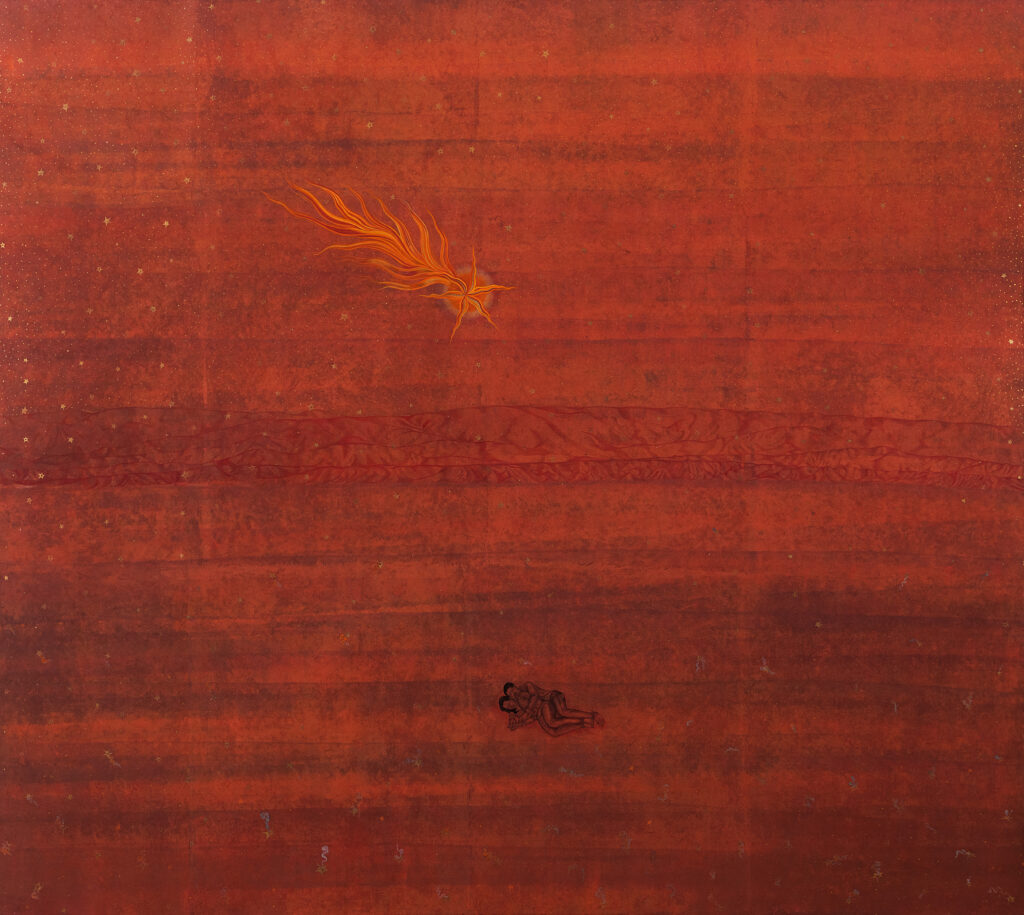
But, is the comet in Saraf’s painting the portent of violent oppression that is yet to unfold, or the harbinger of a bloody revolution? That is for the viewer to decide. Whatever the case maybe, the two figures in the painting declare, in the words of Shakur’s poem — ‘But you, me, and tomorrow hold hands and make vows that struggle will multiply… We are pregnant with freedom. We are a conspiracy.’
Saraf says that, as a body of work, her Caput Mortuum series deals with the collective amnesia that obscures the effects of historic and on-going systemic violence of majoritarian politics and policy-making in the modern nation-state. The increase in communal, caste, and gender violence in particular is made visible, and described in the organic language of ‘wounds,’ ‘scars’, ‘decay’, and ‘malaise’ in her note about the exhibition. This follows a long-standing reflection in her practice on apocalypses and crises as moments that reveal the oppressive structures that undergird everyday life.
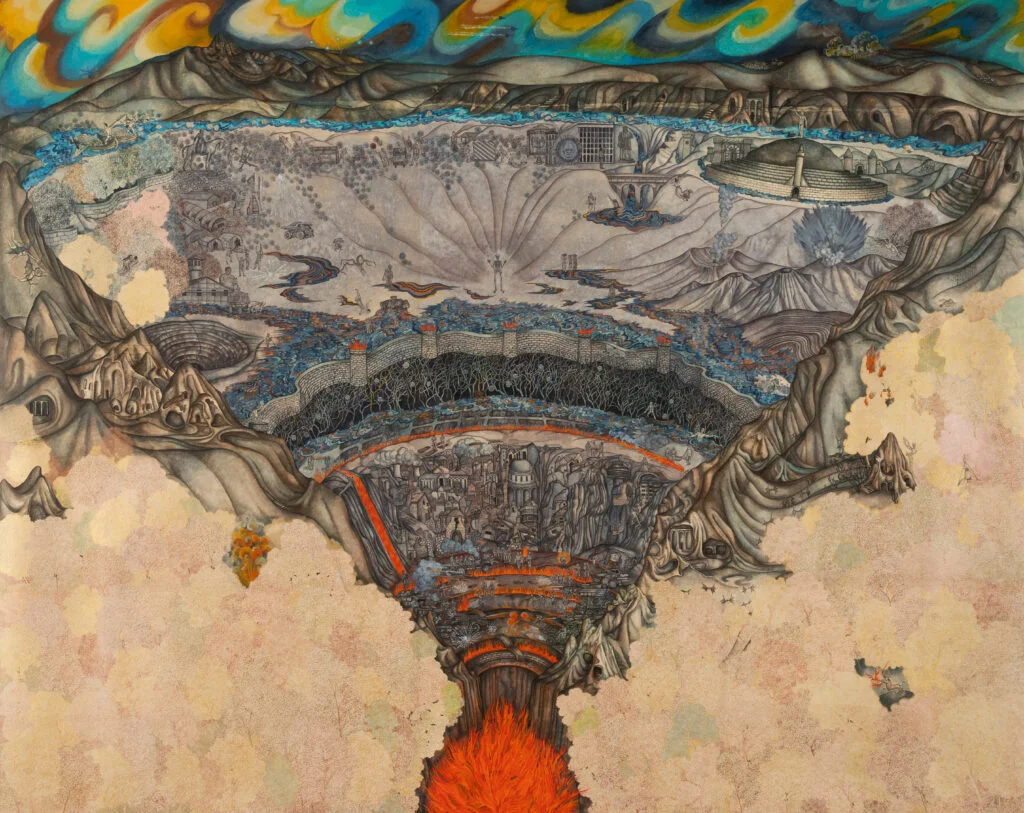
Saraf pays attention to acts of violence, seemingly isolated, whose effects bleed through time, signalling the wider impact of social and political ‘Othering’. In her Caput Mortuum paintings, as well as other series, such as We, The People (2018-2022) and Jugnis (2025), Saraf has shown an on-going engagement with historical struggles as well as the potential for contemporary resistance through acts of solidarity and protest movements, articulating feelings of urgency, anxiety, rage, and hope.
She pinpoints early experiences of seeing vibrant Mughal miniatures in catalogues and edited volumes, such as Marg Publication’s Master Artists of the Imperial Mughal Courts (1991), as having shaped her visual sensibilities. These images were all the more evocative in their contrast to the sombre tones of the Hyderabad of her childhood. The art landscape was quite different, she notes, fondly remembering seeing MF Husain in the city judging art competitions, and how ‘his horses had caught the Hyderabadi imagination’ at the time.
Later, an MFA in Fine Arts and her work as an art historian with a PhD in Visual Studies sparked an academic interest in the contested category of the so-called ‘miniature tradition’. Her fascination for the genre consequently shaped her work as an artist. Saraf expresses discomfort with miniatures being categorised as a ‘tradition’ when her work and the work of other artists show that it is a category ‘in-the-making’. While she references the formal qualities and media-making techniques of the genre, at times even repurposing specific images and motifs from famous Mughal miniatures, she does so in subversive and strategic ways that reveal processes of ‘remaking’ in contemporary contexts.
Her practice is shaped by an array of media and techniques, ranging from watercolours, dyeing and embroidery to woven textiles, sculpted paper, handmade wasli and pigments. The material aspects of her practice are ever evolving. Each medium opens up distinct possibilities, and allows her to draw on specific art histories, such as her use of embroidery that is mapped onto a historical feminist tradition. As an undergraduate student, she was taught painting using colours sourced from Rajasthan, such as lapis lazuli and hara bhata (terre verte). This eventually shifted into the use of ready-made colours like Prussian blue (a synthetic pigment) from established brands like Winsor & Newton, Sennelier and an Old Holland watercolour pan set she still uses, to avoid impurities in the paint and the likelihood of mould formation on finished paintings.
When she decided to use only watercolour paints, even for her forays into large-scale paintings, she began producing her own colours using fine synthetic pigments. At this juncture, Saraf reflects that she could have gone down the route of ‘traditional’ natural pigments but instead chose to use high-quality, museum-grade pigments, which she quips echoes ‘a very Mughal ethos’ of adapting to contemporary techniques and materials.
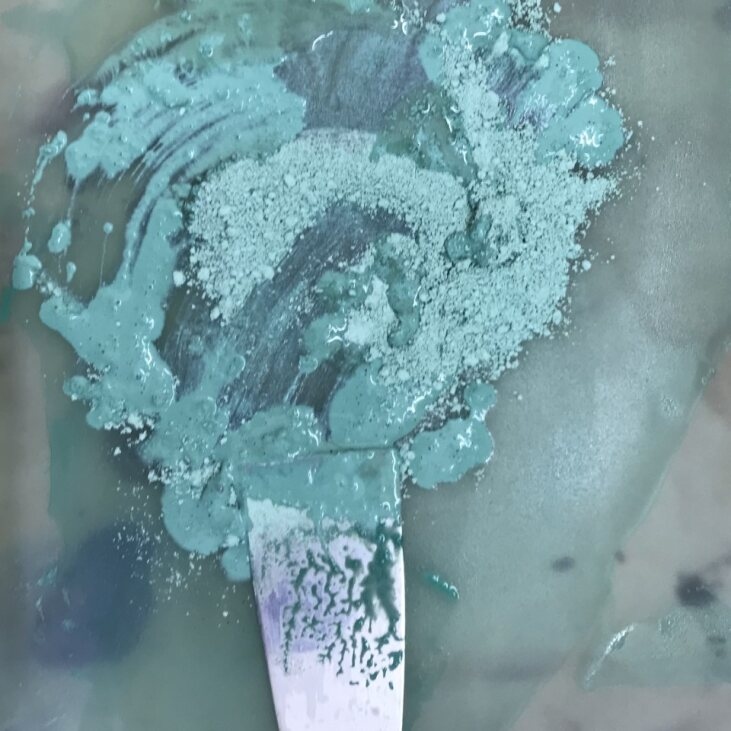
It was through a chance encounter with the art supply store L. Cornelissen & Sons during a fellowship in London, that she first began to consider sourcing and using conservation-grade pigments to produce large quantities of watercolour paints. In her current practice, Saraf shapes the pigments she uses in a multiple-stage process — right from selecting the shades from data sheets and pigment catalogues that determine the opacity and hue of her final colours, to mixing these pigments with binders like gum arabic that create the paste-like paint body. As she states, as opposed to the ‘Turner-esque luminous watercolour washes that show the paper grains beneath’, her work calls for more opaque colours that are built up on top of each other to create a dense and richly-layered painted surface.
Saraf notes that, in the past, her use of these paints was shaped largely by instinct; she would ‘hold a feeling’ that made her reach for certain colours, and through the layering of colours, the surface would start to resemble something of what she was trying to express. This aspect of layering paint, however, also produces the possibility of different pigments interacting with each other in unexpected ways in her work.
Through Saraf’s time working as an artist, her studio space has evolved into a laboratory in which she has discovered the increasing need for protective gear, as well as caution around how pigments age, react, and release toxic chemicals, particularly after the show Caput Mortuum. Having seen the effects and reactions on the painted surface over the last two decades of showing, transporting and storing work, Saraf notes that this past year in particular has been marked by engaging deeply with the chemical make-up of pigments.
For more recent paintings, her palette has been constrained as she chooses pigments that are non-hygroscopic (do not readily absorb moisture), making adjustments for the humid weather in Mumbai where the gallery that represents her — Chemould Prescott Road — is located. Along with this, she has become more attentive to pigments’ lightfastness (the ability to resist fading), toxicity levels, and reactivity in acidic and alkaline environments.
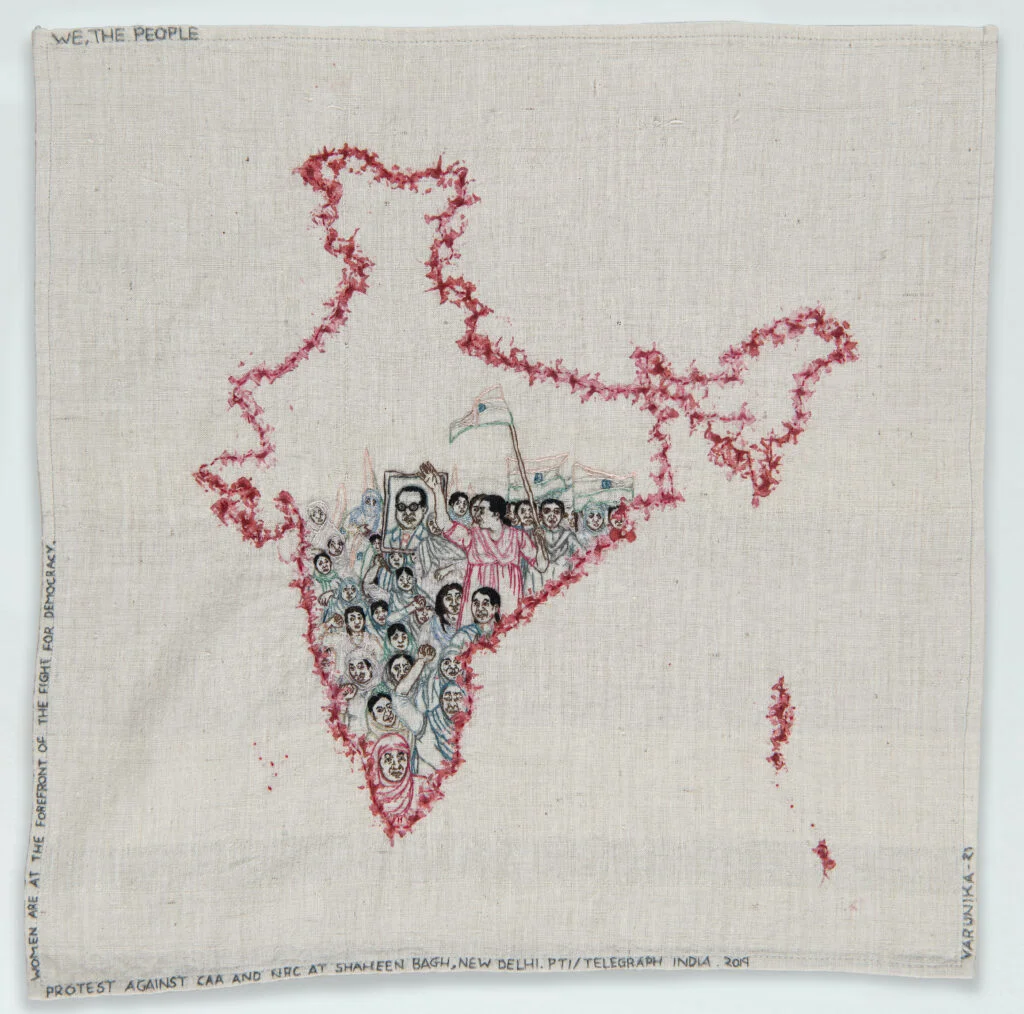
In rare instances, she deliberately uses reactive pigments, such as the orange-red lead pigment minium. Minium has an effect of ‘eating’ paper due to its acidic nature and turning the pigment black in the process. Saraf has made use of its corrosive effect to illustrate gestures of nationalist political figures from the recent past in her series The Miniatures (2019), visibilising decay on the paper surface. She remarks that these ‘private mischiefs’ she indulges in her studio, add layers of meaning to her work. As with the use of minium, her work often plays with the surface itself, using repetitive gestures of layering washes, pasting material, and distressing the surface. In the embroidered works of We, The People series, the map of India is outlined in small tie-dyed sections of fabric that open to reveal the red blotted line of the contested borders. The crumpled sections of cloth are dyed with carmine dye, extracted from the cochineal insect, to produce suturing marks on the fabric surfaces that hold together the festering wounds of the border.
These reflections on pigment, and the way it shapes the conceptual and philosophical underpinnings of her work often emerge when Saraf is working in her studio. She gets drawn to certain paint pigments that then get incorporated into her compositions. Drafts often undergo multiple revisions; reworked, till conceptual themes and points of intersection slowly start to surface. As she notes, her studio space is a place of surprises. A certain morning may begin with an explosion of brightly coloured fine pigment leaving pink footprints around the studio, followed by the tedious clean-up. Another may be more restful, as she finds herself absorbed in getting minute details just right. Her work is often accompanied by visually-striking images and videos of the paint preparation, posted on social media, which offer a peek into her process, though she warns, ‘Studio practice is mostly hard labour!’
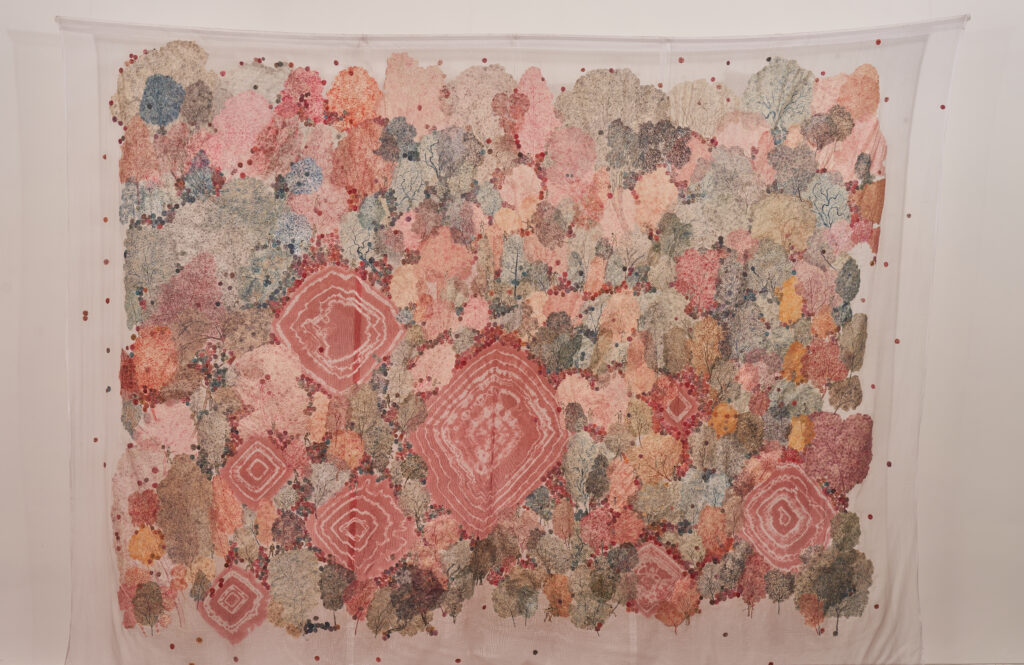
Some of these experiments are evident in Land that Bleeds (2020–21). In it, techniques of dyeing, painting, and paper cutting are brought together in a striking composition executed on gauze-like kota cloth. From a distance, the piece centres on spiral blotches that look like exposed geodes or the rings of felled trees, signifying the passage of time. These create the negative space in the composition, surrounded on all sides by multi-hued stains that together look like the aerial view of a forest. Similar to miniatures which, on detailed examination, reveal several narrative sequences unfolding on the surface, the complexity of Land that Bleeds is only evident once the viewer looks closer. Saraf creates the façade of the ‘natural’ forest landscape using a bright red carmine tie-dye on the kota textile. Paintings of foliage on lokta paper sourced from Nepal are layered over the fabric in muted greens, blues, ochres, and deep red hues.
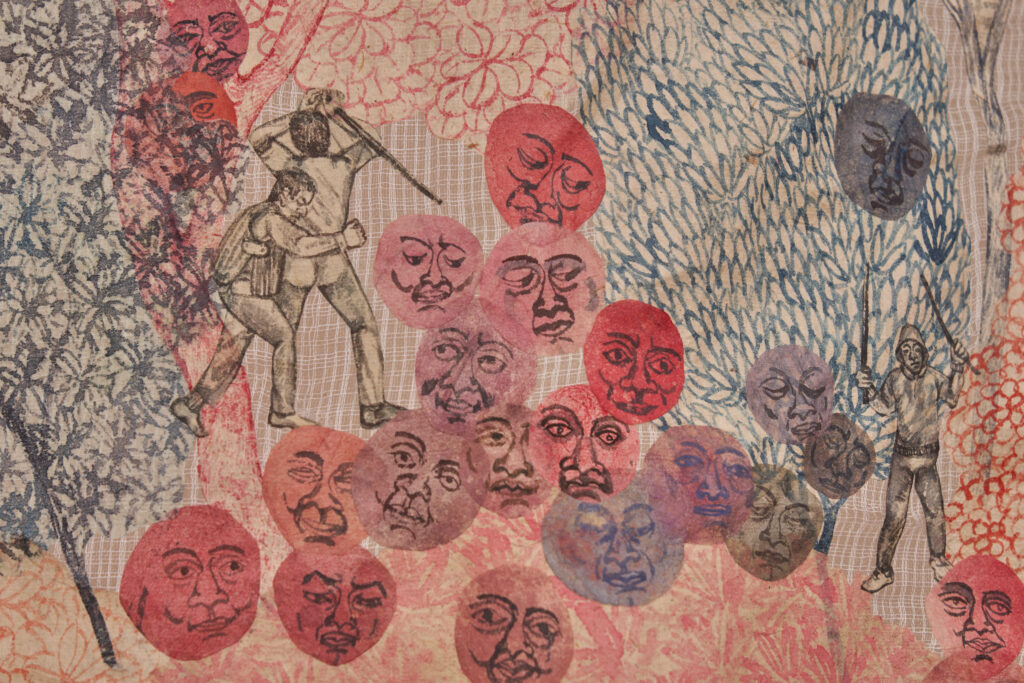
Only on closer viewing, does the viewer find out that the foliage obscures the surface populated by people in motion and faces that look from side to side, all individually pasted onto the cotton textile. The faces, on round, coloured cut-outs on lokta paper, have dramatic expressions of surprise, fear, and at times, neutral indifference. Large red stains of carmine and caput mortuum bleed into the foliage, speaking to the growing stains and seepages of the past that violently intervene in social and ecological presents. Figures armed with sticks are caught mid-motion beside them. The full-moon faces reflect ideas of looking at, looking closely, and looking away as bystanders to violence unleashed by those in power. They form a collective body, asking us to consider our reactions and complicity in an increasingly violent world — a call to undo what has already been set in motion.
Peeling back the layers of Saraf’s practice, the painted surface emerges as one possible entry point into the work in which the artist engages with media and its making to shape meanings. Pigments are worked into metaphors that evoke visceral feelings and pull on historical threads tied to political themes in her compositions. The artist’s process and the shifts in her practice reveal a generative relationship between material and concept, where her interactions with the material are influenced by, and in turn respond to the philosophical meanings she seeks to bring to the forefront. Situated in the space between compelling narrative, unwieldy material, and historical citation, one is prompted to look beyond that which appears on the surface, and instead begin to notice what seeps through.
First published: July 3, 2026