-
ChicagoPathak, Davangi. "Sharp Visions: An Interview with Artist Tayeba Begum Lipi." Impart Perspectives, May 22, 2026. https://imp-art.org/perspectives/interviews/sharp-visions-an-interview-with-artist-tayeba-begum-lipi/
-
MLAPathak, Davangi. "Sharp Visions: An Interview with Artist Tayeba Begum Lipi." Impart Perspectives, May 22, 2026, https://imp-art.org/perspectives/interviews/sharp-visions-an-interview-with-artist-tayeba-begum-lipi/. Accessed 16 Oct 2026.
-
HarvardPathak, D. (2026) Sharp Visions: An Interview with Artist Tayeba Begum Lipi, Impart Perspectives. Available at: https://imp-art.org/perspectives/interviews/sharp-visions-an-interview-with-artist-tayeba-begum-lipi/ (Accessed: 16 October 2026).
Sharp Visions: An Interview with Artist Tayeba Begum Lipi
Widely recognised for her iconic use of steel razor blades, Bangladeshi artist Tayeba Begum Lipi transforms familiar domestic objects into visually stunning yet emotionally unsettling forms.
By Davangi Pathak
Link copied!
Tayeba Behum Lipi. Courtesy the artist
With a multidisciplinary practice that spans sculpture, installation, video, performance, and painting, Tayeba Begum Lipi is one of the most significant contemporary artists to emerge from Bangladesh. Born in 1969 — just before the 1971 Bangladesh Liberation War — Lipi’s work navigates questions of memory, gender, vulnerability, violence, and social transformation. Widely recognised for her iconic use of steel razor blades, Lipi transforms familiar domestic objects into visually stunning yet emotionally unsettling forms that embody layered histories of care, intimacy, pain, and survival.
In our conversation, Lipi reflected on the evolution of her material language, the emotional and political circumstances that shaped some of her most provocative pieces, and the role of memory in her practice. She also offered insights into the changing cultural landscape of Bangladesh, and the larger artistic ecosystem she has helped create in the country.
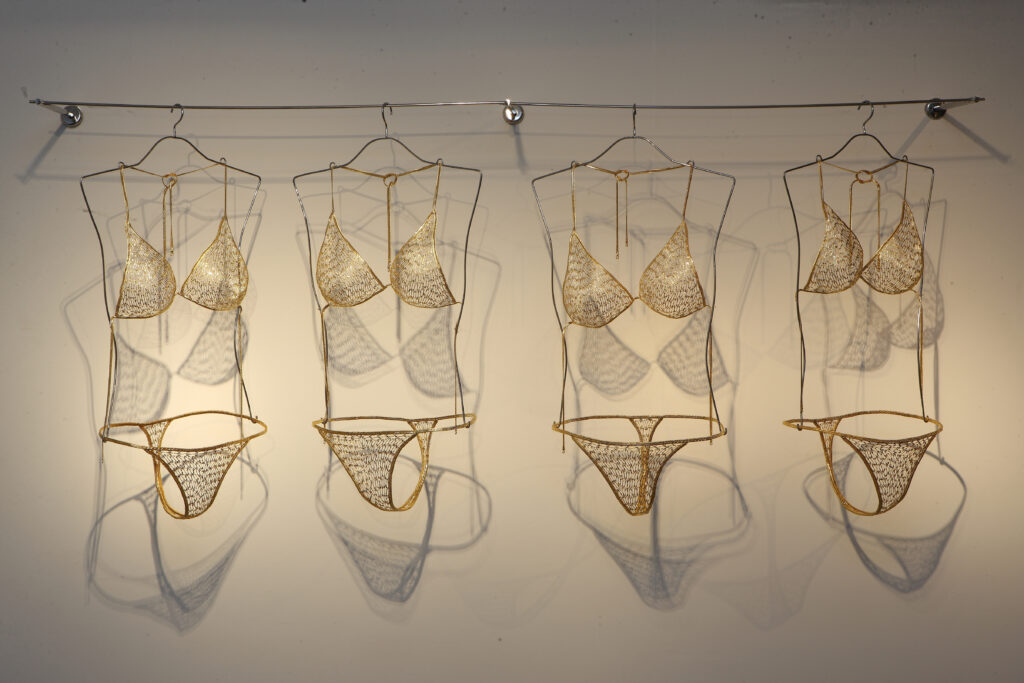
Davangi Pathak: Your work often transforms everyday domestic objects into striking sculptural forms. What draws you to these particular objects as carriers of meaning?
Tayeba Begum Lipi: For me, it really started with a kind of dissatisfaction with two-dimensional work. Even when I was painting, I was always trying to bring something more into it — some texture, some sense of the real. I would paste fabrics, stitch into the surface, or use small objects like safety pins, razors, feathers, sequins, garlands, even stones. I did that for many years. At the same time, I was also working with installations and experimenting with materials like fibreglass.
But with these earlier works, especially when I was using readymade objects, I began to feel limited. The last pieces I made using readymade razors were for the Kathmandu International Art Festival (2012) and another for the Colombo Biennale (2012). But you couldn’t really bend or shape them and that had really started to frustrate me by then. In 2010, when I had begun thinking about a piece for the 54th Venice Biennale (2011) — for the first ever Bangladesh Pavilion — I wanted to create something more complex, like two racks of bras made out of razors. I spoke to my partner, Mahbubur Rahman, who has a strong understanding of materials. He suggested that instead of using readymade razors, I should fabricate them. That idea changed everything.
We worked with a technician, and each razor had to be moulded individually from a single mould. For one particular razor shape, two different moulds were used. It was a technical process, but it gave me the flexibility I was looking for. That was the first time I used fabricated razors, and it opened up a completely new direction in my practice. They’re not exactly the same size as real razors — sometimes slightly bigger or smaller — but that shift allowed me to really shape the work in the way I had imagined.
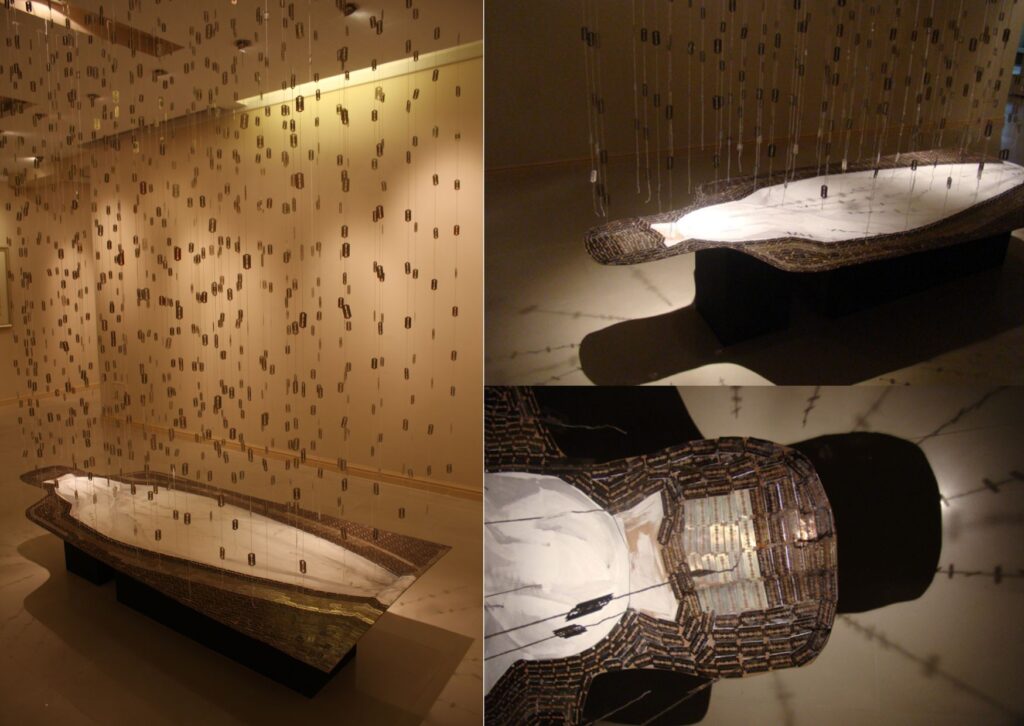
Pathak: The use of razor blades is visually alluring yet unsettling. What made you start using this object, and how has your relationship with it evolved?
Lipi: It really began around 2008. I was invited to Lahore for a studio residency by RM Naeem. At that time, both Bangladesh and Pakistan had seen similar political situations unfold. In Bangladesh, we were under what was officially called a “caretaker government,” but in reality, it was very much an army-shadowed regime. There were arrests, disappearances — journalists were being taken from their homes in the middle of the night. There was a general atmosphere where people felt they couldn’t speak out. It was a very unsettling time. I arrived in Lahore carrying that emotional weight. The residency itself was quite short, and I remember feeling a kind of urgency to respond to what I was experiencing internally. I found myself drawn to something sharp, something reflective, almost instinctively.
Then, in a local bazaar, I came across razor blades in abundance. That struck me immediately. Razor blades also connected to my own childhood. I grew up in Gaibandha, a small town in Bangladesh, and they were incredibly common there. We didn’t have things like sharpeners or nail cutters back then, so razor blades were used for everything — you would keep one tucked inside your books to sharpen pencils in class. So, there was already a familiarity, a kind of personal history attached to them.
But in that moment in Lahore, they took on a different meaning. I was thinking about the people who had disappeared, who never came back, and the silence surrounding that. I started imagining something like a coffin — something that could hold that sense of loss. I ended up making a box and covering it with razor blades, around 3,500 of them. There were black and silver blades, and I used both. Some were pasted but most were suspended over the coffin. The work had this very striking presence. It was shiny, almost beautiful, but at the same time dangerous. You could easily cut yourself. That contrast — the attraction and the threat — felt very true to the political atmosphere I was responding to. It had a coldness to it as well. That was the first time I used razor blades in an installation, and in many ways, it marked the beginning of an ongoing relationship with the material.
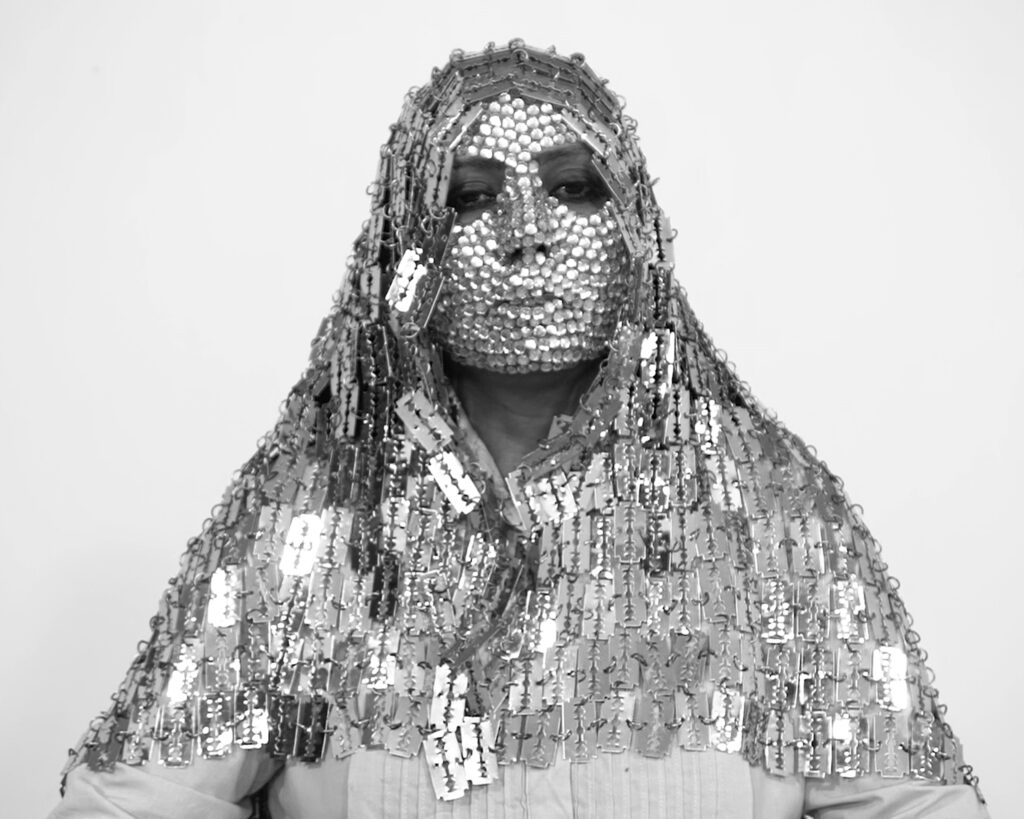
Pathak: You’ve spoken about memory, particularly related to childbirth practices. How do personal and collective memories intersect in your work?
Lipi: I think this connection between personal and collective memory came later, when I started questioning myself — why this material (razor blades)? In fact, back in 2008, I didn’t even know about works made with razors by other artists. It was only later that I encountered two or three artists who were also using this material as a minor element and not as a main object that shapes the subject.
So then I had to ask myself what razors meant to me, specifically, within my practice. I kept returning to a very particular childhood memory. In the countryside where I grew up, razor blades weren’t just used for small, everyday tasks as I had mentioned. Its most significant use was during childbirth. At that time, there were very few rural maternity hospitals, and even when they existed, women avoided them because of the quality of care, preferring to give birth at home.
There was usually an older woman from the village — a kind of traditional midwife — who would be called when someone went into labour. And one of the first things she would ask for was a new razor blade. I remember this very clearly. Someone in the family would be sent to buy one, and then water would be boiled to sterilise it. These women were not formally trained, but they were very experienced. They knew exactly what they were doing and how to manage the situation with the limited resources they had.
As a child, I was both curious and a little afraid. I remember sitting nearby, watching the water boil, wondering what they would do with the blade. It stayed with me as a slightly unsettling memory. Over time, I realised that this wasn’t just my personal memory — it was something shared across many communities. The razor blade becomes more than just an object; it carries multiple layers of meaning. It’s connected to care and birth, but also to vulnerability, risk, and survival. So in my work, it moves beyond an individual experience and becomes part of a larger, collective history.
Pathak: Your practice is often described through a feminist lens. How do you position your work within both local Bangladeshi and global feminist discourses?
Lipi: I don’t always feel the need to position my work strictly within a fixed idea of gender. I’ve also worked with the transgender community — in one of my earliest projects with Shrine Empire, an entire exhibition was built around the experiences of a transgender individual, Annonya, whom I collaborated with. Such exchanges have made me question rigid definitions of gender. There’s also a video work I made for the Venice Biennale, titled I Wed Myself (2010) where I perform the roles of both the bride and the groom. I married myself. For me, that was a way of exploring identity beyond binary categories.
In many ways, I feel more connected to the idea of being human, rather than being defined strictly as male or female. That said, I am of course shaped by my experiences as a woman — through my own life, but also through the stories of people around me. Many of my works are not directly autobiographical; they come from friends, from people I’ve known, from things I’ve witnessed.
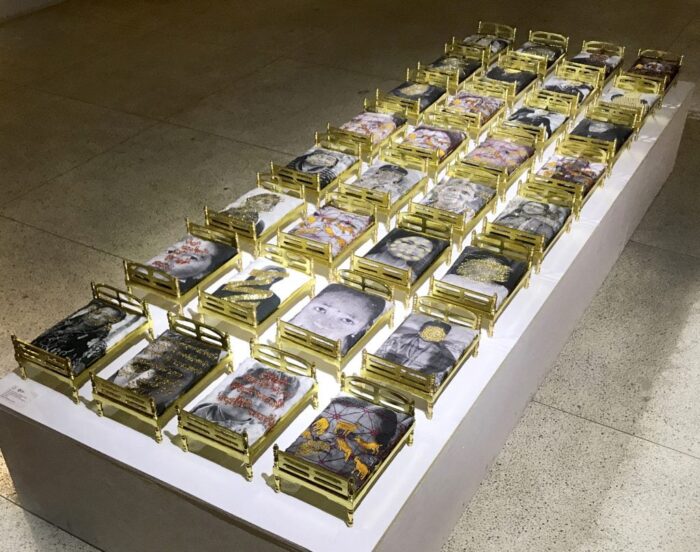
For instance, a work like Love Bed (2012) came from someone else’s story, not my own. Personally, I’ve been in a long and happy marriage, so in such pieces I speak from a space of observation and empathy, rather than complaint. I also feel that social attitudes are constantly shifting. In some ways, I think people were more open before, and now there is a growing conservatism. Conversations around identity, gender, and even religion have become more complex, sometimes more restrictive. These changes inevitably shape how I think and work, both within Bangladesh and in a broader, global context.
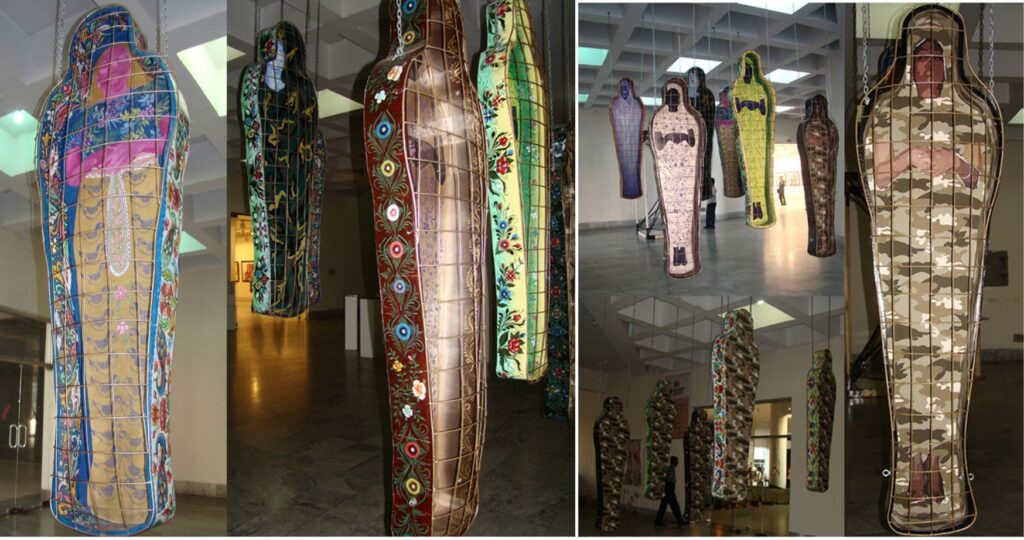
Pathak: Many of your works appear delicate from a distance but often symbolise some form of violence. How important is this tension between attraction and discomfort?
Lipi: I think that tension is actually very central to my work. The razor blade, for example, is such a small object, but it carries a lot of power. It’s precise, sharp, and potentially dangerous — all of that is already embedded in its nature. So, in a way, the attraction and discomfort comes from the material itself.
I’ve always been drawn to this kind of paradox. Many of my works might appear delicate or even beautiful at first, but there’s often something unsettling beneath that surface. Even in my videos, I try to maintain a composed presence, but they can still feel disturbing. I think that’s because, in reality, our lives are not free from discomfort — we are constantly navigating disturbances. Of course, everyone wants peace and beauty… something calm. But if we focus only on that, we might be avoiding an important part of reality. I’m not interested in doing that. Instead, I try to work with both sides — quietly, not in an aggressive way, but in a way that still carries a certain intensity.
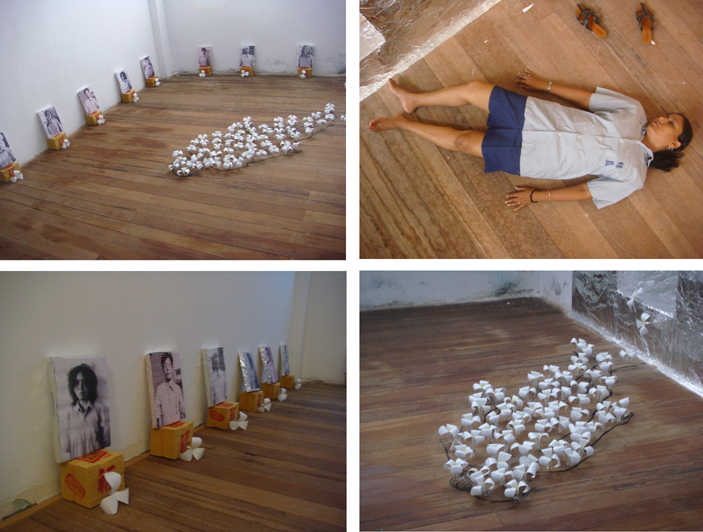
For me, it’s like two sides of the same coin. You can’t really separate them. The beautiful and the unsettling, the attraction and the discomfort — they all exist together, and acknowledging both feels important in the work.
Pathak: Could you reflect on how audiences from different cultural contexts respond to your work, especially given its rootedness in very specific experiences of living in Bangladesh?
Lipi: To be honest, I haven’t exhibited very frequently in Bangladesh in recent years — my last solo show here was in 2016. Logistically, it’s not very easy to exhibit here. You end up having to manage everything yourself. There aren’t many galleries here that represent artists in a sustained way either. In Dhaka, there are only a handful of spaces, and many of them are quite small, sometimes housed in apartments. There is the Bengal Gallery, which offers a larger space. I’ve worked with them and I am planning to have my next solo show there in 2027. But most galleries have space limitations or face other issues, such as access to utilities. So it is challenging to show work consistently, year after year, within the country.
At the same time, my work travels a lot internationally, often without me, and it finds different kinds of audiences. Interestingly, I feel that in many contexts outside Bangladesh, people are able to engage with the work in a more open-ended way. Even though the work is rooted in very specific experiences, the materials and emotions seem to resonate more universally.

In Bangladesh, however, I feel the social atmosphere has changed quite a bit over the years. When I was growing up, people were religious but not necessarily rigid or extreme. Now, there is a noticeable shift, and I don’t feel I could present the same kind of exhibition I did in 2016 in exactly the same way today. The environment has become more cautious, and as artists, we also have to think more carefully about how work will be received. There’s also a broader sense of uncertainty — about the future, about stability. Even when thinking about long-term ideas, like building an archive or a foundation for our work, there are questions about sustainability and support. These are real concerns that shape how we plan and work. So, in that sense, audience response is not just about interpretation — it’s also about context. The same work can feel quite different depending on where it is shown, and what kind of social or cultural climate surrounds it.
Pathak: The female body is often implied rather than directly depicted in your work. What informs this decision to ‘suggest’ rather than ‘represent’?
Lipi: I think this approach has become even more meaningful to me in recent years, especially after my experiences with illness. I’m a cancer survivor, and over the past few years, I have faced multiple health issues, one after another. At one point, I was almost bedridden and I really stepped away from making art entirely. It felt like everything had shifted — suddenly, it was a question of life and death, and art didn’t feel urgent. I didn’t even want to think about working.
But as I began to recover, I started reflecting again. I didn’t return to large works immediately; I began with small drawings. Stopping everything doesn’t help with overcoming pain, illness or depression. That’s why I slowed down but didn’t pause. During my treatment, I had taken many photographs of myself, often just observing my body in the mirror. I started drawing from those moments — simple, quiet observations. It was less about representation and more about trying to process what I had gone through.
My body had changed in ways I hadn’t known before. After breast cancer and surgery, it felt unfamiliar to me. So now, when I think about the body, I’m not interested in presenting it as something ideal or aesthetically “beautiful.” That has never really been my focus. Instead, I’m more drawn to suggesting the body; to hint at its presence, its fragility, its transformations.
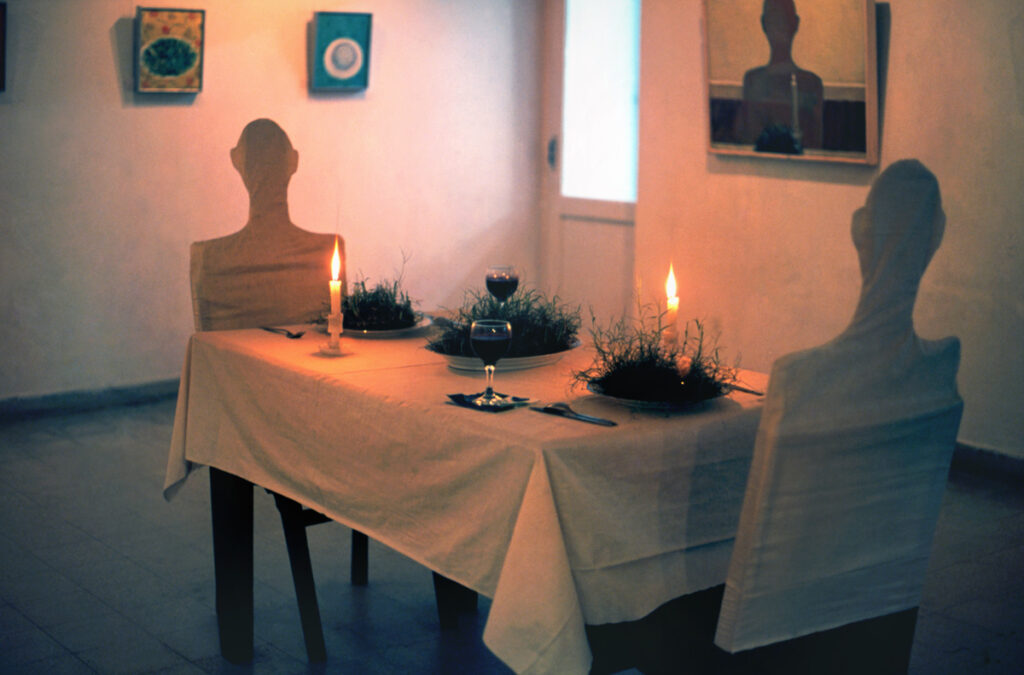
Sometimes it’s about capturing just a glimpse of an experience rather than fully describing it. Because certain things, like illness, vulnerability, or personal change, are not always easy to express directly. By ‘suggesting’, I create the space for those emotions to exist without fixing them into a single image.
Pathak: As a co-founder of Britto Arts Trust, how has your role as an organiser and facilitator influenced your individual artistic practice?
Lipi: Being part of Britto Arts Trust has been deeply formative for me. From early on, we were connected to a wider South Asian network of artist-run spaces — many of them linked through the Triangle Network. Through this, we worked closely with initiatives like Khoj (Delhi), VASL (Pakistan), Theertha (Sri Lanka) and Sutra (Nepal). These platforms created a space where artists could meet, collaborate, and exchange ideas. You weren’t just making your own work; you were constantly in dialogue with others, engaging in critical discussions, workshops, and shared programs. That exposure really expanded my understanding of contemporary practice beyond my immediate context.
We also learned by doing. None of us were trained to run an organisation. We figured it out through experience, through trial and error, through collective effort. That process taught me as much as any formal degree could have. It made me more aware of how artistic ecosystems function — how exhibitions are organised, how collaborations happen, how communities are built. I think it’s important for artists not to remain isolated within their own practice. Engaging with these structures and communities gives you a broader perspective. It enriches your work and connects you to conversations in the larger art world.
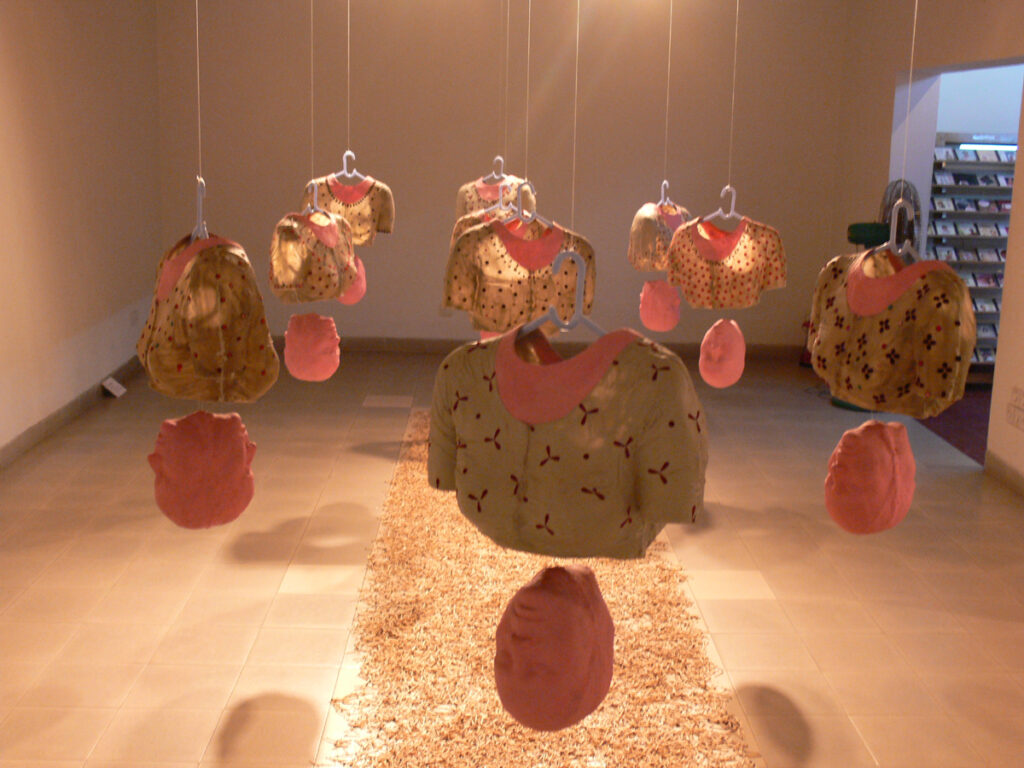
Pathak: Your works often carry an element of labour-intensive craftsmanship. How do you see the role of labour in your art?
Lipi: Labour is central to my work, both physically and symbolically. My pieces usually have a long, collaborative process behind the scenes. We’ve built and trained a small team and it is usually these same five to six people [Mahbubur Rahman and I] work with. While some of them came with technical skills, they’ve gradually learned the specific processes my work requires. We have studios set up where everything is produced — each element is made by hand.
For example, every razor blade is individually moulded and then assembled through a detailed welding process. Quite repetitive. But shaping the final form — getting the curves, edges, and structure right — is the most challenging part. It requires a high level of precision and care.
At the same time, such labour also carries a symbolic dimension. My work is often discussed from a feminist perspective, yet the physical making involves a team that is largely male. For me, that’s meaningful in itself — it reflects the idea that empowerment is not an isolated act. It involves support, collaboration, and shared effort. I feel very fortunate to work with people who understand and support my vision. In that sense, the labour behind the work becomes part of its meaning. It’s not just about the object, but also about the process and the relationships that make it possible.
Pathak: In exhibiting internationally, have you felt any pressure to contextualise or translate your work differently for global audiences?
Lipi: Not really. I’ve been working consistently with galleries like Shrine Empire and Sundaram Tagore Gallery over the past decade, and the approach has remained quite organic. I think the nature of my work allows it to travel across contexts without needing too much explanation. Even though it comes from very specific experiences, people seem to connect with it in different ways wherever it’s shown.
Residencies have also played an important role in this. I’ve done many over the years, and they offer a very focused environment. You’re removed from daily responsibilities and can spend time thinking, researching, and working closely with your ideas. That kind of space helps the work grow naturally, rather than you trying to adapt to a particular audience. So, for me, it’s less about translating an artwork and more about allowing it to exist in different contexts, allowing it to generate its own meaning in those contexts.
First published: May 22, 2026