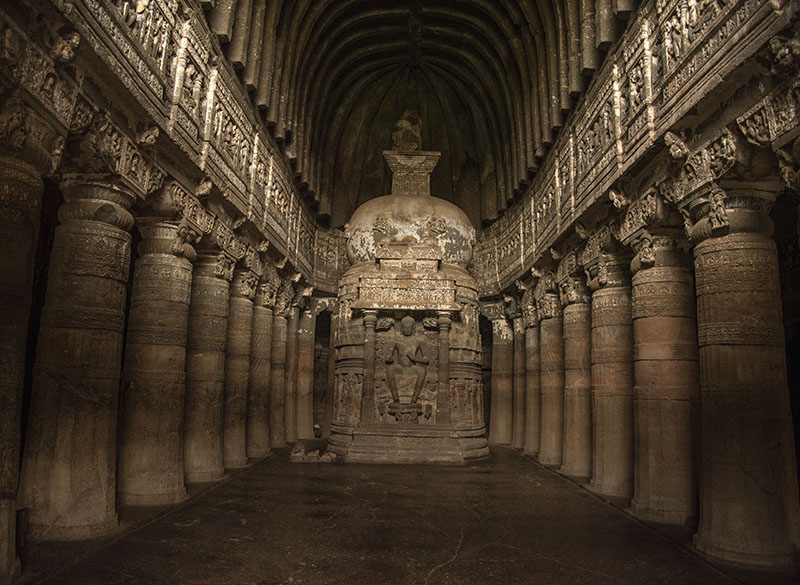
Meaning ‘shrine’ or ’sanctuary’ in Sanskrit, chaitya or chaitya griha (‘chaitya hall’) refers to a pillared hall in Buddhist architecture, which usually houses a votive stupa in an apse at its end. It is typically a long and narrow structure with a high roof. The stone ceiling has carved beams in imitation of the original wooden construction, or attached timber ribs, as seen in the earliest surviving chaityas in the rock-cut caves of Karle and Bhaja in the Western Ghats of India. The term is also used in Buddhism, Hinduism and Jainism to refer more generally to a temple or sacred monument.
More Definitions
Tala
A tier or storey in a shikhara, vimana or gopuram, found primarily in Dravida temple architecture.
Jaali
Latticed screen windows often found in Islamic architecture, typically made of stone, metal, and in rare cases, also wood. Apart…
Kapotabandha
In Indian temple architecture, it is a style of decorative moulding seen on a tier of the adhisthana, the raised…
Ananda Nilayam
The name of the vimana (the sanctum sanctorum and the tower over it) of the Tirumala Venkateswara Temple in Andhra…
Tin Thal
A three-storeyed Mahayana cave temple in Ellora dating to the eighth century CE. Marked as Cave 12, it houses a…
Vaulted
An architectural descriptor for ceilings or roofs that feature self-supporting arches known as vaults. In its simplest form, the vault…
Capital
In architecture, uppermost member of a column or pilaster, wider than the shaft and often distinctively carved or decorated in…
Palisade
A fence or defensive wall made of closely packed wooden or iron stakes or tree trunks and typically serves as…