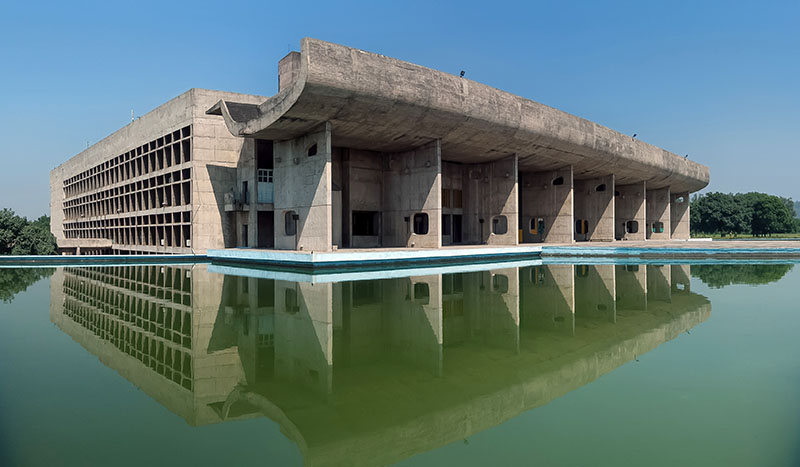
The adaptation of Western Modernist principles — functionalism, minimal ornamentation, and the use of industrial materials like reinforced concrete — to India’s climatic, social, and cultural contexts, which emerged in the mid-twentieth century and gained momentum by the mid-1970s. Inspired by Prime Minister Jawaharlal Nehru’s vision of the potential of architecture to address technological advancement, Modernist architecture in India marked a shift away from the country’s colonial architectural past to that of a modern nation-state. While the works of foreign architects like Le Corbusier and Louis Kahn in India were influential, from the 1960s Indian architects such as Balkrishna Doshi, Achyut Kanvinde and Charles Correa developed an architectural language that integrated Modernist aesthetics with regional materials, local building knowledge systems, traditional forms, and climate-responsiveness, reflected in housing, planning, and institutional projects. Recent scholarship also considers lesser known built forms from the early twentieth century as expressions of Indian architectural Modernism.
Indian Modernist architecture
Link copied!