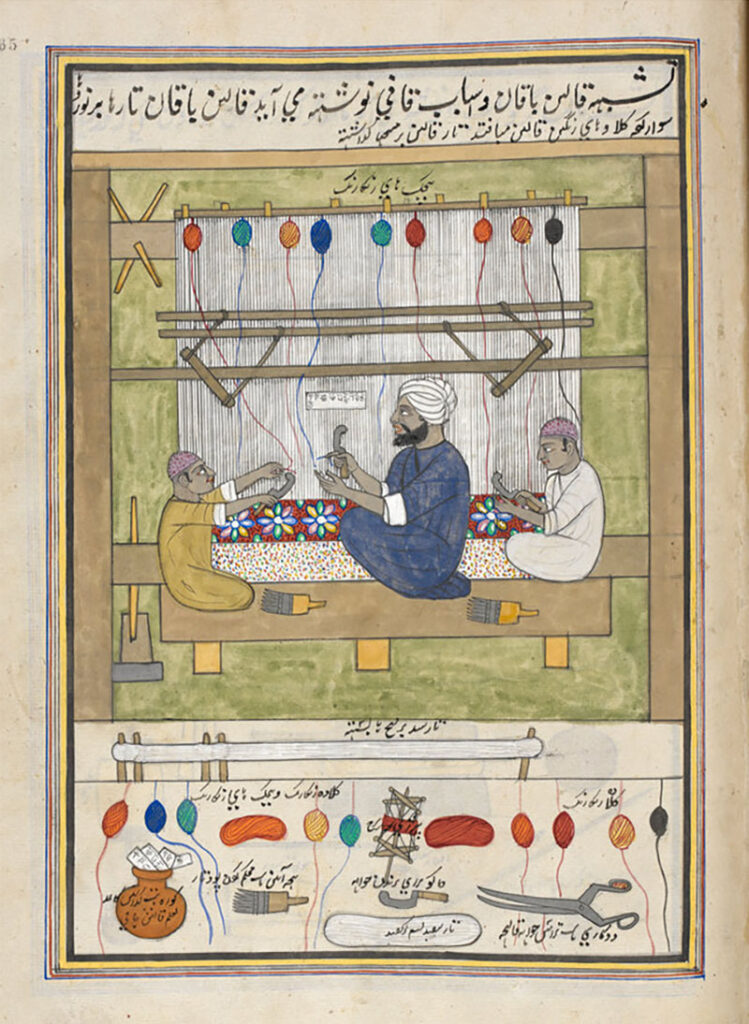
Upright handloom traditionally used for tapestry and carpet weaving, in which the warp threads are stretched vertically between roller-beams at the top and bottom, or, in early versions, suspended from a cross-beam at the top and weighted at the bottom. The shed or gap for the weft threads to pass through is opened by a hand-operated mechanism, making the weaving process slower than the treadle-operated low-warp loom. Facing the loom, the weaver works weft patterns into the back of the warp, ensuring consistency with the reference image by going around the loom or using mirrors. The high-warp loom is speculated to have originated in Syria or Mesopotamia.
More Definitions
fixed-focus lens
Camera lens whose focal distance is pre-determined at the time of manufacture and cannot be adjusted by the user. It…
Roller-Beam Loom
A vertical loom predominantly used to weave carpets in India, Iran and Turkey. The loom consists of two moveable beams…
Hollowed Bone
A tool made from shaping human or animal bone and used by prehistoric people as tools as well as to…
Treadle
A part of a manually operated machine, such as a loom, in which a pedal is used to create a…
Tube Drill
A technology for drilling developed during the Mature Phase (c. 2600–1900 BCE) of the Indus Valley Civilisation. It was made…
Medium Format Camera
Film cameras that produce images larger than 24 mm x 36 mm but smaller than 4 inches x 5 inches.
Fixed Heddle Loom
Also known as rigid heddle looms, they feature a single shaft wherein heddles are fixed in place and resemble the…
Schiffli
A multi-thread machine used to create machine embroidery and lace, invented in 1893 by Swiss inventor Isaak Grobli. The term…