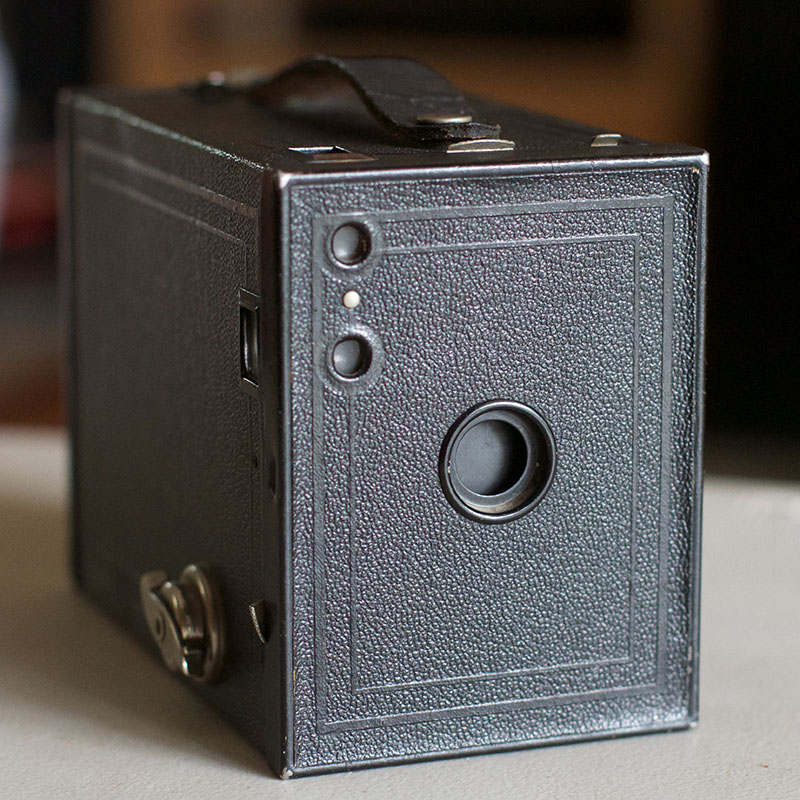
Also known as the Kodak brownie, it is a series of box cameras with a meniscus lens and roll film, invented by Frank A Brownell and made by Eastman Kodak in 1900. The camera was marketed primarily to children, with a low starting price of USD 1. The camera had different versions throughout the years and are generally credited with making photography accessible to the public and giving rise to amateur photography.
More Definitions
Large Format Camera
Film cameras that produce images that are 9 cm x 12 cm or larger.
Naksha
Also known as a jala, it is an arrangement of threads that maps the desired design and is attached to…
Four-Shaft Pit Loom
A pit loom with four shafts or harnesses that support the healds through which the warp threads are passed. The…
fixed-focus lens
Camera lens whose focal distance is pre-determined at the time of manufacture and cannot be adjusted by the user. It…
viewfinder
The eyepiece on a camera that allows the photographer to compose and determine the focus of the image received through…
Bageshwari charkha
Treadle-operated charkha or spinning wheel used in the Indian subcontinent to spin carded wool, cotton, silk, nettle or hemp into…
Frame Loom
Made of rods and boards fixed at right angles, it is a compact, box-shaped loom. It is portable and can…
photosensitive paper
Paper coated with a photosensitive emulsion, used for making photographic prints, usually in a darkroom. It is first exposed to…